What is social media autopilot? How AI posting works (and where to keep a human)
Social media autopilot uses AI to plan, draft, schedule and publish posts. Learn how the loop works, platform AI rules, and where a human must stay in charge.
Autopilot & AI
Stop churning out generic AI content. Discover the 2026 workflow to scale your unique voice using top AI social media tools for research, synthesis, and growth. Nikita ShekhawatSocial Media Growth ExpertPublished 5 min read
The era of hitting "generate" and praying for a viral hit is officially dead. In 2026, the creators winning the attention economy aren't the ones using AI to churn out generic sludge; they are the ones using AI as a high-leverage operating system to handle the heavy lifting of research, synthesis, and distribution.
If you are still stuck in the "prompt-and-paste" cycle, you aren't a creator—you’re a factory line worker for an algorithm that already knows you’re faking it. The new gold standard is an "Input-First" philosophy: you curate the brilliance, and the AI acts as the force multiplier that scales your unique perspective across every platform.
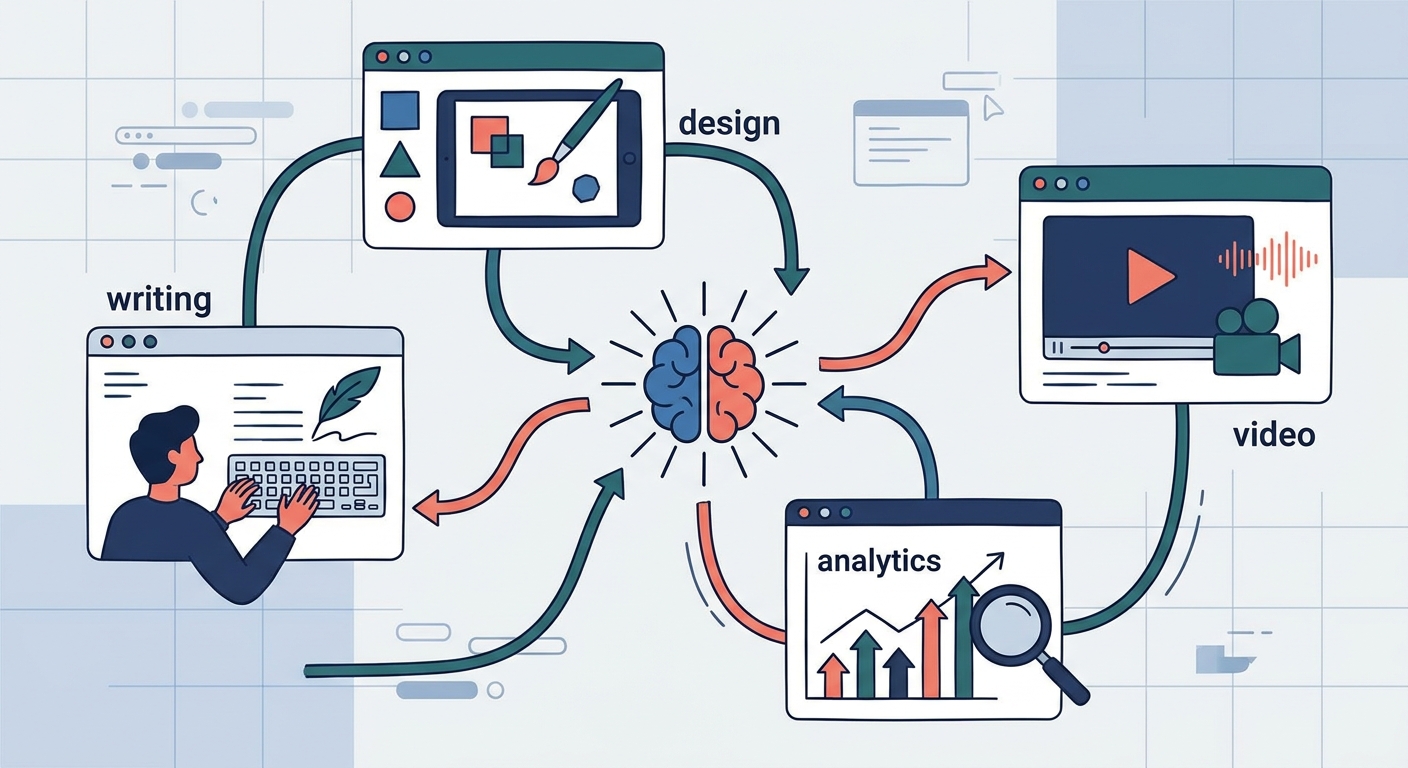
To stop drowning in tabs and subscription fatigue, you need to visualize your workflow as a pipeline rather than a collection of disconnected apps. The goal is to move from a raw idea to a polished, multi-platform campaign with minimal friction.
graph LR
    A[Knowledge Base: Sublime] --> B[LLM: Claude/GPT-4o]
    B --> C[Management: Buffer/Sprout]
    C --> D[Platform Distribution]

    style A fill:#f9f9f9,stroke:#333,stroke-width:2px
    style B fill:#e1f5fe,stroke:#0277bd,stroke-width:2px
    style C fill:#fff3e0,stroke:#ef6c00,stroke-width:2px
    style D fill:#e8f5e9,stroke:#2e7d32,stroke-width:2px
This pipeline ensures that your content is rooted in your own intellectual property, not a model’s hallucination. By the time your content hits an audience, it has been filtered through your specific brand voice and strategy.
The most common failure point for creators is poor input. If you feed an LLM generic prompts, you get generic results. The "Garbage In, Garbage Out" rule has never been more lethal to a personal brand. In 2026, the elite creators use personal knowledge management tools like Sublime to build a private library of their own research, bookmarks, and observations.
By maintaining a curated knowledge base, you provide your AI with a "source of truth." When you ask your LLM to draft a thread based on a specific insight you saved six months ago, the resulting output retains the nuance and authority that generic AI writing inherently lacks. This is the difference between sounding like a brochure and sounding like an expert.
The "messy middle"—the gap between a scribbled thought and a coherent draft—is where most creators stall. This is where tools like Claude or GPT-4o are best utilized, but only if you have established the foundations of a consistent brand voice first.
Don't ask the AI to "write a post about social media." Instead, feed it your raw, messy notes and a style guide. Ask it to "Synthesize these rough bullet points into an opinionated 280-character post that sounds like a veteran industry observer, using short, rhythmic sentences."
By narrowing the scope, you force the AI to respect your constraints. The tools that bridge this gap effectively are those that allow for "context-aware" drafting, meaning they remember your previous successful posts and apply that same cadence to your new drafts.
Video is no longer a luxury; it is the baseline. However, manual editing is a time-sink that kills creative momentum. The 2026 stack for video-first creators is non-negotiable: you need automated clipping, audio cleanup, and rapid assembly.
Tools like OpusClip have become the industry standard for turning long-form podcasts or streams into high-performing short-form clips. When paired with Adobe Podcast for AI-driven audio enhancement, you can transform a recorded Zoom call into professional-grade content in minutes. As highlighted in current industry research from Sprout Social, the velocity of content production is now a competitive advantage. If you aren't using these tools to repurpose your long-form efforts, you are leaving 80% of your potential reach on the table.
Deciding between an all-in-one suite and a bespoke stack depends entirely on your maturity level. If you are a solo creator, tool fatigue is your greatest enemy. Managing five different subscriptions for drafting, editing, clipping, and scheduling will eventually break your workflow.
According to workflow-based resource guides from Buffer, integrated platforms are increasingly handling the entire lifecycle. If you want to simplify, start with a suite that handles scheduling and basic AI drafting. Only graduate to "bespoke" tools—like specialized transcription services or advanced AI video editors—when you have hit a specific bottleneck in your production that the all-in-one suite can no longer solve.
The greatest danger of AI is the illusion of competence. It is incredibly easy to publish "perfect" content that says absolutely nothing. AI can mimic the structure of an expert, but it cannot mimic your lived experience, your proprietary data, or your contrarian opinions.
You must remain the architect. Use AI to draft the skeleton, but ensure you are leveraging AI for content repurposing while manually injecting personal anecdotes and specific case studies. If you find yourself clicking "publish" without reading the draft, you have surrendered your brand.
The goal is to use AI to handle the labor so you can spend your time on the high-value work: developing the strategy and the unique insights that no algorithm can replicate.
If you feel overwhelmed, stop trying to overhaul everything at once. Pick one tool that solves your biggest friction point.
The 2026 Must-Haves:
Start with these, master the "Input-First" workflow, and you will find that you aren't just creating content faster—you are creating better, more authoritative work than ever before.
No. In fact, overlapping subscriptions usually create "tool fatigue" that hampers your output. For most independent creators, an integrated suite that handles scheduling and basic drafting is more than enough to maintain a consistent presence. Only add specialized tools when your volume justifies the cost.
The secret is training. Create a "style document" that includes your past successful posts, your specific vocabulary, and your preferred sentence structure. When you prompt the AI, feed it this guide alongside your content. Most importantly, always perform a manual "voice-polish" in the final stage to add the human quirks that AI models are programmed to smooth out.
No. Algorithms prioritize engagement, watch time, and audience retention. They do not care if a tool helped you draft the text. If your content provides value and resonates with your audience, the algorithm will reward it. The penalty only comes when you use AI to flood the feed with low-quality, repetitive content.
If you are just starting, stick to all-in-one platforms like Buffer or Canva. They provide a low-friction entry point by bundling AI-assisted scheduling, design, and caption generation into a single interface. These tools allow you to focus on your content strategy rather than managing a complex, multi-app tech stack.
Social media autopilot uses AI to plan, draft, schedule and publish posts. Learn how the loop works, platform AI rules, and where a human must stay in charge.
Struggling with content fatigue? Learn how to use AI social media post generators to scale your marketing while maintaining an authentic human brand voice.
Stop juggling subscriptions. Discover the top 12 Agentic AI tools for integrated content workflows, brand voice consistency, and enterprise-grade data security.
Social9 schedules your posts on 11 networks, and Autopilot can draft them in your brand voice for you to approve. Start on the free plan.
We use strictly necessary cookies to run this site. With your permission, we also use analytics cookies to understand how the site is used. We never use advertising cookies. See our Cookie Policy.