Best times to post on each social network in 2026
When to post on Facebook, Instagram, LinkedIn, X, TikTok, YouTube, Pinterest and Threads in 2026, per Sprout, Buffer, Later and Hootsuite, plus a test plan.
Data & Studies
Stop tracking vanity metrics. Learn how to use social media reporting tools to prove ROI, bridge the dark funnel, and align social activity with business goals. Nikita ShekhawatSocial Media Growth ExpertPublished Updated 6 min read
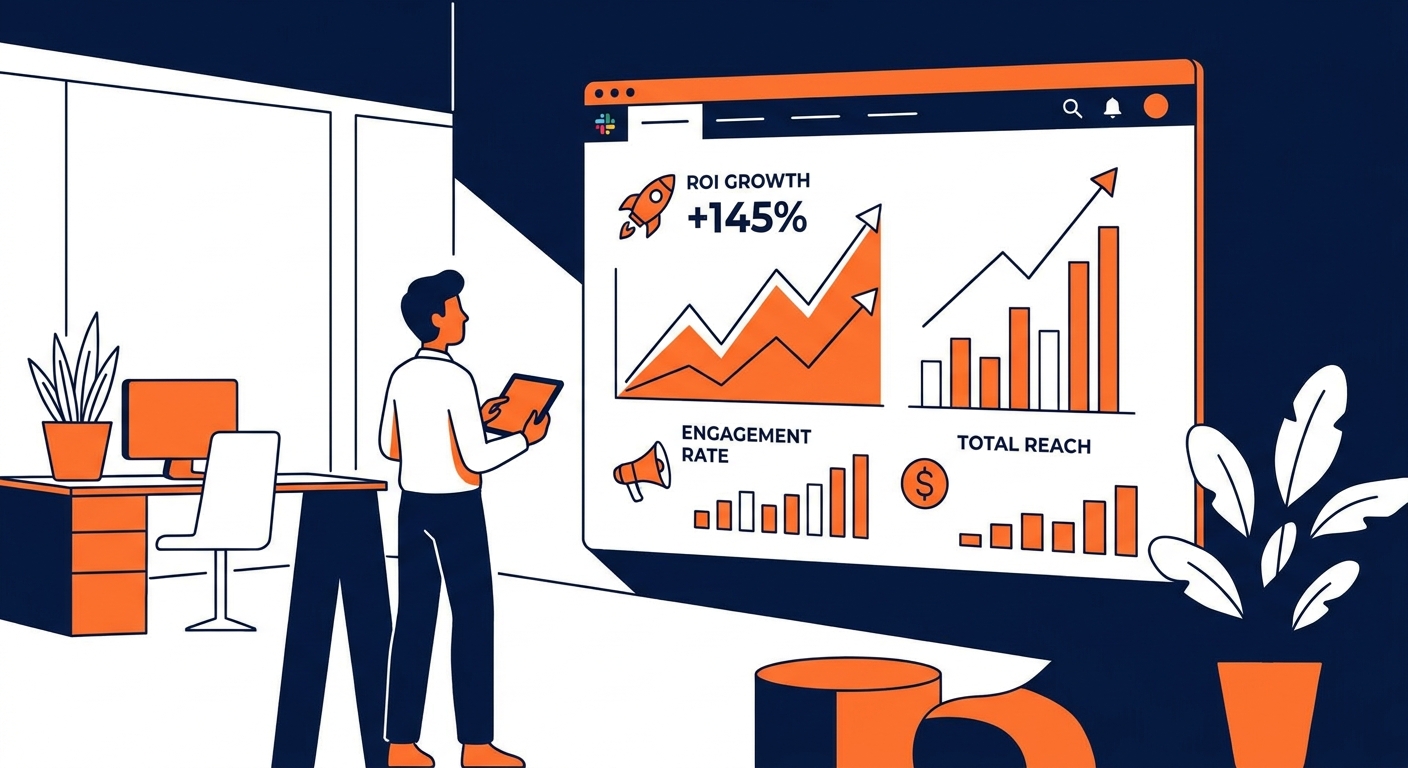
If your social media report is still just a glorified spreadsheet of "Likes" and "Follower Growth," you’re essentially lighting your marketing budget on fire for sport. It’s 2026. If you can’t draw a straight line from your social activity to your bottom line, your entire reporting strategy is broken.
Global social ad spend is hitting $317 billion this year. Your leadership team? They’re past the point of accepting "brand awareness" as a shield for missing revenue targets. They want to see the money. To survive—and thrive—you have to pivot. Stop reporting on activity and start reporting on growth. Proving ROI isn’t about counting hearts; it’s about business-impact intelligence. Every post, every comment, and every share needs to be measured by one standard: does it move a lead through the pipeline?
Let’s be real: the industry has finally grown up. We’re done with the vanity metrics era. A million followers might look sexy on a slide deck, but if they aren't buying, they’re just noise.
To command respect from your CFO, you need to categorize your data into a hierarchy of impact. According to foundational 2026 metrics research from Sprout Social, the focus has shifted entirely to three buckets: Awareness, Conversion, and Retention.
When you shift your focus, a "Like" stops being a meaningless vanity metric and starts being a signal of brand health. That’s how you turn social into a business asset.
The biggest hurdle for any marketer? The "Dark Funnel."
Picture this: A prospect sees your LinkedIn post on Tuesday. They chat about your solution in a private Slack channel on Wednesday. On Friday, they search for your brand directly and sign up for a trial. If your reporting tool is stuck on "last-click" attribution, that sale shows up as "Direct Traffic." Your team gets zero credit.
You need multi-touch attribution that acknowledges social’s influence even when there isn't a direct click. You have to account for the whole journey.
graph LR
    A[Social Touchpoint] --> B{Attribution Path}
    B -->|Direct| C[Web Conversion]
    B -->|Dark Funnel| D[Brand Search/Direct Traffic]
    D --> E[CRM Record]
    C --> E
    subgraph "The ROI Gap"
    D
    end
    E --> F[Revenue Attribution]
Stop undervaluing your content. Your reports should highlight how social touchpoints reduce friction, effectively lowering your total cost per acquisition. When you map the journey, you realize that social isn't just a megaphone; it’s the grease that keeps the sales engine running.
Engagement isn't just a percentage—it’s a diagnostic tool. If your engagement rate is flat, your content is missing the mark on your audience’s pain points. As detailed in this guide on calculating engagement and ROI from Hootsuite, you need the math to be rock solid: (Total Interactions / Total Reach) * 100.
But don't get lost in the math. The why matters more than the what.
If you find that long-form video crushes static images, quit beating a dead horse with graphics. Pivot. If you’re struggling to turn these data points into a repeatable strategy, you might need to learn how to streamline your content workflows. Use your data to build a feedback loop. Data-backed creative beats intuition every single time.
The "Social-to-CRM" bridge is the holy grail. When you use an all-in-one management tool to automate the flow of social data into your CRM, you stop guessing. You start proving.
Imagine walking into a meeting and telling Sales, "This lead came from a LinkedIn comment thread about industry-specific compliance." That level of transparency changes the room. Suddenly, social isn't a siloed department—it's a critical pipeline driver. When social data lives inside the CRM, you can track a lead from a comment all the way to a closed-won deal. That is how you prove your strategy is a profit center.
When you step into the boardroom, leave the "Engagement Rate" jargon in the lobby. Your executives don't care about click-through rates. They care about Customer Acquisition Cost (CAC) and Lifetime Value (LTV).
Don't say: "We saw a 10% increase in engagement." Do say: "Our targeted social strategy has reduced our lead acquisition cost by 15% this quarter."
Focus on the outcomes that actually keep the lights on: churn reduction, lead quality, and shortening the sales cycle. Speak their language, and they’ll start treating your department as a core part of the business, not a line item they can cut when times get tough.
Your reporting tool should do more than just display charts—it should interpret them. It’s a balancing act between depth, integration, and speed.
| Tool Category | Reporting Depth | CRM Integration | Automation Level | Price Point |
|---|---|---|---|---|
| Enterprise Suites | High | Native/Robust | High | Premium |
| Mid-Market Tools | Medium | API-based | Medium | Moderate |
| Entry-Level Apps | Low | Limited | Low | Budget |
If you’re scaling, Enterprise Suites are non-negotiable because of the deep CRM hooks. For smaller teams, Mid-Market tools usually hit the sweet spot of automation and price. Don't overpay for features you won't use, but don't under-invest in the data that proves your worth.
Influencer marketing and community building are notoriously slippery to track. You can't just slap a UTM parameter on everything. You need to look at the "halo effect."
For deeper insights on how to benchmark these efforts, refer to influencer marketing ROI benchmarks for 2026. By assigning value to mentions and sentiment, you start to quantify trust. Trust is what drives long-term loyalty—and that is the most valuable asset your brand has.
Consistency is how you win. Here’s how to structure your time:
Focus on the shift toward multi-touch attribution. Explain that social acts as a top-of-funnel driver that educates prospects, builds trust, and keeps your brand top-of-mind, which significantly reduces the cost of acquisition when they finally enter the sales funnel.
An engagement rate is your "interest indicator"—it tells you if your message is resonating. A conversion rate is your "business result"—it tells you if that interest is translating into action. You need both: engagement to pull them in, and conversion to capture value.
Vanity metrics like follower counts and reach look good on a slide but don't pay the bills. You should report on metrics that move the needle in your CRM, such as lead conversion rates, attribution to qualified pipeline, and customer sentiment scores.
There is a tension between agility and strategy. Audit your tactical performance weekly to stay agile, but conduct a strategic review quarterly to ensure your social efforts remain perfectly aligned with your broader business goals.
When to post on Facebook, Instagram, LinkedIn, X, TikTok, YouTube, Pinterest and Threads in 2026, per Sprout, Buffer, Later and Hootsuite, plus a test plan.
Stop tracking vanity metrics. Learn to measure intent, optimize engagement rates, and drive real revenue in the 2026 social media landscape.
Stop chasing vanity metrics. Learn how to track social media ROI, bridge the attribution gap, and leverage AI for predictive growth in 2026.
Social9 schedules your posts on 11 networks, and Autopilot can draft them in your brand voice for you to approve. Start on the free plan.
We use strictly necessary cookies to run this site. With your permission, we also use analytics cookies to understand how the site is used. We never use advertising cookies. See our Cookie Policy.