How agencies manage 20+ client calendars without burning out
A playbook for agencies running 20+ client calendars: workspace setup, a capacity formula, a monthly cadence, approval SLAs, safe access and burnout rules.
Playbooks
Stop manual workflows. Learn how AI integration APIs and headless architecture are transforming social commerce into an autonomous, high-conversion engine. David KimAI EngineerPublished 6 min read
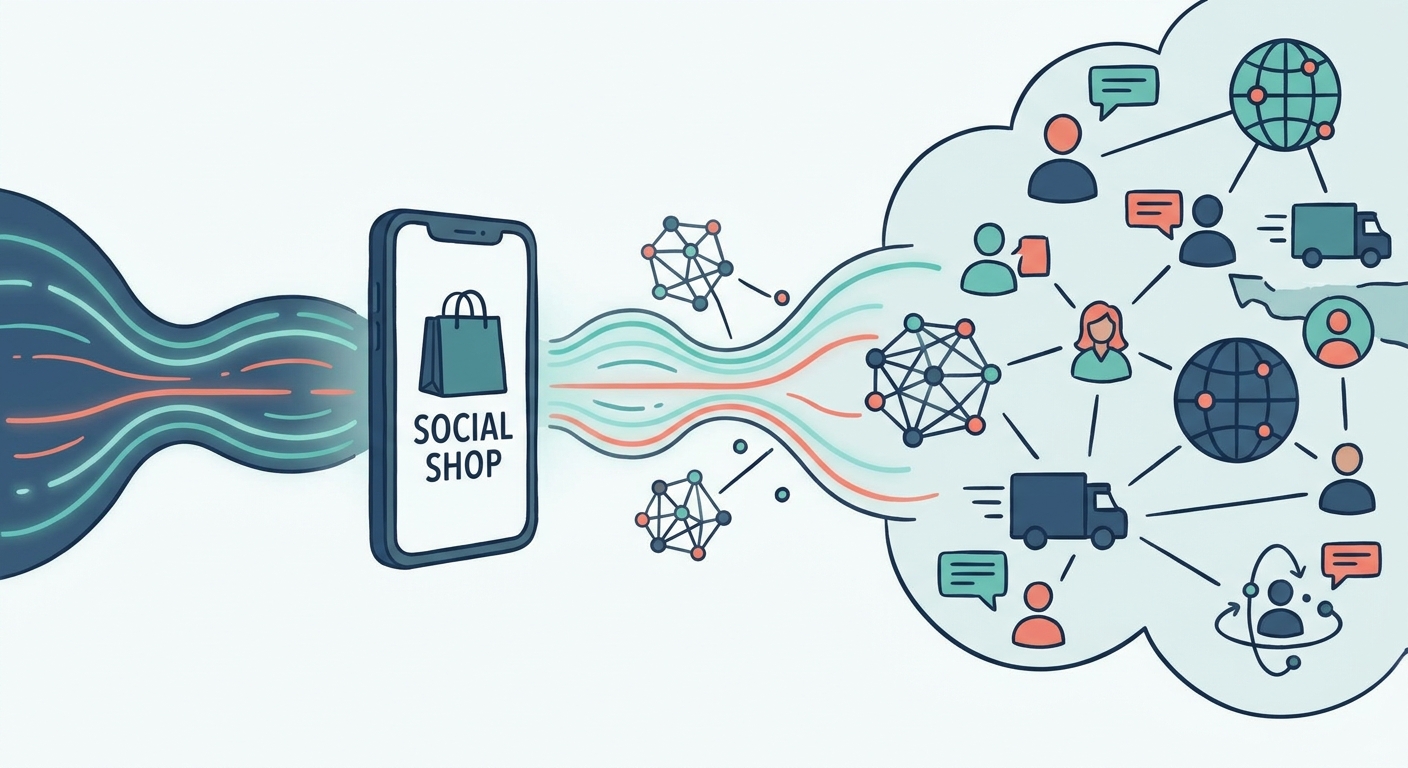
The era of social media as a glorified digital billboard is over. We’ve entered the age of transactional fluidity, where the friction between "Oh, that’s cool" and "I just bought it" is disappearing. By 2026, the winners won't be the brands that just dump more content into the void. The winners will be the ones who treat their product catalogs like living, breathing data streams—piped directly into the AI agents and social ecosystems where their customers actually hang out.
If you’re still relying on manual dashboard management, you’re playing a losing game. It’s time to move toward a headless architecture powered by robust AI integration APIs.
For years, the playbook was standard: run ads, pray for clicks, and hope your landing page didn't scare people off. That model is wheezing. It relies on the flawed assumption that a consumer actually wants to leave their app to visit your website. Guess what? They don't. They prioritize convenience. They want the path of least resistance.
We’re seeing the rise of the "Creator-Affiliate" hybrid. Content creators aren't just brand mouthpieces anymore—they’re portable storefronts. Platforms like TikTok have completely changed the game by embedding TikTok for Business: Creator Tools directly into the UX. It’s one-tap purchasing, and it’s the new gold standard.
If your inventory isn't synced in real-time to these social endpoints, you aren't just losing a few sales. You’re becoming invisible to a generation that expects to check out without ever opening a browser.
The next evolution of AI isn't just another chatbot that regurgitates FAQs. It’s the autonomous agent—a digital assistant that handles the grunt work. According to Morgan Stanley: Agentic Commerce Projections, we’re looking at a massive shift. Soon, AI agents will compare prices, vet reviews, and pull the trigger on transactions for the consumer.
This is "Agentic Commerce." Instead of a human scrolling through a bottomless feed of ads, an AI agent will scan the digital landscape to find the best deal on a specific item. If your brand data isn't optimized for these agents, you’ll be filtered out before a human even catches a glimpse of your product. These agents don't care about your brand's "vibe" or your witty caption. They care about structured data, pricing accuracy, and inventory levels. The buyer journey is no longer a path you dictate; it’s a math problem solved by an algorithm.
As generative AI becomes the default interface for the web, keyword-based SEO is starting to feel like a relic. Welcome to the era of Answer Engine Optimization (AEO). When a user asks an AI, "What’s the best winter jacket for wet conditions?", they don’t want ten blue links. They want a definitive, synthesized answer.
To thrive, your product data must be "LLM-ready." Stop stuffing keywords into descriptions and start building semantic, structured data. Frame your product info in Q&A formats that speak directly to user intent. If your product page is just marketing fluff, an LLM will choke on it. If it’s a structured data object—clearly defining materials, use cases, pricing, and comparative advantages—you become the primary source of truth.
If you’re still tethered to a monolithic CMS where the frontend and backend are glued together, you’re structurally incapable of competing in the 2026 market. Headless architecture is the only way to decouple your data from your brand website, letting you push inventory to TikTok, Instagram, and emerging social storefronts simultaneously.
When you adopt a Headless Commerce Explained approach, your backend becomes the single source of truth. Your PIM (Product Information Management) system acts as the brain, while APIs act as the nervous system, delivering real-time inventory and pricing updates to every corner of the internet. This kills the "out-of-stock" frustration that ruins social conversion rates. Consistency is everything.
The technical challenge is keeping everything in sync. You need a data pipeline that treats your PIM as the source and your social frontends as the destination.
graph LR
    subgraph Source["System of Record"]
        PIM[PIM Database]
        ERP[Inventory/Pricing]
    end

    subgraph Middleware["API Orchestration Layer"]
        Gateway[API Gateway]
        AI_Logic[AI Processing Engine]
        HITL[Human-in-the-Loop Review]
    end

    subgraph Frontends["Social Commerce Endpoints"]
        TikTok[TikTok Shop]
        IG[Instagram Checkout]
        YT[YouTube Shopping]
    end

    PIM --> Gateway
    ERP --> Gateway
    Gateway --> AI_Logic
    AI_Logic <--> HITL
    HITL --> Gateway
    Gateway --> TikTok
    Gateway --> IG
    Gateway --> YT
By plugging AI APIs into your gateway, you can automate tagging, captioning, and even sentiment analysis for customer queries. But don't get lazy—the "Human-in-the-Loop" (HITL) component is non-negotiable. Use AI for the heavy lifting of data formatting, but keep a human in the driver's seat to ensure your brand voice doesn't turn into a soulless robot. This hybrid workflow slashes your time-to-market, letting you push updates across all channels in minutes, not hours.
We’re heading toward a "Zero-Click" reality. Research from Bain & Company: Generative AI Research confirms that consumers are increasingly leaning on AI-generated summaries to make purchasing decisions. In this world, the brand website is often skipped entirely.
Stop fighting to drag people to your domain. Instead, focus on winning the "zero-click" moment. Your data needs to be so precise that when an AI agent summarizes the "best options" for a category, your brand is the obvious, data-backed choice. Visibility in 2026 isn't about ranking on a search page; it’s about being the answer the AI provides.
The difference between a manual workflow and an API-integrated one is the difference between surviving and scaling. In a manual setup, your team spends 80% of their time updating spreadsheets and fixing sync errors. With an AI-integrated workflow, they’re freed up to focus on strategy, creative direction, and community building.
You can no longer rely on "website clicks" as your North Star. You need to track "API-driven conversion events" across all channels. If you’re looking to audit your current tech stack and find those manual bottlenecks, Our Guide to Marketing Automation provides the framework you need to start scaling.
The winners today are the brands that treat their commerce infrastructure like a software product. Consider the mid-market apparel brands that have gone fully headless. By using real-time inventory synchronization via API, they’ve eliminated the overselling disasters that plague social-first brands.
These companies don't just post content; they treat their social feeds as dynamic, data-responsive environments. When a product goes viral, their API-driven architecture updates stock levels and pricing across all endpoints in milliseconds. That kind of reliability builds massive consumer trust—which is the only real currency in a crowded market.
Future-proofing isn't about guessing which app will be cool next year. It’s about building the infrastructure to plug into whatever comes next.
The future of commerce isn't coming—it’s being coded right now. Stop chasing the algorithm. Start building a foundation that thrives on it.
The transition from manual user-led browsing to autonomous AI agents that handle the discovery, comparison, and checkout process on behalf of the consumer.
Focus on structured Q&A formats within your product descriptions, social captions, and schema markup to ensure your brand data is easily ingested and synthesized by LLMs.
While not mandatory for small-scale operations, it is highly recommended for scaling across multiple social platforms simultaneously using APIs to ensure real-time inventory and pricing accuracy.
AI APIs can automate the influencer-brand matching process, track affiliate performance in real-time, and automatically generate personalized product snippets tailored to specific influencer audiences.
It necessitates a shift in strategy: focus on being the primary source of truth in AI summaries rather than relying solely on organic search traffic to your landing pages.
A playbook for agencies running 20+ client calendars: workspace setup, a capacity formula, a monthly cadence, approval SLAs, safe access and burnout rules.

Stop the chaos. Discover how to build a high-output, AI-human hybrid social media workflow that converts and scales in 2026. Read the handbook.

Stop the burnout cycle. Learn how to scale your small business social media marketing using AI automation to create consistent content without the manual grind.
Social9 schedules your posts on 11 networks, and Autopilot can draft them in your brand voice for you to approve. Start on the free plan.
We use strictly necessary cookies to run this site. With your permission, we also use analytics cookies to understand how the site is used. We never use advertising cookies. See our Cookie Policy.