What is social media autopilot? How AI posting works (and where to keep a human)
Social media autopilot uses AI to plan, draft, schedule and publish posts. Learn how the loop works, platform AI rules, and where a human must stay in charge.
Autopilot & AI
The internet was built on the back of the "remix"—a chaotic, beautiful, and often legally precarious exchange of cultural artifacts. It’s the digital equivalent Alex ChenAI Content StrategistPublished Updated 7 min read
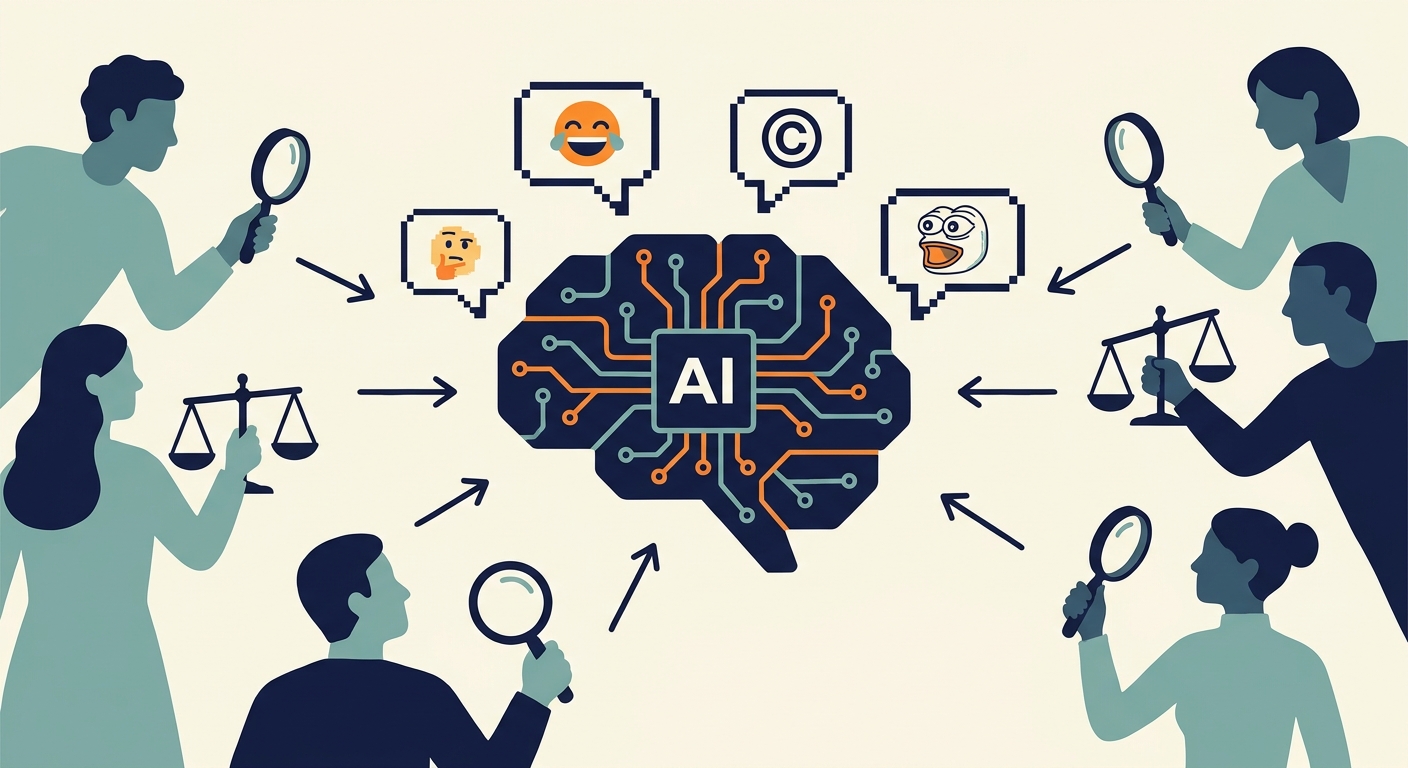
The internet was built on the back of the "remix"—a chaotic, beautiful, and often legally precarious exchange of cultural artifacts. It’s the digital equivalent of a messy, midnight kitchen session where everyone tosses ingredients into the pot. But the arrival of generative AI has fundamentally altered the chemistry of this culture.
We’ve shifted from the era of the "Photoshop power-user" to the era of the "prompt-engineer." A single sentence can conjure a viral image in milliseconds. It’s intoxicating, sure. But that speed masks a brewing crisis of intellectual property, artistic consent, and basic corporate responsibility.
If you are using AI to manufacture your brand’s humor, you aren’t just a creator anymore. You’re a participant in a legal and ethical grey zone currently being defined by courts and community outcry. To stay relevant in 2026, stop treating AI as a "get-out-of-jail-free" card for content. Treat it like a power tool: dangerous if you’re reckless, but transformative if you’re an expert.
The most common misconception in the current digital landscape is that if you generate it, you own it. The US Copyright Office: AI Guidance tells a much harsher story: purely AI-generated content lacks the "human authorship" required for copyright protection.
If your creative process begins and ends with a prompt, you are essentially creating "public domain" fodder. You’re handing out free assets to anyone who wants to scrape them.
This is the "human-in-the-loop" requirement. To move your memes into the realm of protectable intellectual property, you have to show your work. Use AI as a base—a sketch, a texture, or a composite—and then apply your own editorial, artistic, or transformative layers. Without this, your brand is just pumping out content that anyone can legally steal. By shifting from a "prompter" to a "curator," you inject human soul back into the content. You turn a disposable digital scrap into a defensible asset.
We live in a constant tug-of-war between the open-source spirit of the web and the locked-down reality of training data. When you ask a model to create a meme in the distinct style of an independent artist, you aren't just "getting inspired." You are potentially facilitating digital plagiarism.
The ethical line is simple: does your AI-generated meme act as a direct replacement for the work of a human artist?
graph TD
    A[Start: AI Meme Generation] --> B{Level of Originality?}
    B -->|High Human Input/Editing| C[Transformative Parody]
    B -->|Minimal Input/Direct Style Mimicry| D[Derivative Work]
    B -->|Identical/Registered IP Usage| E[Direct Copy/Plagiarism]

    C --> F[Ethically Sound / Fair Use Potential]
    D --> G[Legal Gray Area / Risk of Infringement]
    E --> H[High Legal Risk / Ethical Violation]

    style F fill:#d4edda,stroke:#28a745
    style G fill:#fff3cd,stroke:#ffc107
    style H fill:#f8d7da,stroke:#dc3545
The difference between a "transformative parody"—which is generally protected—and "AI-generated imitation" is the difference between sharp cultural commentary and lazy IP theft. If your AI tool is trained on unlicensed works, your "humor" is built on the broken backs of creators who never consented to be part of your training set. Think about that the next time you hit 'generate.'
The democratization of AI has made it dangerously easy to place private citizens—or public figures—into compromising, humiliating, or defamatory scenarios under the banner of "satire." There is a massive, life-altering distinction between parodying a public figure and creating non-consensual deepfakes of private individuals.
Platforms are tightening their belts, and brands are under more scrutiny than ever. If your marketing team pushes an AI-generated meme that uses a person's likeness without their explicit, informed consent, you are inviting a PR nightmare and a lawsuit.
Before you post, ask: Does this joke rely on the dignity of a human being? If the answer is yes, hit delete. For those navigating this rocky terrain, we have outlined our own AI Ethics Policy to ensure our creative output remains grounded in respect rather than exploitation.
Not all AI models are created equal. Some developers prioritize "open" data—which usually just means scraping the internet indiscriminately—while others prioritize "ethical" training sets that include licensed data or artist opt-out mechanisms.
As a creator, you are the final filter. Using a tool that respects the creative community isn't just a moral choice; it’s a brand-safety choice. Before settling on your primary generator, look for transparency in their training data. Resources like the Lummi: Ethics of AI Images offer a deep look into how we can select models that treat artists as partners rather than raw material. If your tool refuses to disclose its training sources, assume it’s built on ethically shaky ground.
To navigate the 2026 landscape without compromising your integrity, follow this framework:
For those ready to dive deeper into how to integrate these practices into your broader strategy, our Guide to Responsible AI Marketing provides a roadmap for balancing speed with stewardship.
Consider the dichotomy of two retail brands in 2025.
Brand A released a series of AI-generated "funny" memes to promote a holiday sale. They were generic, slightly uncanny, and clearly mimicked the style of a popular indie illustrator. The backlash was swift. The artist community identified the style, the brand was accused of "creative theft," and they were forced to issue a public apology and pull the entire campaign. It cost them millions in lost goodwill.
Contrast this with Brand B, which used AI exclusively as a "creative assistant." They used a tool to generate rough mood boards for their human design team, who then took those concepts and hand-illustrated the final assets. The AI was the spark, but the human was the fire. Brand B avoided the ethical pitfalls and created a campaign that felt authentic, polished, and—most importantly—copyrightable.
The lesson is clear: "Lazy" AI is a liability. "Assistant" AI is an asset.
The legal system is finally catching up to the speed of the internet. As noted in recent reports on Copyright Law in 2025-2026, courts are actively drawing lines around what constitutes "market harm" in the age of generative models.
We are moving toward a future where "fair use" will be defined by the quality of the training data and the extent of human contribution. For meme makers, the era of the "wild west" is closing. Regulations are coming, and they will favor those who have prioritized ethics and transparency. If you have been building your strategy on the assumption that "it’s just a meme," you are standing on shifting sand.
The future of the meme isn't one where AI replaces the human spirit; it’s one where the human spirit directs the machine to achieve new heights of creativity. We are entering a phase where the most "viral" content will be the kind that feels undeniably, authentically human.
The machines can generate the pixels, but they cannot generate the context, the irony, or the shared human experience that makes a meme travel across the globe. Prioritize your humanity, respect the work of your peers, and use AI as the powerful, secondary tool it was meant to be. The ultimate currency of the internet remains what it has always been: a genuine, human connection.
Under current USCO guidelines, you cannot copyright content that is entirely generated by AI. To secure copyright, you must prove substantial "human authorship." This means using the AI output as a foundation and adding significant, original creative input and editing that reflects your own artistic choices.
While parody of public figures is often protected, using AI to generate non-consensual, realistic, or defamatory imagery of any individual—public or private—is a major ethical and legal risk. Always prioritize consent and avoid content that could be interpreted as harassment or defamation.
An ethical tool is one that provides transparency regarding its training data. Look for platforms that use licensed datasets, compensate the artists involved in their training, or provide robust "opt-out" mechanisms for creators. If a tool is opaque about its sources, it is likely built on the unauthorized work of others.
No. While "parody" is a common legal defense in copyright infringement cases, it does not automatically grant you ownership of the AI-generated output. Parody is a defense against a claim of infringement, not a shortcut to gaining copyright protection over an image you didn't create.
Social media autopilot uses AI to plan, draft, schedule and publish posts. Learn how the loop works, platform AI rules, and where a human must stay in charge.
If you’re still dragging grainy stock images into a basic editor and slapping white text over them, you aren’t just behind the curve. You’re invisible. In 202
The "Distracted Boyfriend" template is officially six feet under. If you’re still pushing out static images and dusty stock photography to grab attention in 202
Social9 schedules your posts on 11 networks, and Autopilot can draft them in your brand voice for you to approve. Start on the free plan.
We use strictly necessary cookies to run this site. With your permission, we also use analytics cookies to understand how the site is used. We never use advertising cookies. See our Cookie Policy.