What is social media autopilot? How AI posting works (and where to keep a human)
Social media autopilot uses AI to plan, draft, schedule and publish posts. Learn how the loop works, platform AI rules, and where a human must stay in charge.
Autopilot & AI
Stop cloning content. Learn how to use content repurposing tools to scale your social media strategy with high-velocity, platform-native assets that drive engagement. Nikita ShekhawatSocial Media Growth ExpertPublished 6 min read

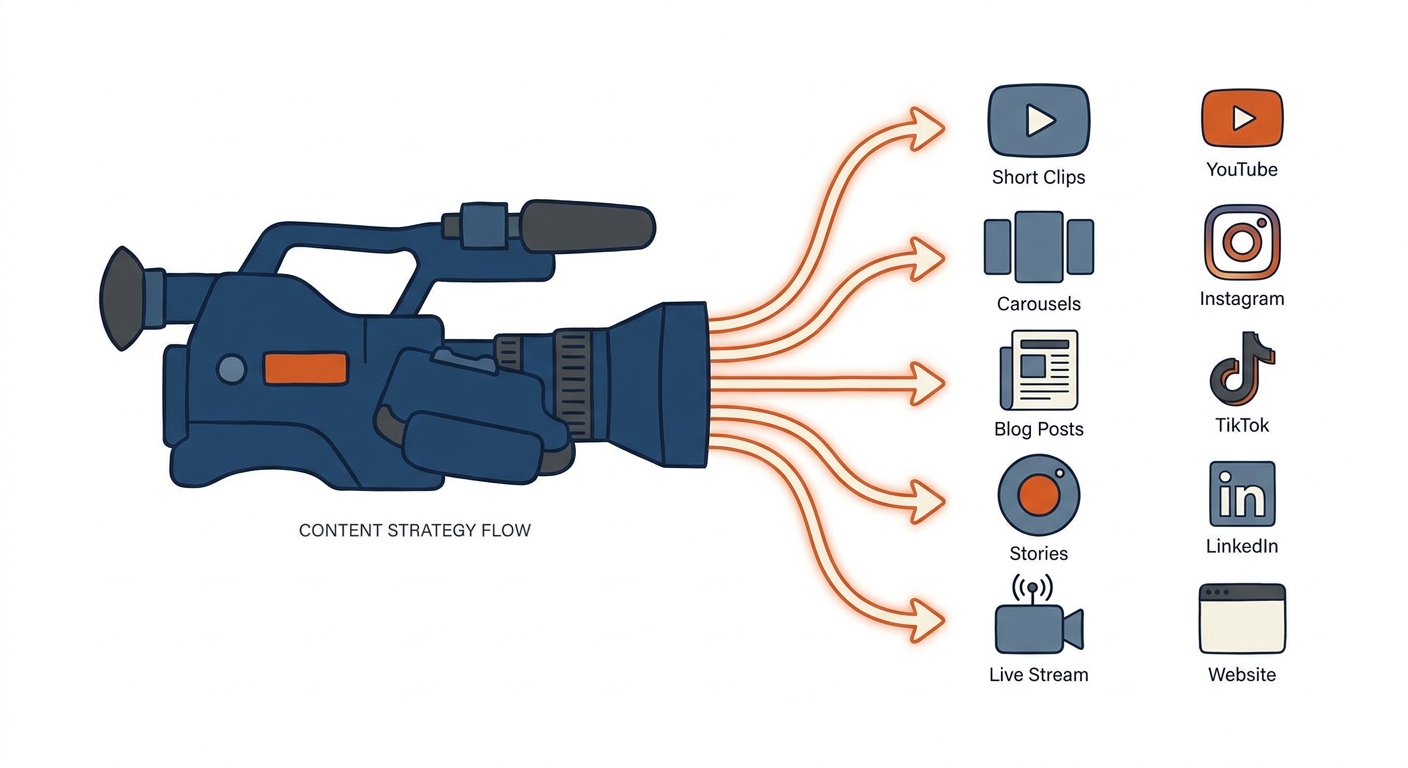
Content repurposing isn't about cloning your work across the web. That’s just noise. It’s the strategic art of taking one core idea and translating it into the native language of every platform where your audience lives.
If you want to win in 2026, stop looking for tools that just "generate text." You need a system that understands the "Validation Gap." If your current workflow is simply hitting "post" on a syndication tool and praying the algorithm likes it, you’re already losing. You aren't just invisible; you’re being relegated to the digital graveyard of low-engagement feeds. Success today isn't about volume. It’s about velocity and value. Every asset you create needs to be engineered specifically for the environment it’s entering.
We’ve all been there: the "Blank Page" panic followed by the soul-crushing exhaustion of trying to feed five different social channels at once. The knee-jerk reaction? Use a tool that blasts the same link and caption to LinkedIn, Twitter, and Facebook with one click.
Don't do it. It’s a fatal error.
Platforms are hypersensitive to "lazy" content. Post a link preview that looks broken on X, or a caption that ignores the professional nuance of LinkedIn, and the algorithm punishes you. According to Buffer’s Guide to Social Media Algorithms 2026, platforms are obsessed with native formatting—content that feels like it was built for the specific user experience of that app. When you rely on generic cross-posting, you’re training the algorithm to see your brand as spam.
AI content generation isn't the bottleneck anymore. We have plenty of text. The bottleneck is the failure to respect platform constraints. If your tool can’t tell the difference between a LinkedIn carousel and an Instagram Reel, it’s effectively a paperweight. You need a system that respects the "Validation Gap"—the technical reality of API limits, aspect ratios, and link-preview behaviors.
In a professional kitchen, a "Mother Sauce" is the foundation for everything else. In content strategy, your "Mother Content" is your high-value, long-form asset—a recorded webinar, a deep-dive whitepaper, or a feature-length video interview. You don't treat this as a single post. You treat it as raw material.
As outlined in HubSpot’s Content Strategy Guide, an effective strategy relies on deconstructing primary assets into "spices." These are your hooks, your contrarian takes, and your bite-sized insights. Your repurposing tool should act as the chef: taking the Mother Content, stripping the fluff, and seasoning it for the right palate. LinkedIn audiences want an analytical breakdown; TikTok audiences want high-energy, raw takeaways. If your tool can’t extract those nuances, you’re just serving cold leftovers to everyone.
As teams scale, they hit a wall I call "Coordination Debt." This is what happens when five people try to repurpose content across ten channels, and the process turns into a tangled mess of emails and Slack messages. You’ve got legal teams wanting to review claims, stakeholders obsessing over brand voice, and a social manager trying to keep the calendar full.
Most tools are built for solo creators, leaving enterprise teams in the lurch. True high-performance teams don't just use a tool; they build an integrated workflow. When you build a high-performance social media workflow, you move the approval process upstream. Stop waiting for a post to go live to see if it’s "on-brand." Your tools must allow for stakeholder visibility at the drafting stage. If your tool doesn't have an integrated approval loop, you aren't saving time. You’re just building a new bottleneck.
graph TD
    A[Mother Content: Long-form Video/Article] --> B{AI Repurposing Engine}
    B --> C[Validation Layer: API Constraints/Character Limits]
    C --> D[Approval Workflow: Legal/Stakeholder Review]
    D --> E[Platform-Native Distribution]
The market is split. You have the Enterprise Tier, which prioritizes governance and multi-user workflows. If you’re in a regulated industry, this is your only path. You need tools that track who approved what and when. Then, there’s the Creator Tier, which is all about speed—perfect for the solo operator turning a podcast into a dozen clips in ten minutes.
Finally, there is the Technical Tier. These tools prioritize API-level validation. They warn you if your caption is too long or if your aspect ratio is wrong for a specific player. Before you commit, I highly recommend reviewing our complete guide to AI content creation to ensure your new tools actually play nice with your existing tech stack.
If you’re evaluating software this year, demand these three pillars.
First, Context-Awareness. The tool must be trained on your brand voice. If the output sounds like a generic robot, your engagement will be zero. Second, Native Formatting. Stop looking at the text and start looking at the container. Does the tool know how a LinkedIn carousel slide structure works? Does it render link previews correctly? As noted in Hootsuite's Social Media Trends Report 2026, the visual experience is often more important than the caption itself.
Finally, Unified Dashboards. If you’re jumping between a video editor, a text generator, and a compliance portal, you have "stack fatigue." The future is in AI-native platforms that consolidate these steps.
| Feature | Enterprise Tier | Creator Tier | Technical Tier |
|---|---|---|---|
| Approval Workflows | Mandatory | Optional | Rare |
| Native Formatting | Standard | Standard | Advanced |
| API Validation | High | Medium | Critical |
| Brand Voice Integration | Strict | Flexible | Variable |
Stop buying tools just because they have a flashy feature set. Audit your bottlenecks instead. Is your team slow because the writing is hard, or because the approval process is a mess? The shift toward AI-native platforms is meant to solve the latter. Look at your 1:10 ratio and find where the chain breaks. If you can fix the "Validation Gap," your cross-platform success won't be a matter of luck. It will be the result of a deliberate, architectural strategy.
No, provided it is "context-aware." Algorithms do not penalize repurposing; they penalize spam. If you adapt your content to fit the native format and audience expectations of each platform, you are creating value. If you simply copy-paste identical text and links everywhere, you will be flagged as low-quality.
The "Validation Gap" refers to the technical failure of many AI tools to check for platform-specific constraints before scheduling. This includes things like character limits, aspect ratios for video, and whether a link preview will actually render properly. Tools that ignore these constraints lead to broken, unprofessional-looking posts.
Aim for a 1:10 ratio. One high-value "Mother Content" piece—like a deep-dive article or a long video—should provide the raw material for at least 10 platform-native snippets, such as short-form video clips, LinkedIn carousels, X threads, or newsletter highlights.
Most repurposing tools are built for solo creators and lack the governance features enterprise teams require. Large organizations need built-in approval workflows, legal and compliance checks, and multi-user visibility to ensure that every repurposed post meets brand and regulatory standards.
You must prioritize brand voice guideline integration. The best tools in 2026 allow you to upload your tone-of-voice documents and style guides, ensuring the AI captures your specific vocabulary and cadence. Even then, "human-in-the-loop" editing remains the final, non-negotiable step to ensure the content feels authentic.
Social media autopilot uses AI to plan, draft, schedule and publish posts. Learn how the loop works, platform AI rules, and where a human must stay in charge.

Stop manual drafting. Discover 5 free AI social media post generators to automate your content workflow, save time, and scale your brand presence in 2026.
Stop manual editing. Learn how to use AI-driven content repurposing tools to transform one long-form video into a month of high-intent social media posts.
Social9 schedules your posts on 11 networks, and Autopilot can draft them in your brand voice for you to approve. Start on the free plan.
We use strictly necessary cookies to run this site. With your permission, we also use analytics cookies to understand how the site is used. We never use advertising cookies. See our Cookie Policy.