Beyond Posting: How to Use Social Listening and Analytics to Drive Follower Growth

TL;DR
- ✓ Abandon the volume-based posting myth to stop creator burnout and brand irrelevance.
- ✓ Use sentiment analysis to transform audience feedback into actionable research and development.
- ✓ Implement the Listen-Create-Analyze loop to build a precision-engineered growth engine.
- ✓ Distinguish between fleeting trends and cultural shifts using offensive social listening tactics.
Growth on social media in 2026 isn't a volume game anymore; it’s a game of intelligence. If your current strategy is just a rigid calendar of daily posts designed to "feed the algorithm," you aren't building an audience. You're building a graveyard of forgotten content.
True growth happens when you stop shouting into the void and start interpreting the signals your audience is actually sending. By shifting your focus toward the A-E-L framework—Acquisition, Engagement, and Loyalty—you can turn your social presence from a chaotic content mill into a precision-engineered engine for sustainable growth.
Why Your Posting Schedule is Failing
The "consistency trap" is the single most dangerous myth in modern marketing. We’ve been conditioned to believe that if we just blast out three posts a day, the platform gods will reward us with reach.
In reality? Posting without listening is like trying to have a conversation while wearing noise-canceling headphones. You’re broadcasting, not connecting.
This treadmill leads to two things: creator burnout and brand irrelevance. When you prioritize volume, you sacrifice quality. And when you sacrifice quality, you lose the very people you’re trying to attract. The reality is that audiences have become hyper-selective. They don’t want more content; they want content that feels like it was made specifically for them. Growth isn't a product of frequency—it’s a product of intelligence. If you aren't using data to inform your next post, you’re just gambling with your brand’s most valuable currency: attention.
Are You Posting or Are You Listening?
There’s a massive chasm between social monitoring and social listening. Monitoring is defensive. It’s checking notifications, replying to comments, or tracking a brand mention. It’s passive.
Listening, however, is offensive. It’s the active aggregation of data across your industry to understand the "why" behind the "what."
We’re navigating what analysts call "Chaos Culture," a period defined by rapid trend shifts and volatile public sentiment, as detailed in the Hootsuite Social Trends 2026 report. In this environment, a brand that knows when to stay silent is often more strategic than one jumping on every viral bandwagon. Listening allows you to distinguish between a fleeting trend that will alienate your core audience and a genuine cultural shift that provides a bridge to new followers.
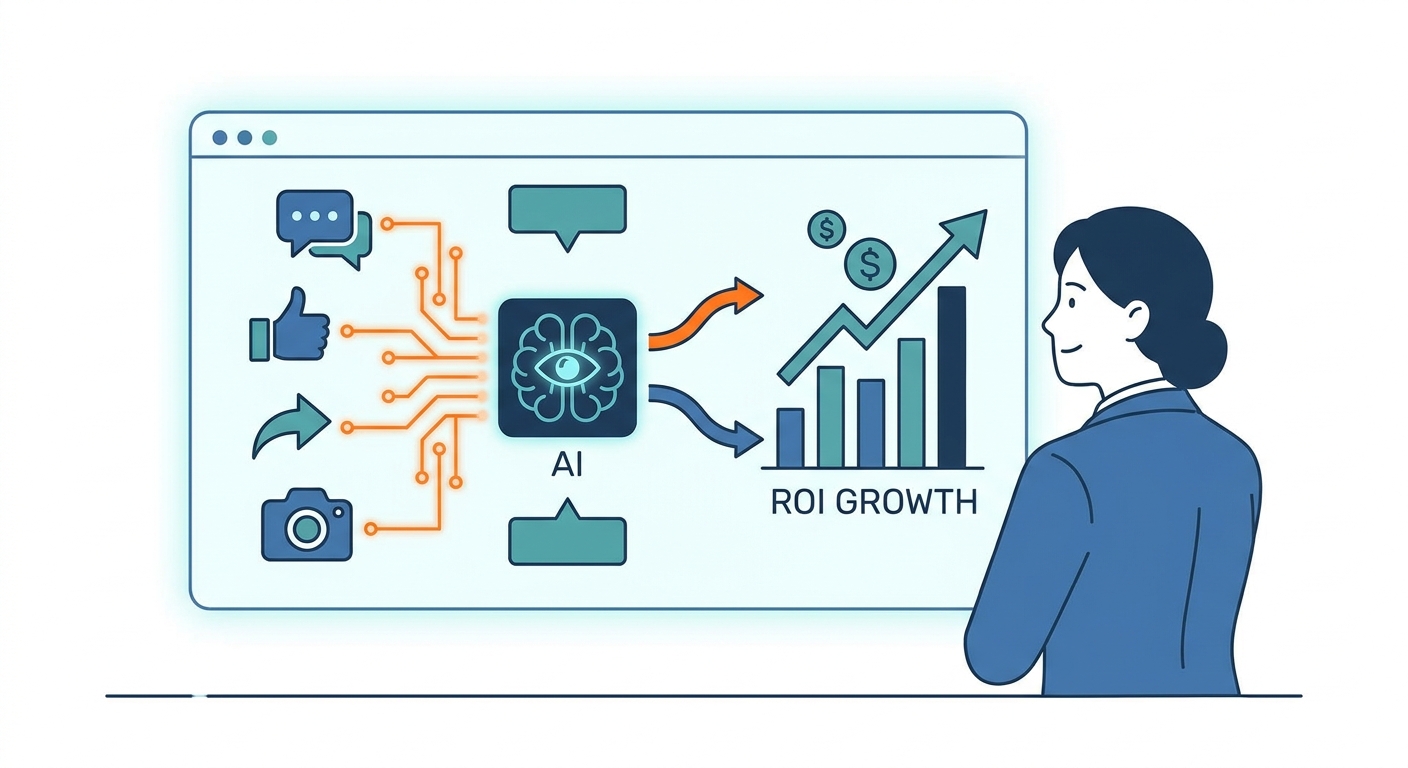
To find the signal in the noise, you must use sentiment analysis. Don't just look at whether people are talking about you; look at how they’re talking about you. Are they frustrated with a common industry process? Are they begging for a solution that doesn't exist yet? When you filter mentions through the lens of sentiment, you stop seeing comments as data points and start seeing them as R&D for your next campaign.
How Do You Build the "Listen-Create-Analyze" Loop?
The era of static, months-long content calendars is dead. If you’re planning your Q3 content in Q1, you’re already behind. Instead, you need a dynamic loop that treats every post as a hypothesis to be tested. When you integrate a flexible content calendar into your workflow, you create space for spontaneity informed by data.
The loop is simple but rigorous: you listen for trends, draft a content hypothesis, distribute that content—ideally through a social-first, video-heavy approach—and then validate your results against your KPIs.
This cycle ensures your content is always evolving. If a specific video format hits, the "Analyze" stage informs your next "Listen" phase, helping you figure out why that format resonated and how you can replicate that success in a different context.
The 30-Minute Weekly Audit: A Step-by-Step Guide
The biggest barrier to growth? Analysis paralysis. You don’t need to spend hours staring at complex dashboards. A disciplined, 30-minute weekly audit is all it takes to keep your strategy on track.
First, ignore "vanity metrics" like raw follower counts or mere impressions. They are sugar-free calories. They look like growth, but they provide no sustenance. Instead, build an "A-E-L" scorecard. Focus on Acquisition (how many people found you through non-paid discovery), Engagement (specifically shares and saves, which indicate high-value resonance), and Loyalty (DM conversations and repeat interactions). According to the Sprout Social Metrics Guide, these community-owned metrics are the true north stars for sustainable growth.
During your 30 minutes:
- Identify the Top 3: Find the three posts that generated the most saves or shares. Why did they work? Was it the hook? The visual style? The specific problem it solved?
- Review the Sentiment: Scan the comments. Is there a recurring question you haven't answered yet? That is your next content pillar.
- Iterate: Take your "winning" format and create 3-5 variations. If a "how-to" video on a specific pain point saved well, make three more variations focusing on different aspects of that same pain point.
What Does Real-World Growth Look Like?
Real growth is targeted resonance, not broad reach. Consider a brand that shifts from trying to go "viral" to trying to be "essential." By analyzing industry benchmarks—such as those found in Emplifi’s Social Benchmarks—you can stop comparing yourself to massive accounts and start comparing yourself against your actual competitors.
When you move from broad impressions to targeted resonance, you often see a dip in total views but a massive spike in conversion and community loyalty. This is the "Consultant’s Edge." At this level, you stop worrying about the algorithm and start worrying about your audience’s problems. If you find the data-strategy overlap too complex to manage internally, our social media management services are designed to bridge that gap, turning raw data into a narrative that compels action.
What Are the Most Common Pitfalls to Avoid?
The most common trap is the "Vanity Metric Obsession." When you prioritize follower counts, you ignore the quality of your engagement. A thousand followers who share your content and buy your products are worth ten thousand followers who scroll past your posts without a second thought.
Another danger is the misuse of AI. Many creators use AI to spark ideas—which is excellent—but they fail to use it for trend forecasting. If you use AI only to write your captions, you’re creating generic content that sounds like everyone else. Use AI to scan large datasets, identify emerging industry pain points, and synthesize sentiment. That is where the competitive advantage lies.
Finally, stop repurposing. Taking a long-form YouTube video and chopping it into a low-resolution TikTok is a recipe for stagnation. Each platform has its own language and culture. A "social-first" strategy means creating content native to the platform where it lives. This is the only way to achieve the kind of 200% year-over-year growth that separates market leaders from the rest of the pack.
Conclusion: Turning Strategy into Sustainable Growth
Social listening isn't just a tool you check once a month; it’s a culture of curiosity. It’s the decision to put your ego aside and let the audience dictate the direction of your brand. When you stop chasing the next viral hit and start focusing on the feedback loop, you stop being a "content creator" and start being a strategic partner to your audience. Growth is a marathon, not a sprint, and the only way to win is to listen closer than anyone else.
Frequently Asked Questions
What is the fundamental difference between social monitoring and social listening?
Monitoring tracks specific mentions and direct engagement (the "what"), while listening aggregates data to understand broader sentiment, industry shifts, and predictive trends (the "why").
How often should I review my social media analytics to see actual growth?
While daily checking is tempting, a "30-Minute Weekly Audit" is the gold standard for identifying actionable patterns without falling into the trap of analysis paralysis.
I have a small audience; is social listening still worth it?
Yes—in fact, it is more critical. For small accounts, listening allows you to find gaps in your competitors' content strategy, enabling you to "steal" the conversation by providing the value they are ignoring.
How can I use social listening to find content ideas that my competitors haven't covered yet?
By monitoring industry-specific keywords and analyzing "unmet needs" in customer comments, you can identify recurring pain points that competitors are failing to address, turning those gaps into your primary content pillars.