What is social media autopilot? How AI posting works (and where to keep a human)
Social media autopilot uses AI to plan, draft, schedule and publish posts. Learn how the loop works, platform AI rules, and where a human must stay in charge.
Autopilot & AI
Struggling with content fatigue? Learn how to use AI social media post generators to scale your marketing while maintaining an authentic human brand voice. Alex ChenAI Content StrategistPublished 6 min read
Let’s be honest: the "content treadmill" is exhausting. You’re expected to be everywhere at once—LinkedIn, TikTok, Instagram—all while keeping your brand voice sharp. If you feel like you’re constantly chasing the algorithm, you aren't alone.
Enter the AI social media post generator. At its simplest, it’s a tool that uses large language models (LLMs) and smart image synthesis to handle the heavy lifting of social media marketing. But don't mistake these for simple "auto-writers." Today’s top-tier tools act as a force multiplier for your team. They take one core idea and spin it into a dozen platform-specific posts, handling everything from the initial draft to the final scheduling.
We’re living in a time of unprecedented volume. With 75% of marketing teams now leaning on AI, the goalpost has shifted. It’s no longer about whether you can create content; it’s about how to stay relevant without burning your team to the ground.
According to 2026 Social Media Statistics, audiences have developed a sixth sense for "sterile" content. They can smell a generic, AI-generated post from a mile away. This is the "Authenticity Paradox": you need AI to keep up with the algorithm’s demand for volume, but you need human intuition to make sure the brand doesn't lose its soul. AI is the engine, sure. But you? You’re the one holding the steering wheel.
Think of an AI generator as a tech stack, not just a chatbot. It starts with an LLM that’s been trained on the classics—AIDA (Attention, Interest, Desire, Action) and PAS (Problem, Agitation, Solution).
But in 2026, it goes deeper. Modern tools now integrate image synthesis that actually understands your branding guidelines and aspect ratios. They plug directly into your publishing dashboard via APIs. It’s full-funnel repurposing: you feed it a long-form blog post, and it spits out a LinkedIn carousel, a script for a short-form video, and a series of punchy tweets. It’s about working smarter, not just faster.
The teams winning right now aren't hitting "generate" and walking away. They’re using a "Human-in-the-Loop" (HITL) workflow to keep the quality high and the brand safe.
graph TD
    A[Input/Prompting] --> B[AI Draft & Visual Gen]
    B --> C{Human Edit & Brand Polish}
    C -->|Needs Revision| B
    C -->|Approved| D[Multi-Platform Scheduling]
    D --> E[Analytics & Feedback Loop]
    E --> A
Here’s the golden rule: 80/20. Let the AI handle the 80%—the hashtags, the resizing, the boring draft variants. Save your 20% for the "human spark." That’s where you inject the personal anecdotes, the proprietary data, and the cultural nuances that an AI simply cannot fake. Before you start, make sure your team has a clear How to Build a Brand Voice guide. If the AI doesn't know who it's supposed to be, it’ll just default to being a robot.
Time is your most valuable asset. Teams using these tools are clawing back 10–12 hours a week, according to AI & Social Media Data. That’s time you can spend on actual strategy instead of formatting images.
But it’s not just about speed. It’s about consistency. Keeping a uniform voice across a professional LinkedIn post and a casual Instagram story is a headache. An AI generator acts as a central brain, keeping your tone steady across the board. Plus, these tools are getting predictive. They’re analyzing engagement patterns to suggest trending topics before they peak. You stop chasing waves and start riding them.
Don't get blinded by the marketing hype. Look for tools that play nice with your current scheduler and allow for deep "brand voice" training.
| Tool Name | Best For | Learning Curve | Key Feature |
|---|---|---|---|
| EnterpriseAI | Scalability | High | Compliance Guardrails |
| VidFlow | Short-Form Video | Medium | Text-to-Video Engine |
| SMB-Master | Small Business | Low | All-in-One Dashboard |
Check the visuals. If the tool produces a graphic that needs to be manually cropped or fixed, it’s not saving you time—it’s costing you more. For a deeper dive into how these tools fit into your wider goals, refer to Our Guide to Social Media Strategy.
The industry has split into two lanes. Enterprise teams are obsessed with compliance and brand safety—they need to know the AI isn't going to hallucinate a fake product feature. On the other hand, creators and small businesses are flocking to "all-in-one" platforms. If a tool can’t turn a prompt into a slick, 30-second video clip today, it’s already behind the times. Video is the gold standard, and static text is no longer enough to cut through the noise.
Your output is only as good as your input. A lazy prompt gets you a lazy post. A great 2026 prompt follows a simple structure:
Don't just say, "write a post about AI." Try this instead: "Act as a social media strategist for a tech firm. Write three LinkedIn post variations about the impact of AI on productivity. Use a professional but conversational tone. Include a hook that addresses the 'content fatigue' pain point, and end with a question that encourages comments. Keep it under 200 words." As highlighted in current 2026 Social Media Trends, those who learn to "speak" to their AI tools are the ones who stay ahead of the curve.
We’ve all seen it: the posts with three emojis in every line, the overused buzzwords, the total lack of soul. That’s "Lazy AI." To avoid this, you have to add your "secret sauce." If the AI output feels generic, it’s because your prompt was generic. Add a weird story from your office. Mention a specific failure your team learned from. Share a controversial opinion. The AI can give you a skeleton, but you have to provide the muscle and the blood.
If you need to justify the subscription cost, stop talking about "follower count." Talk about money. Calculate how much time your team saves and multiply that by their hourly rate. Then, link the increased posting frequency—which you’re now doing with ease—to your conversion rates. When you can show leadership that you’ve tripled your output without hiring more staff or sacrificing engagement, the budget conversation becomes an easy win.
Platforms are getting smarter, but they don't care about the source. They care about engagement. If your content gets people talking, saving, and sharing, the algorithm is going to push it. Don't worry about the "AI label"—worry about whether the content is worth a human's time.
Only if the content is spammy or low-effort. Algorithms aren't "anti-AI"; they’re "anti-boring." If your AI-assisted posts are insightful and tailored to your community, your reach will likely improve because you’re showing up more consistently.
Feed the beast. Provide the AI with your "Brand Bible" or a list of your best-performing past posts. Use these as "few-shot" examples in your prompts. When the AI sees your sentence structure and vocabulary, it stops sounding like a generic bot and starts sounding like a member of your team.
Free tools are great for tinkering. But once you’re serious about growth, you’ll find they lack the "brand voice" training and the compliance guardrails that keep you out of trouble. Use them to learn the ropes, but plan to upgrade as your brand footprint grows.
Absolutely. AI can draft a great caption, but it often misses the nuance of platform-specific SEO. Always do a manual check on your keywords and ALT tags. AI is a partner, not a replacement for your strategic brain.
Social media autopilot uses AI to plan, draft, schedule and publish posts. Learn how the loop works, platform AI rules, and where a human must stay in charge.
Stop churning out generic AI content. Discover the 2026 workflow to scale your unique voice using top AI social media tools for research, synthesis, and growth.
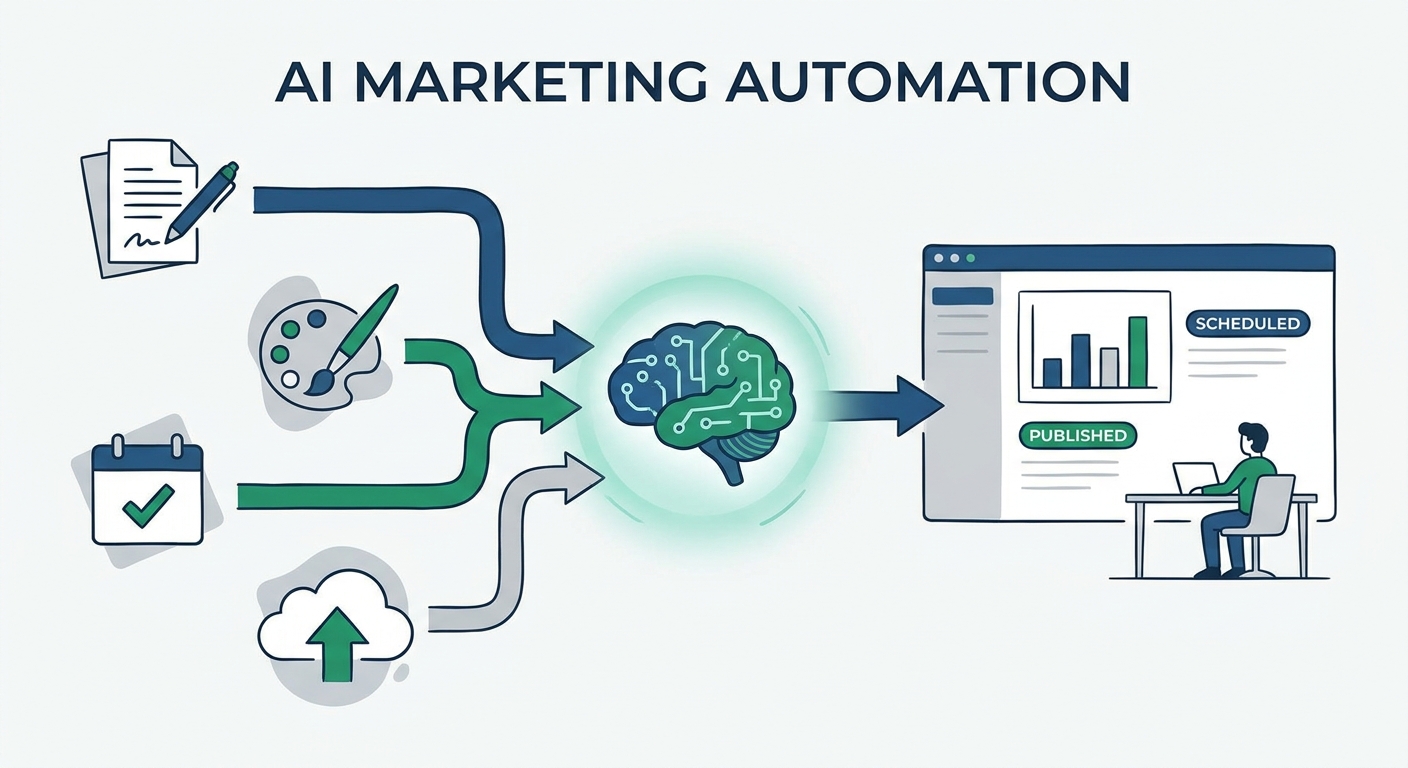
Stop manual content switching. Discover the 10 best AI social media post generators of 2026 to automate your marketing workflow and scale your content output.
Social9 schedules your posts on 11 networks, and Autopilot can draft them in your brand voice for you to approve. Start on the free plan.
We use strictly necessary cookies to run this site. With your permission, we also use analytics cookies to understand how the site is used. We never use advertising cookies. See our Cookie Policy.