What is social media autopilot? How AI posting works (and where to keep a human)
Social media autopilot uses AI to plan, draft, schedule and publish posts. Learn how the loop works, platform AI rules, and where a human must stay in charge.
Autopilot & AI
Stop the content grind. Learn how to use AI to atomize your long-form video into a month of high-authority social media posts without losing your brand voice. David KimAI EngineerPublished Updated 6 min read
If your content calendar has become a graveyard of half-baked ideas, you’re drowning. You’re stuck in the "Velocity Trap"—that soul-crushing daily race to churn out mediocre posts just to keep the algorithm fed.
Stop it. You’re doing it wrong.
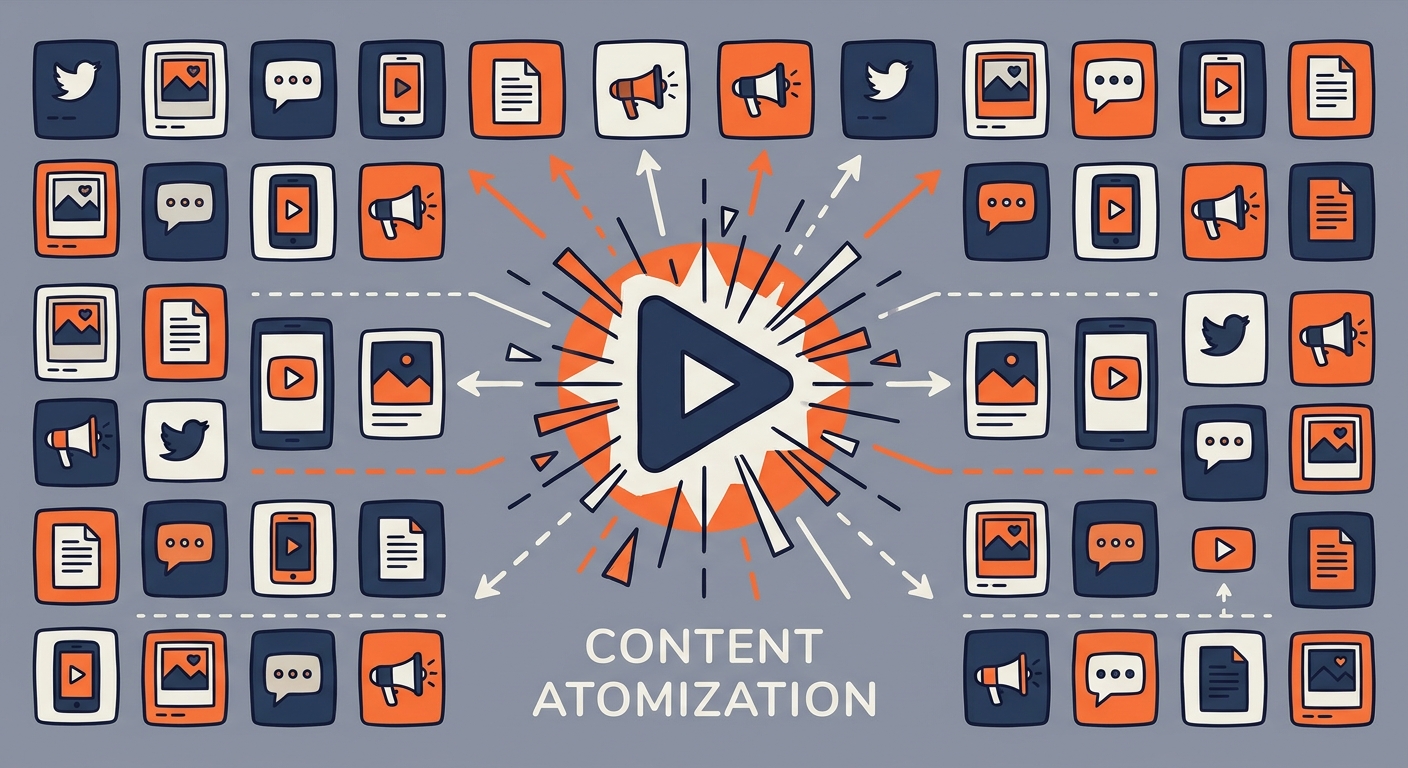
In 2026, the brands actually winning aren't the ones screaming the loudest or posting the most. They’re the ones producing the densest content. We’re talking about "Content Atomization." By using an AI engine to strip a single high-value video of its core insights, you can turn one hour of work into a month of authority. This isn't about mass-producing robotic sludge. It’s about taking one brilliant masterclass, podcast, or webinar and refracting it through the lenses of LinkedIn, X, and TikTok. You maximize reach without selling your soul.
The internet is currently suffocating under a mountain of AI-generated noise. If your repurposing strategy is just letting a bot vomit generic summaries of your videos, you aren't building a brand—you’re actively eroding your credibility. According to the State of Content Marketing 2026 report, audiences have developed a sixth sense for machine-written hollow filler. They ignore it. They block it. And eventually, they forget you exist.
The shift is toward "Atomization." Stop trying to create thirty mediocre posts. Create one piece of "Source Material" so packed with value that it can be fractured into dozens of sharp, specific insights.
Use the 70/30 Rule. Let AI handle the 70% of the mechanical heavy lifting—the tedious transcription, the basic formatting, the initial drafting. Then, let your human team handle the 30% that actually matters: the nuance, the contrarian takes, and the raw, unfiltered brand voice.
You cannot scale bad content. If your primary video is just a rambling, unfocused Zoom call, AI will simply turn that ramble into a series of incoherent social posts. Garbage in, garbage out.
Before you touch a single AI tool, ensure your "Content DNA" is dense. Your long-form assets—your deep-dive interviews, your strategic webinars—must solve a specific, nagging pain point for your Ideal Customer Profile. If you’re struggling to define that core, learn more about our core Content Strategy Framework to ensure your foundation is solid before you start the atomization process.
To turn one video into a month of content, you need a system that doesn't break. You aren't just cutting clips; you are transforming a narrative.
graph LR
    A[Long-form Video] --> B[AI Transcription]
    B --> C[Thematic Extraction]
    C --> D{Platform-Specific Formatting}
    D --> E[LinkedIn: Long-form Narrative]
    D --> F[TikTok/Reels: Video Hooks]
    D --> G[X/Threads: Contrarian Threads]
    E --> H[Scheduling]
    F --> H
    G --> H
    H --> I[Published Content]
The process starts with clean data. You need more than a literal transcript; you need an interpretation of the value buried in the audio. Using advanced transcription tools—check out best practices for AI video transcription and clipping to get started—you can identify the "Golden Nuggets."
These are the moments where you drop a contrarian take, a framework, or a piece of proprietary data. AI can now tag these moments by theme, allowing you to pull out the most "shareable" sections of a 45-minute video in seconds. Don't look for the "best" clips; look for the "most useful" ones.
Atomization isn't just chopping a video into 60-second chunks. It’s deconstructing a core argument into its constituent parts. If your video is about "The Future of SaaS Pricing," your atomization map should look like this:
By categorizing these insights, you ensure that every piece of content serves a distinct purpose in your audience's journey.
You cannot just cross-post the same text everywhere. Native platform adaptation is essential for 2026 algorithms, and the "DNA" of your content must change to survive.
The biggest mistake marketers make is trusting the AI to be the editor. If you want to avoid the generic sludge, you must feed the AI your specific brand voice guidelines. Learn how to build a consistent Brand Voice so your AI agents know exactly how you talk, what words you avoid, and what kind of tone you strike.
The "Human-in-the-Loop" (HITL) checklist is your final line of defense. Before anything goes live, ask:
When you move from manual creation to an AI-agent workflow, the math changes drastically.
| Metric | Manual Workflow | AI-Agent Workflow |
|---|---|---|
| Time per Month | 40+ Hours | 8 Hours |
| Cost per Post | High ($200+) | Low ($20) |
| Consistency | Low | High |
By automating the mechanical aspects, you aren't just saving time; you are buying back the mental bandwidth needed to produce higher-quality primary assets.
The market is currently split between "All-in-one AI Agents" and "Specialized Tool Stacks." If you are a lean team, start with an MVP approach: one high-quality transcription tool and one capable LLM for drafting. As you scale, you can integrate specialized agents that connect your video source directly to your scheduling software, creating a "set it and forget it" pipeline that still allows for human editorial oversight.
Not if you focus on value. Search engines and social algorithms prioritize unique insights. As long as you are using AI to reformat and refine your own original, high-value thoughts rather than letting it generate generic filler, you will be rewarded for the consistency and depth of your content.
Quality beats quantity. A 20-minute, high-density webinar where you share a unique framework is worth more than a 60-minute rambling meeting. Aim for at least 15-20 minutes of "dense" insight to ensure you have enough raw material to pull 15-20 high-quality social posts.
The 70/30 rule is your solution. AI does the heavy lifting, but you must inject specific, anecdotal evidence—personal stories, niche examples, or internal company data—that the AI cannot invent. These human markers act as "antibodies" against the generic, robotic feel of standard AI output.
Absolutely not. Start with an MVP: use one reliable transcription tool to get your text, and one LLM to help you structure that text into posts. Once you have mastered that workflow, you can add automation tools to connect the pieces. Don't let the tech overwhelm the strategy.
The "Strategy/Extraction" phase. If you fail to identify the truly valuable, contrarian, or helpful moments in your source video, the rest of the workflow is just automating noise. The value is created in the human decision of what to repurpose, not the automated distribution of it.
Social media autopilot uses AI to plan, draft, schedule and publish posts. Learn how the loop works, platform AI rules, and where a human must stay in charge.

Stop churning out generic AI fluff. Learn how to build a full-stack content workflow that scales your unique human expertise and builds reader authority.
Stop using AI as a typewriter. Learn to build agentic workflows that scale high-authority content and beat synthetic mediocrity in 2026.
Social9 schedules your posts on 11 networks, and Autopilot can draft them in your brand voice for you to approve. Start on the free plan.
We use strictly necessary cookies to run this site. With your permission, we also use analytics cookies to understand how the site is used. We never use advertising cookies. See our Cookie Policy.