What is social media autopilot? How AI posting works (and where to keep a human)
Social media autopilot uses AI to plan, draft, schedule and publish posts. Learn how the loop works, platform AI rules, and where a human must stay in charge.
Autopilot & AI
Stop generic AI content. Learn how to maintain a consistent brand voice and tone while using AI social media tools to boost engagement and trust. Jessica ThompsonBrand Strategy & Community ExpertPublished 6 min read

Maintaining a consistent brand voice in an era of automated content creation isn’t about fighting the technology; it’s about mastering the leash. If your AI-generated social media output sounds like a beige wall of corporate jargon, you aren't suffering from a tool failure—you’re suffering from a lack of governance.
To stay relevant, you must treat AI as a co-pilot, not an autopilot. When you allow an LLM to operate without guardrails, it naturally trends toward the "average" of its training data, resulting in the dreaded "generic trap." By implementing a rigid human-in-the-loop workflow, you can ensure that your brand’s unique perspective remains the heartbeat of every post, protecting your 33% revenue uplift that comes from consistent brand presentation.
The primary reason most AI content fails is a fundamental misunderstanding of the relationship between voice and tone. Think of your brand voice as your personality—it is the static, unchanging core of who you are. It is the vocabulary, the rhythmic cadence of your sentences, and the specific perspective you bring to your industry. It is the part of your brand that should never change, regardless of the channel.
Tone, by contrast, is a shapeshifter. It is the context-specific adjustment of that personality. You wouldn’t talk to your grandmother the same way you’d talk to a rowdy crowd at a dive bar, right? Your brand shouldn't either. Your AI tools need to be instructed specifically on this distinction. If you fail to separate the two, your AI will produce a flat, one-note output that fails to resonate with the specific audience on platforms like LinkedIn or TikTok. Nielsen Norman Group research highlights how deeply psychology plays into this; when a brand’s voice wavers, the audience’s subconscious trust in that brand erodes rapidly.
The phenomenon of "regression to the mean" is the enemy of brand identity. AI models are trained on the vast, messy, and often bland aggregate of the entire internet. When you give an AI a vague prompt, it calculates the most statistically probable response—which is almost always the most boring, safe, and widely accepted phrasing possible.
In the modern digital ecosystem, this is a death sentence for your reach. Algorithms are increasingly prioritizing E-E-A-T (Experience, Expertise, Authoritativeness, and Trustworthiness). As outlined in Google’s E-E-A-T Guidelines, search and social platforms are actively filtering out content that lacks human value. If your AI content is indistinguishable from the thousands of other posts generated by the same models, you are effectively invisible. To break out of this, you must feed the model your unique data, your internal Brand Voice Guidelines, and your specific stylistic quirks.
Stop relying on PDFs tucked away in a shared drive. AI tools cannot "read" your company culture through a static file unless you feed it into a structured Knowledge Base. An AI-ready guide must contain three critical pillars:
By housing these in a dedicated AI Content Workflow, you transform your guidelines from a dormant document into an active set of operational parameters.
Automation should stop at the drafting stage. The moment the AI hits "generate," a human must step in. This is the "Human-in-the-Loop" mandate.
graph TD
    A[AI Draft Generation] --> B[Human Tone Check]
    B --> C{Tone Aligned?}
    C -- No --> D[Refine/Edit]
    D --> B
    C -- Yes --> E[Platform-Specific Adjustment]
    E --> F[Final Compliance Review]
    F --> G[Publishing]
This workflow ensures that your brand identity remains intact while you reap the efficiency benefits of AI. The "Tone Check" is the most critical juncture; it is where a human editor ensures the AI hasn't hallucinated a corporate platitude or adopted the wrong persona for the target platform. If the content doesn't feel like something a human on your team would say, it gets sent back to the drawing board.
One of the most persistent issues in 2026 is "instruction drift." If you are using long, multi-turn chat threads, the AI will slowly lose context of your brand voice, drifting toward whatever the most recent prompt requested. This is the equivalent of a game of telephone where the message gets muddied over time.
To prevent this, abandon the long-thread approach. Instead, leverage "System Prompts" that are injected into every new interaction. By utilizing the best practices found in the AI Prompt Engineering Guide, you can force the model to re-verify its instructions against your "Brand Knowledge Base" before it writes a single word. This ensures that every post starts with a clean slate of your core brand identity.
If you want the AI to sound like you, stop telling it how to sound—show it. This is "Few-Shot Prompting." Instead of saying "write in a professional tone," provide the AI with 3–5 examples of your best-performing, most "on-brand" social posts alongside 3–5 examples of "bad" (generic/robotic) posts.
When you provide this contrast, the AI doesn't just guess your style; it maps the delta between your successful content and the generic noise. It essentially learns to emulate your cadence and logic. This is the difference between a bot that sounds like a generic assistant and one that sounds like a member of your marketing team.
If you suspect your social media feed has become a bland echo chamber, run this audit today:
Your voice is the constant, but your tone is the variable. A LinkedIn post demands authority and actionable insight; a TikTok script demands brevity, visual hooks, and a high-energy, conversational rhythm. You can use the same core Knowledge Base for both, but you must instruct your AI to apply "Platform-Specific Mapping."
For LinkedIn, set your system prompt to prioritize "Data-backed, professional, and industry-authoritative." For TikTok or Instagram, swap the parameters to "Visual-first, punchy, and community-focused." You are essentially creating different "skins" for your core brand personality.
Finally, treat your AI content strategy as a living organism. Don't just publish and move on. Use your engagement data as a feedback loop. If a specific type of post (e.g., a "How-To" guide with a specific, witty intro) performs exceptionally well, feed that success back into your System Prompt. By constantly retraining your model based on high-performing content, you create a self-optimizing engine that gets better at sounding like you with every passing month.
AI models are trained on the "average" of all internet data. Without specific, unique examples of your brand's voice, the AI defaults to the most common, safe, and generic phrasing.
Stop using long, ongoing chat threads. Use "System Instructions" or a dedicated "Brand Knowledge Base" feature in your AI tool to ensure the voice parameters are applied to every new prompt.
While not always legally required, it is a best practice for building trust. Prioritize the quality and authenticity of the message; if it feels like your brand, the source matters less to the reader.
Relying on "autopilot" mode. Brands that skip the human-review stage often suffer from "instruction drift," where content gradually loses its unique personality and becomes indistinguishable from competitor AI-generated posts.
By treating AI as a "Co-pilot." Use AI to handle ideation and drafting, but reserve the "Human-in-the-Loop" phase for tone-tuning and final sign-off to ensure the output aligns with your core identity.
Social media autopilot uses AI to plan, draft, schedule and publish posts. Learn how the loop works, platform AI rules, and where a human must stay in charge.
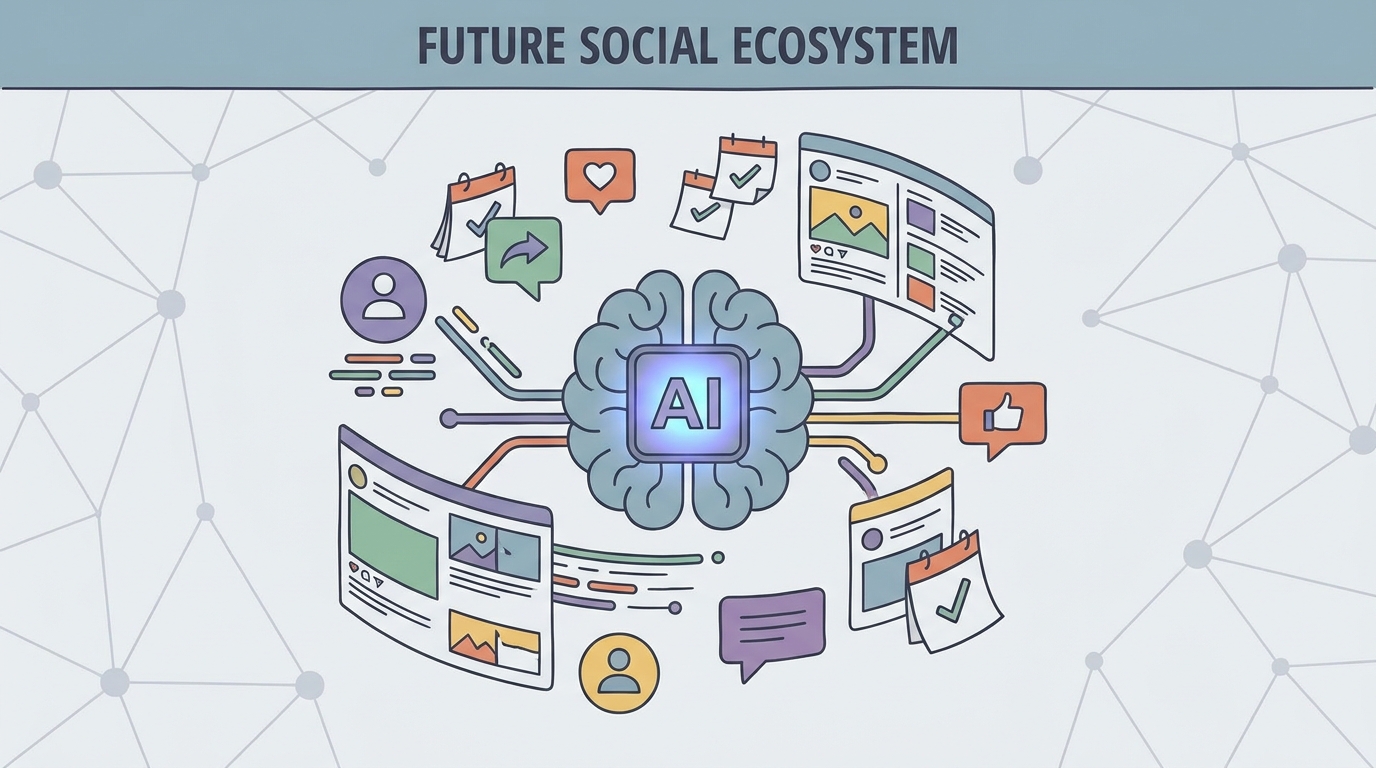
Stop manually posting. Discover how to build an AI-orchestrated social media workflow to dominate 2026 recommendation engines and scale your brand voice.
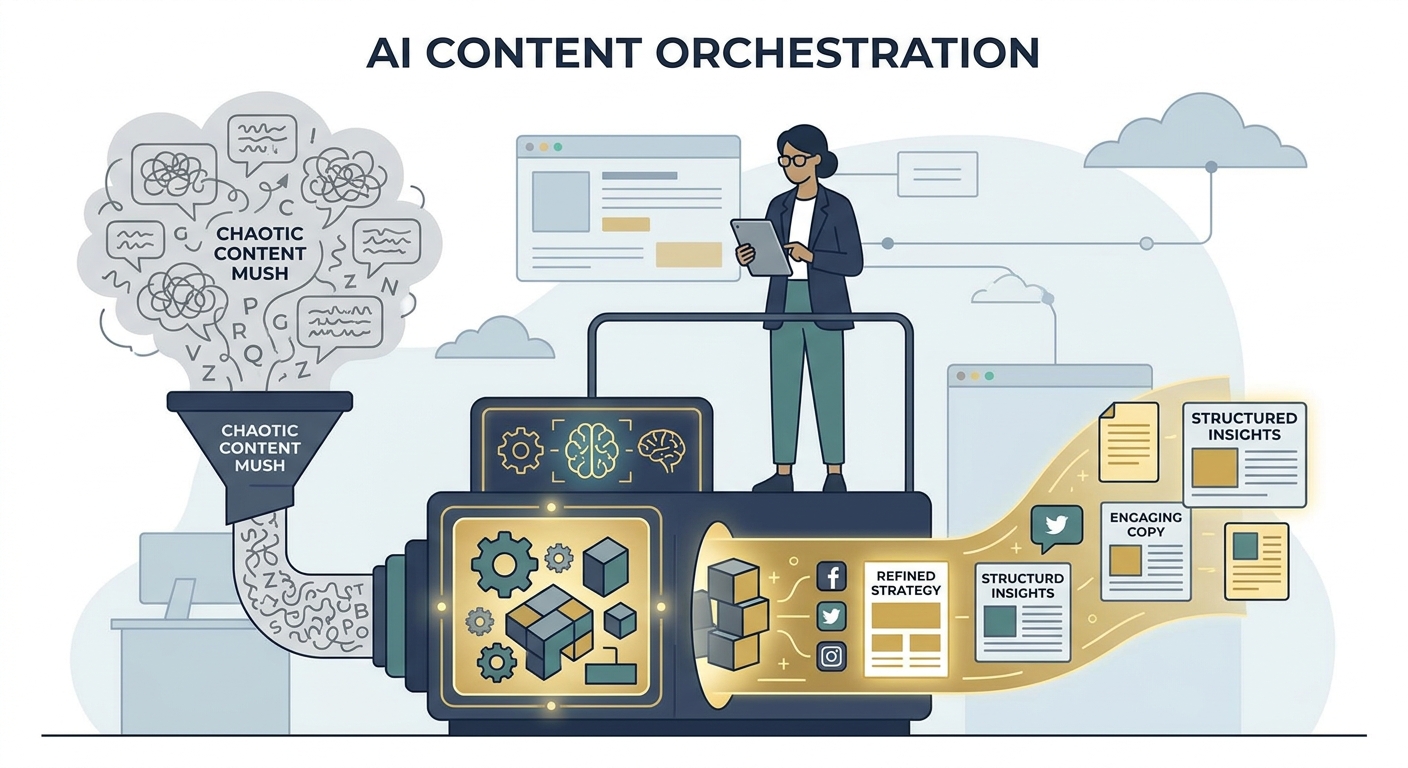
Stop 'prompting and praying.' Learn how to master agentic workflows and human-centric AI strategies to scale your content marketing efforts in 2026.
Social9 schedules your posts on 11 networks, and Autopilot can draft them in your brand voice for you to approve. Start on the free plan.
We use strictly necessary cookies to run this site. With your permission, we also use analytics cookies to understand how the site is used. We never use advertising cookies. See our Cookie Policy.