What is social media autopilot? How AI posting works (and where to keep a human)
Social media autopilot uses AI to plan, draft, schedule and publish posts. Learn how the loop works, platform AI rules, and where a human must stay in charge.
Autopilot & AI
Stop manually posting. Discover how to build an AI-orchestrated social media workflow to dominate 2026 recommendation engines and scale your brand voice. David KimAI EngineerPublished Updated 6 min read
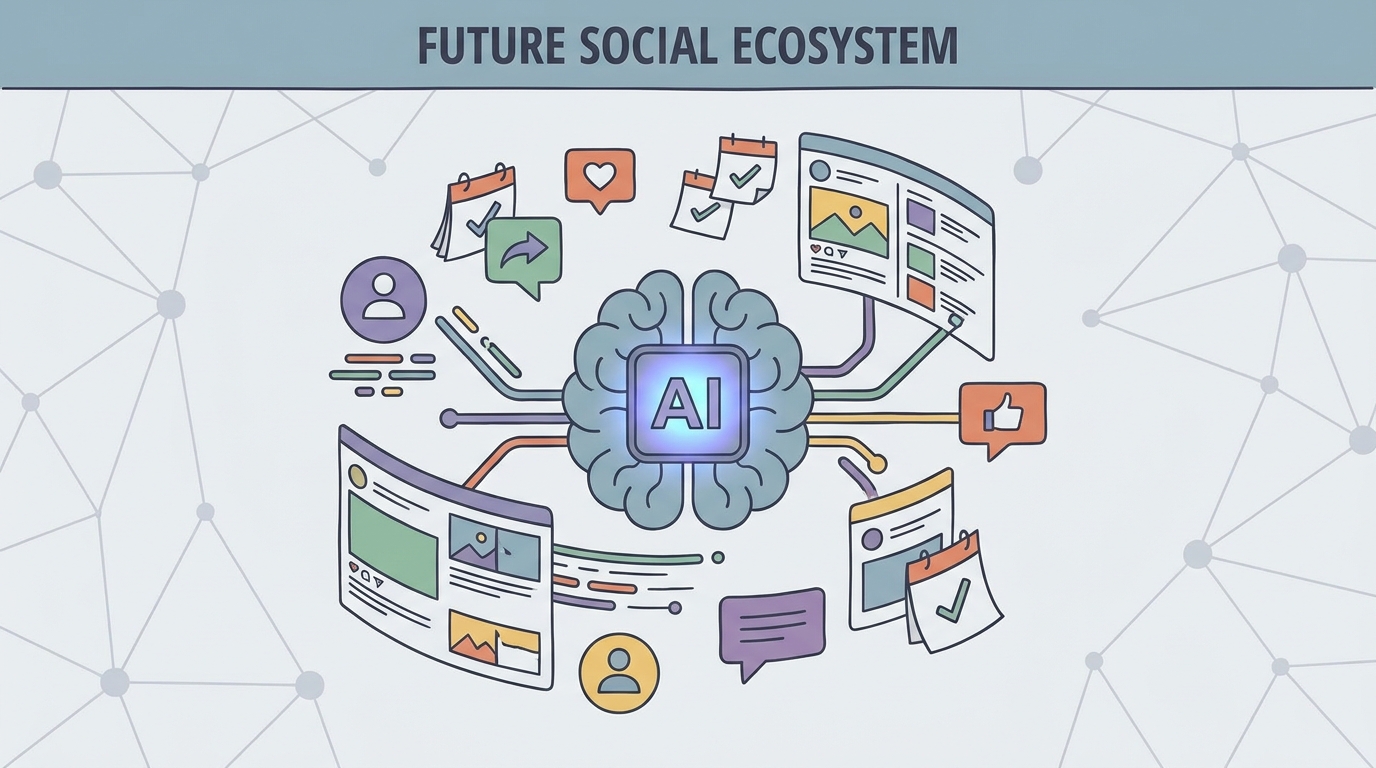
Forget the old playbook. If you’re still mapping out content calendars manually or grinding through hourly posts, you’re not just behind—you’re invisible. By 2026, social media stopped being a "posting schedule" and turned into a living, breathing ecosystem. It’s an AI-orchestrated machine.
If you think AI is just for writing a quick tweet or fixing a typo, you’re missing the point. The platforms have moved past the chronological feed. They’re now hyper-aggressive recommendation engines. They don't care about your "brand guidelines" as much as they care about watch time and resonance. To win today, you have to treat AI as your operating system. It’s the silent engine that hunts for trends, adapts your formats, and predicts your flops before you ever hit "publish."
Most brands are failing because they use AI like a toy. They generate a caption here, a stock photo there. That’s not a strategy; that’s just noise. True success comes from the pipeline. You aren't just making a post; you’re building a system that feeds itself.
graph LR
    A[Trend Discovery] --> B[AI Ideation]
    B --> C[Human Review - HITL]
    C --> D[Cross-Platform Adaptation]
    D --> E[Predictive Analytics]
    E -->|Feedback Loop| A
This pipeline starts with real-time trend discovery. Your AI should be watching sentiment shifts in your niche like a hawk. As noted in the Hootsuite 2026 Social Media Trends, platforms are doubling down on content that captures the rapid-fire evolution of cultural discourse. By automating the jump from a trending topic to a platform-ready asset, you stop being reactive and start owning the conversation.
"Authentic AI" sounds like an oxymoron, right? It’s not. It’s the only way to survive the sea of beige, robotic content that’s currently flooding every feed. When every competitor has the same access to the same LLMs, your brand voice is your only moat. If your content sounds like a Wikipedia summary, you’ve already lost. People scroll past robots. They stop for people.
This is where the Human-in-the-Loop (HITL) strategy becomes non-negotiable.
Set rigid editorial guardrails. Think of your AI as a brilliant, lightning-fast junior assistant who happens to have zero life experience. That’s where you come in. You’re the editor-in-chief. You inject the grit, the controversial takes, and the industry-specific scars that AI can’t fake. If you’re stuck on how to build those guardrails, our Content Marketing Services can help you lock down that brand identity so it stays consistent, even when the machines are doing the heavy lifting.
Mass-market messaging is dead. It’s been dead for years, but in 2026, the recommendation engine is the final nail in the coffin. The algorithm wants content that feels like it was made for one specific person.
AI lets you slice your audience into tiny, precise segments. You can take one core message—say, a new product launch—and have AI re-render it into a dozen variations. Engineers get the technical specs. Executives get the ROI metrics. End-users get the emotional benefits. As outlined in the Sprout Social AI Marketing Strategy Guide, the goal is to cut the noise. You want the right version of your story hitting the right person at the exact moment they’re looking for an answer.
Stop chasing the "tool-of-the-month." It’s a trap. A real stack is an ecosystem where the tools actually talk to one another. You need three pillars:
You aren't designing for the "feed" anymore. You’re designing for the "recommendation engine." These algorithms don't care about your logo placement; they care about engagement signals.
sequenceDiagram
    participant AI as AI Content Engine
    participant P as Social Platform Algorithm
    participant U as End User

    AI->>P: Submit Content + Metadata
    P->>P: Analyze Engagement Signals
    P->>U: Deliver to Recommended Feed
    U->>P: Interaction (Like/Share/Watch Time)
    P->>AI: Update Performance Data
To win, you have to feed the engine what it craves. That means obsessing over visual markers—contrast, pacing, text overlays—and structuring your metadata so the algorithm knows exactly who to show your content to. It’s technical, yes, but it’s the only way to get your content in front of the right eyes.
Transparency isn't just "nice to have." It’s a competitive advantage. When synthetic media is everywhere, the brands that voluntarily label their AI-generated content build a level of trust that others lose. Use disclosure labels like a badge of honor. It proves you’re using tech to enhance the user experience, not to deceive the consumer. Your audience is smart. Don't treat them like they're gullible.
If your only metric is "how many posts did we do this week?", you’re playing a losing game. High-volume, low-value content is the fastest way to get ghosted by the recommendation engine. Focus on engagement depth. Use your predictive analytics to see how a post will perform before you ship it. If the AI predicts a dud, don't waste the resources. Kill it.
You must train your AI on your specific brand assets. By creating a custom GPT or using proprietary brand style guides, you can "fine-tune" the output to match your tone, vocabulary, and values. Learn more about this process in our guide on How to Build a Brand Style Guide.
No, algorithms do not penalize content because it was "AI-assisted." They penalize content that is low-value, repetitive, or irrelevant. If your AI-assisted content provides genuine utility or entertainment, the algorithm will reward it just as it would human-created content.
The most efficient workflow involves using AI-driven clipping tools to extract viral moments based on engagement markers (like spikes in audio intensity or sentiment). Once the clips are extracted, use a human editor to add the final polish, branding, and context-specific hooks.
Use AI to handle the "heavy lifting"—the research, the drafting, the formatting, and the scheduling. This frees up your human team to focus on the things AI cannot do: community management, responding to comments in a conversational way, and building actual relationships with your audience.
Always check the latest platform-specific disclosure requirements. Most platforms now have a "made with AI" toggle. Automate the inclusion of these labels in your workflow so that compliance is a standard step in your publishing pipeline, not an afterthought.
Social media autopilot uses AI to plan, draft, schedule and publish posts. Learn how the loop works, platform AI rules, and where a human must stay in charge.
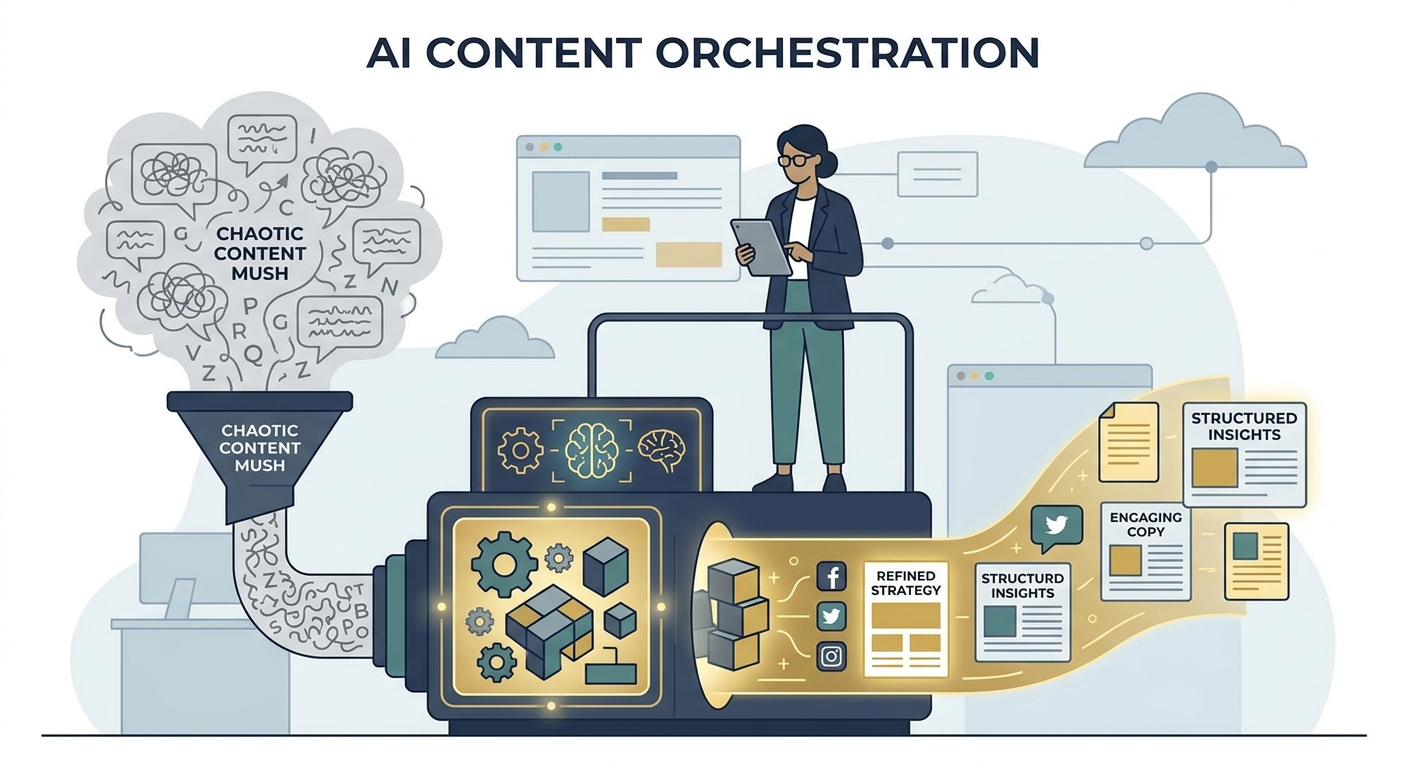
Stop 'prompting and praying.' Learn how to master agentic workflows and human-centric AI strategies to scale your content marketing efforts in 2026.

Stop using AI as a typewriter. Learn to build agentic workflows that scale high-authority content and beat synthetic mediocrity in 2026.
Social9 schedules your posts on 11 networks, and Autopilot can draft them in your brand voice for you to approve. Start on the free plan.
We use strictly necessary cookies to run this site. With your permission, we also use analytics cookies to understand how the site is used. We never use advertising cookies. See our Cookie Policy.