Best times to post on each social network in 2026
When to post on Facebook, Instagram, LinkedIn, X, TikTok, YouTube, Pinterest and Threads in 2026, per Sprout, Buffer, Later and Hootsuite, plus a test plan.
Data & Studies
Stop chasing vanity metrics. Learn how to use predictive social listening and AI-human hybrid strategies to dominate content discovery in 2026. Michael JohnsonAnalytics & Performance SpecialistPublished 7 min read
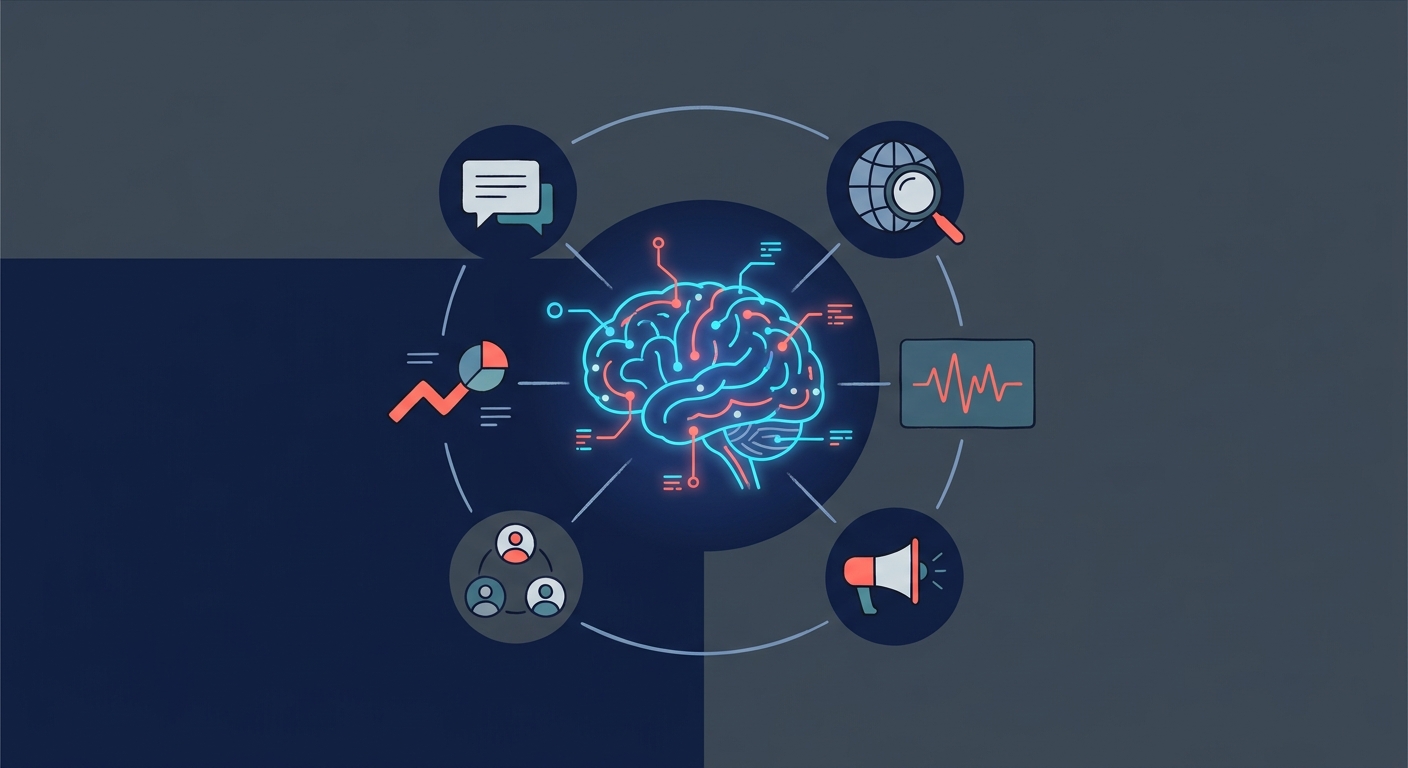
Social listening in 2026 isn’t about chasing vanity metrics or obsessing over sentiment scores. If you’re still just counting mentions, you’re missing the point. It’s the central nervous system of any brand worth its salt today. If your strategy still relies on manual trend-spotting or waiting for a PR fire to start before you react, you are already months behind the curve.
The smartest brands don’t just watch the market; they use social data as a predictive engine. They’re feeding real-time signals into their product development and content calendars before a trend even hits the mainstream. As noted in the 2025 Impact of Social Media Report, cultural conversations move at a breakneck speed that makes traditional, glacial editorial cycles look like relics of the past. To win, you have to stop being a spectator of the noise and start being an architect of the insights.
The "all-AI" content farm is dead. Algorithms are getting better at sniffing out soulless, robotic output, and they’re actively punishing it. We’ve entered an era where the industry has finally settled into a sensible hybrid model: use AI to do the heavy lifting, but keep the human in the driver’s seat for the nuance.
Think of it this way: AI scans the millions of data points and transcribes the hours of video to show you the "rising wave" of a trend. That’s your raw material. It’s the baseline. But the brand voice? That’s all you. It’s the human decision to walk away from a viral meme because it feels cheap or off-brand. It’s the choice to inject a specific, sharp perspective into a conversation that your competitors are crowding with generic, AI-generated fluff.
Using a Content Automation Suite is non-negotiable for handling the grunt work of distribution and metadata. It frees up your best minds to focus on what actually matters: brand voice calibration. If you aren’t using the machine to move faster, you’re losing the race. If you aren’t using a human to edit the machine’s output, you’re losing the audience. Period.
We’ve hit a "Semantic Shift." If you’re still banking on hashtags to categorize your content, you’re living in the past. Gen Z and Alpha don’t use social media like a digital magazine; they use TikTok and YouTube like they use Google. They aren't looking for a curated feed. They’re looking for specific, intent-driven answers.
Social search is active. It’s a user typing "how to clear a clogged drain" into a search bar. Social discovery is the algorithmic loop—the passive, hypnotic consumption where a user gets served a trend they didn't know they wanted. To win here, you need to pivot to semantic search. Your video transcripts, your captions, and even the visual metadata of your clips need to be optimized so that when a user asks a question, your content shows up as the definitive answer.
graph TD
    A[User Intent] --> B{Search vs Discovery}
    B -->|Active Query| C[Traditional Search Path]
    C --> D[Keyword Input]
    D --> E[Results Page]
    E --> F[Direct Answer]

    B -->|Passive Consumption| G[Algorithmic Discovery Loop]
    G --> H[Content Feed]
    H --> I[Engagement Analysis]
    I --> J[Interest Profiling]
    J --> G
Most brands wait until a topic is all over the news to jump on it. By then, the ship has sailed. Predictive forecasting is about catching the trend during the "cluster" phase. By tracking keyword velocity in niche communities—months before it hits the mainstream—you can plant your flag and seed your content calendar with an authoritative voice early.
This is where social listening turns into zero-party data gold. When you analyze what your community is actually asking, complaining about, or wishing for in the comments, you’re doing the most valuable market research on the planet. As highlighted in this guide on how social listening drives consumer insights, this data belongs in your product development meetings. Don't just listen to market your product; listen to build a better one.
The polished, glossy aesthetic of the late 2010s? It’s failing. People are tired of sterile, over-produced corporate creative. They want "Chaos Culture"—the raw, low-fi narratives that feel like they were shot on an iPhone in a kitchen.
Embracing this doesn’t mean you stop being professional. It means you stop being a robot. When a cultural moment happens, your ability to jump in with a quick, low-fi, human response will outperform a six-figure, high-budget campaign every single time. The trick is knowing when you have the "right to speak." If you can add real value, move fast. If you’re just chasing attention, the audience will smell the desperation, and they won’t be kind about it.
One trend should never be just one piece of content. It needs to be an ecosystem. You find the thread, then you weave it across your platforms based on what they do best.
graph LR
    subgraph Core_Trend [Core Trend: AI Ethics]
    A[Deep Dive Video]
    B[Short-form Hook]
    C[Professional POV]
    end

    A -->|YouTube| D[Long-form Education]
    B -->|TikTok| E[Casual Discovery]
    C -->|LinkedIn| F[Industry Authority]
The "right" tool depends on where you are in your journey. If you’re a scrappy startup, don’t go blowing your budget on a massive enterprise suite. Start with the free stuff: Google Trends for macro-level interest, the TikTok Creative Center for rising audio and hashtag velocity, and the native search bars on every platform.
Once you scale, you’ll hit a wall. That’s when you need a dedicated suite to track sentiment, competitor share-of-voice, and consumer insights. Check out this list of the 13 best social media listening tools for 2026 to see what fits your stack. Just make sure whatever you choose integrates with your CRM—a tool that lives in a silo is a tool that will eventually collect dust.
Don't try to change your culture overnight. Start by running a Social Media Audit Checklist to see where you actually stand. Next, define your "Alert Triggers." Forget about tracking every single brand mention. Track the intent. Set alerts for phrases like "how do I," "alternative to," or "why does [competitor]..."—these are high-intent signals that show someone is ready to buy or is frustrated with a problem you can solve.
Finally, force the "Feedback Loop." Every month, your social team should be presenting a "Listening Report" to your product and R&D folks. When marketing and product start speaking the same language, your whole organization gets faster.
The brands winning in 2026 aren't necessarily the ones with the biggest piles of cash. They’re the ones with the sharpest ears. A non-rigid, listening-first approach lets you pivot when the market shifts and double down when you find a winning thread. In a world where content goes stale in hours, agility is the only real competitive advantage you have.
Stop talking. Start listening. Let the data tell you what to create next.
Social monitoring is reactive and retrospective; it tracks metrics like mentions, likes, and shares to understand what has already happened. Social listening is proactive and strategic; it analyzes the context behind those mentions to identify emerging trends, consumer sentiment, and competitive threats before they reach critical mass.
Focus on identifying "keyword clusters" within niche subreddits, Discord servers, and niche hashtags. When you see a group of related terms gaining velocity—measured by the rate of change in mentions over a 48-hour period—you have found a "rising wave" that is likely to break into the mainstream within a week or two.
Not necessarily. You can build a highly effective stack by combining free discovery tools like Google Trends and the TikTok Creative Center with a singular, high-value paid tool for sentiment analysis and reporting. Only upgrade to enterprise-level suites when your volume of data exceeds your team's ability to manually synthesize it.
Social listening is the new keyword research. By analyzing the questions people ask on video platforms, you can capture long-tail search queries that haven't yet been optimized in traditional search engines. This allows you to create content that answers user intent at the exact moment they are searching for it.
Absolutely. By monitoring negative feedback loops, you can identify product flaws or service failures in real-time. Addressing a customer's frustration publicly and constructively before it creates a PR firestorm is the most effective way to turn a potential crisis into a demonstration of brand integrity.
When to post on Facebook, Instagram, LinkedIn, X, TikTok, YouTube, Pinterest and Threads in 2026, per Sprout, Buffer, Later and Hootsuite, plus a test plan.
Stop the consistency trap. Learn how to use social listening and data-driven analytics to build an intelligent, sustainable social media growth strategy.
Learn how automated social listening for sentiment analysis can transform your content strategy. Understand the tools, benefits, and steps involved.
Social9 schedules your posts on 11 networks, and Autopilot can draft them in your brand voice for you to approve. Start on the free plan.
We use strictly necessary cookies to run this site. With your permission, we also use analytics cookies to understand how the site is used. We never use advertising cookies. See our Cookie Policy.