How agencies manage 20+ client calendars without burning out
A playbook for agencies running 20+ client calendars: workspace setup, a capacity formula, a monthly cadence, approval SLAs, safe access and burnout rules.
Playbooks
Stop translating and start localizing. Learn how to adapt your social media strategy for global markets without losing your brand voice or meaning. David KimAI EngineerPublished Updated 6 min read
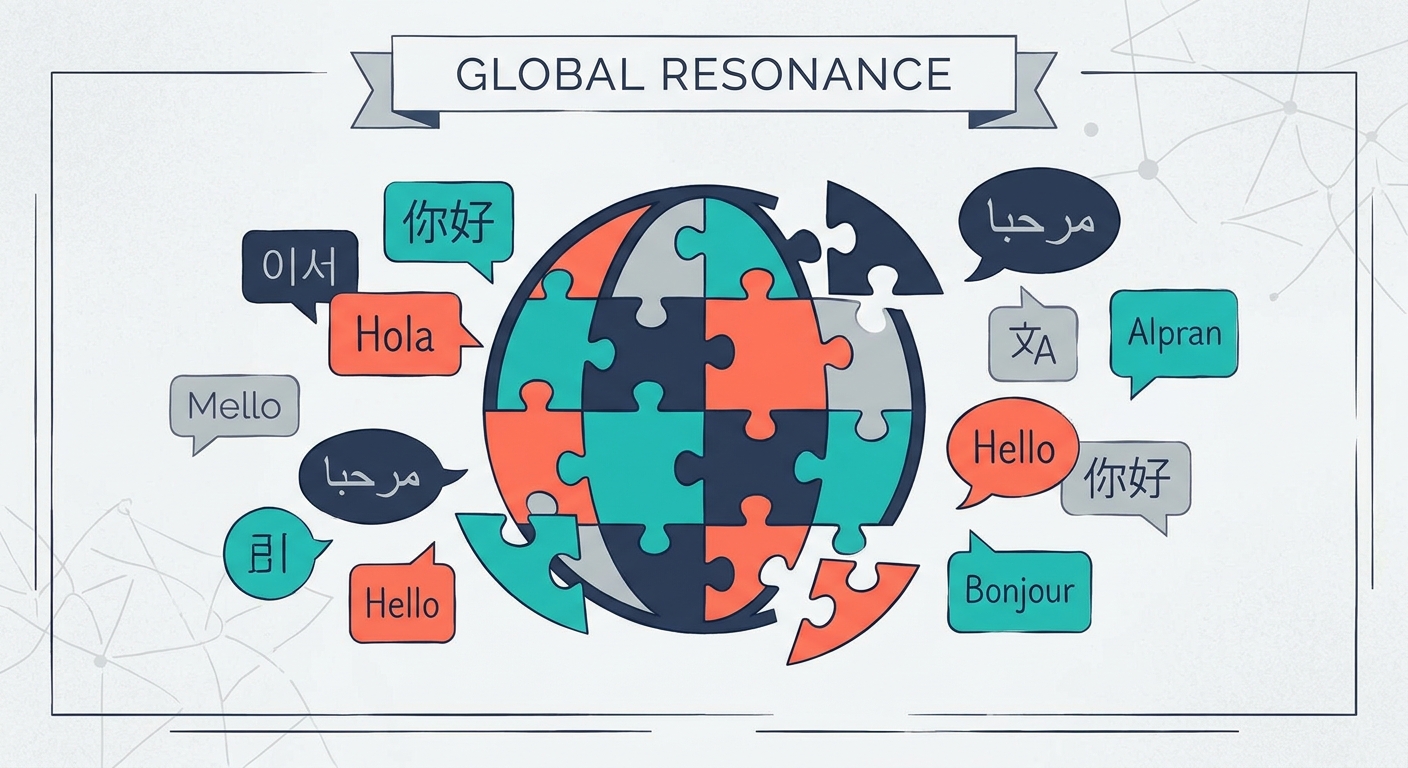
Global reach is a vanity metric. Resonance? That’s the only currency that actually buys you anything.
If you’re just shoving your English ad copy into a translator and hitting "post" on your international channels, you aren't building a brand. You're building a caricature. True localization isn’t about swapping vocabulary; it’s about having the cultural IQ to know what actually lands. In 2026, the winners are the brands that realize a message is only as effective as its ability to survive the trip across borders. As noted in The State of Localization 2026, the shift from rigid translation to fluid, context-aware transcreation is now the primary line between market leaders and the brands that get laughed off the timeline.
Translation is mechanical. It’s syntax, grammar, and literal meaning—the bare minimum. Localization, on the other hand, is an act of empathy. It’s the art of stepping into the shoes of a user in Tokyo, São Paulo, or Berlin and asking the hard questions: Does this joke actually work here? Is this imagery respectful? Does this CTA sound like an invitation or a demand?
Your global strategy needs to prioritize intent over literalism. When you translate, you change words. When you localize, you translate the experience. If your brand voice is "sassy and witty" in New York, that same sass might read as "rude or unhinged" in a more formal market. You aren't just changing the language; you’re recalibrating your brand’s personality to fit a different ecosystem.
The digital graveyard is packed with brands that thought they could automate their way to global dominance. "Lazy" localization—the kind that leans on machine-generated output without a human in the room—leads to a few specific, catastrophic failures:
Scaling doesn’t mean sacrificing your soul; it means building a rigorous, human-centric architecture. Treat AI as a draft-engine, not a final-product generator. The "human-in-the-loop" model is the only way to keep your quality high while moving fast.
graph TD
    A[Content Creation] --> B[AI Draft]
    B --> C{Human Cultural Vetting}
    C -- Needs Adjustment --> B
    C -- Approved --> D[Platform-Specific Adaptation]
    D --> E[Final Approval]
    E --> F[Publishing]
You need a centralized foundation. If you don't have a clear, documented brand voice, you will never achieve consistency across regions. Start by Building a Brand Style Guide that defines not just your visual identity, but your "personality rules." This guide should dictate how your brand handles sarcasm, how it addresses customers, and which topics are off-limits globally. When your regional teams have a clear North Star, they can adapt content with confidence instead of guessing what HQ wants.
We’re in the age of generative AI. These tools are incredible for speed, but they are notoriously tone-deaf. AI models are trained on massive datasets, but they lack the lived experience of a local.
There are three spots where AI consistently face-plants:
The "AI-Human Hybridization" strategy is simple: Use AI to handle the heavy lifting of drafting and formatting, but mandate that every single piece of content passes through a native speaker’s filter before it hits the feed. The human is the soul; the AI is just the scribe.
A message that converts on LinkedIn in Japan will likely get ignored on TikTok in Brazil. You have to conduct a regional platform audit to understand which social channels dominate in your target markets and how the "social etiquette" changes from platform to platform.
For example, in a professional-heavy market like Japan, your LinkedIn content should be structured, respectful, and value-driven. The same brand, when pivoting to TikTok in Brazil, should lean into high-energy, personality-led, and community-focused video content. You aren't just translating; you are adapting to the behavioral expectations of the platform. If you want to dive deeper into how to structure these campaigns, check out the Global Content Strategy Framework.
If you’re still measuring success through global vanity metrics like "total impressions," you’re missing the forest for the trees. To understand the ROI of localization, you need to track engagement and sentiment on a market-by-market basis.
Are your conversion rates improving in the DACH region? Is your community sentiment actually positive in Southeast Asia? These are the indicators that your localization is doing its job. Furthermore, as you expand, you have to stay hyper-aware of regional data privacy laws. Privacy-first localization isn't just a legal necessity—it’s a trust-building exercise. When users see that you respect their boundaries, they’re far more likely to engage. If the complexity of managing these workflows feels overwhelming, our Content Marketing Services are designed to help brands navigate these exact hurdles.
Localization is the bridge between being a global brand and being a beloved global brand. It takes patience, a commitment to human oversight, and a refusal to settle for "good enough." By ditching the "one-size-fits-all" approach and embracing cultural intelligence, you turn your social channels into real engines for international growth.
The work is intensive. But the reward? A brand that feels native to every market it enters. Stop translating. Start communicating.
Focus on "Core Brand Pillars vs. Local Flavor." Your brand pillars—your mission, your values, and your core messaging—should remain constant globally. However, the delivery of those pillars (the "flavor") should be adjusted by local experts to ensure the tone and medium align with regional cultural expectations.
Use AI for high-volume, low-stakes content like community management responses or internal testing. For high-stakes brand messaging, ad campaigns, and anything that requires emotional resonance or cultural nuance, human translators are non-negotiable.
Separate accounts are almost always better for engagement. A single global account often results in a "bland" voice that satisfies no one. Separate accounts allow you to cater to local time zones, local trends, and local languages, which is essential for building a genuine community.
Stop looking at global aggregate data. Focus on regional conversion rates, perform regular sentiment analysis to see how your brand is perceived in different languages, and track community growth in specific markets compared to your baseline. High engagement in a specific region is the ultimate proof that your localization is hitting the mark.
A playbook for agencies running 20+ client calendars: workspace setup, a capacity formula, a monthly cadence, approval SLAs, safe access and burnout rules.

Stop the noise. Learn how to use human-centric brand storytelling frameworks to build authentic social media loyalty and cut through the Inattention Economy.
Stop sounding like AI. Learn how to define your brand voice, build a personality matrix, and use the 'Spectrum Model' to stand out on social media in 2026.
Social9 schedules your posts on 11 networks, and Autopilot can draft them in your brand voice for you to approve. Start on the free plan.
We use strictly necessary cookies to run this site. With your permission, we also use analytics cookies to understand how the site is used. We never use advertising cookies. See our Cookie Policy.