What is social media autopilot? How AI posting works (and where to keep a human)
Social media autopilot uses AI to plan, draft, schedule and publish posts. Learn how the loop works, platform AI rules, and where a human must stay in charge.
Autopilot & AI
Stop using generic brand voice adjectives. Learn how to use behavioral constraints to create consistent, high-converting AI-generated content. Jessica ThompsonBrand Strategy & Community ExpertPublished 6 min read

Your brand voice is currently dying a slow, painful death by a thousand "professional" adjectives. If your prompt library is stuffed with descriptors like "authoritative," "witty," or "approachable," you aren't building a brand. You’re building a robot that sounds exactly like every other competitor using the same LLM.
The secret to consistent messaging in the age of AI isn’t better adjectives. It’s the total abandonment of abstraction in favor of rigid, executable behavioral constraints. To stop the bleed of generic content, you must stop treating your brand voice like a "feeling" and start treating it like a set of binary instructions.
The "Blandness Trap" is the hidden tax on modern marketing. When you ask an LLM to write in a "friendly and professional" tone, it retreats to the statistical average of the internet. It defaults to a beige, lifeless middle ground that fails to convert because it fails to resonate.
This isn't just a stylistic annoyance; it’s a financial drain. According to research on brand consistency by Marq, inconsistent branding can cost organizations up to 20% of their annual revenue by eroding trust and diluting market presence.
When your content reads like it was generated by a committee of algorithms, you lose the human connection that fuels loyalty. If your team is constantly rewriting AI drafts to inject "life" back into the copy, you are suffering from an enforcement gap. We often help clients bridge this divide through our professional content strategy services, where we move beyond surface-level tone shifts to build an architecture of brand identity that survives the AI generation process.
By 2026, the industry standard has shifted. We no longer ask AI to "capture our brand's spirit." We tell it how to act. Abstract values are useless to a machine because they lack a binary state. "Authoritative" is a feeling; "No hedging language" is a rule.
To master brand voice, you must translate your brand manifesto into a series of "Do/Don't" lists. This is the transition from descriptive prompting to prescriptive engineering.
graph LR
    A[Abstract Value: Authoritative] --> B[Behavioral Constraint: No hedging language]
    B --> C[AI Prompt Instruction: 'Do not use phrases like I think, maybe, or possibly.']

    style A fill:#f9f9f9,stroke:#333
    style B fill:#e1f5fe,stroke:#0277bd
    style C fill:#fff3e0,stroke:#ef6c00
When you define your voice through behavioral constraints, you remove the AI’s ability to guess. You aren't asking it to be "concise"; you are instructing it to "limit every paragraph to a maximum of three sentences." You aren't asking it to be "engaging"; you are forbidding it from using tired clichés.
Building a guide for a human is different from building one for an algorithm. Human editors can "feel" when a tone is off; AI needs an explicit roadmap.
Distinguish between your permanent Brand Voice and your temporary Campaign Style. Your brand voice is the soul—it should remain constant for a decade. Your campaign style is the outfit—it changes based on the season or the product launch. If you fail to draw this line, your AI will drift. It will learn the slang from a short-term social media campaign and start applying it to your legal whitepapers.
One size does not fit all. A whitepaper requires a different cadence than a LinkedIn post. Create tiered guidelines. Use this guide on creating brand voice for AI tools as a foundation for structuring these tiered instructions. For example, your technical documentation guidelines might emphasize precision over punchiness, whereas your email newsletters should prioritize brevity and conversational flow.
To achieve true consistency, you need a workflow that treats AI output as a draft that must be audited, not as a finished product.
Anchoring is the most effective way to lock in a brand voice. Instead of just describing your style, provide the AI with three to five "Golden Samples"—pieces of content that perfectly embody your brand. Instruct the AI to analyze the sentence structure, vocabulary density, and punctuation of these samples before it generates a single word of new copy.
The most sophisticated teams now use "Validator Agents." This is a secondary AI instance whose only job is to grade the primary output against your brand rulebook.
graph TD
    A[Source Prompt] --> B[Primary AI Generator]
    B --> C{Brand Validator AI}
    C -- Fails Validation --> B
    C -- Passes Validation --> D[Human Review]
    D -- Edits Needed --> B
    D -- Approved --> E[Final Output]

    style C fill:#ffebee,stroke:#c62828
    style E fill:#e8f5e9,stroke:#2e7d32
Scaling requires governance. When you have ten marketers using ten different prompts, you have ten different brands. You need an enterprise-wide prompt library where the "Brand Voice System Prompt" is hardcoded and immutable.
Avoiding "Voice Drift" is a constant battle. AI models are prone to learning from the most recent content they processed. If you feed them a string of low-quality, off-brand AI drafts, the model will begin to mimic those bad habits. You must regularly clear the context window and re-inject your core brand manifesto. For a deeper, more technical understanding of how to manage these interactions, see our complete guide to AI prompt engineering.
For further reading on maintaining these standards within a larger organization, consult AI Content Governance Best Practices.
| Feature | Generic AI Output | Brand-Aligned AI Output |
|---|---|---|
| Opening | "In the ever-evolving world of tech..." | "The tech industry is moving faster than your current infrastructure can handle." |
| Tone | "We are thrilled to offer innovative solutions." | "We build tools that solve [Specific Problem]." |
| Sentence Length | Long, winding, passive sentences. | Short, punchy, active voice. |
| Vocabulary | Buzzword-heavy (e.g., "Synergy," "Leapfrog"). | Direct, plain language, industry-specific terminology. |
Consistency is a KPI. If your brand voice is aligned, you should see a decrease in "time-to-publish" because human editors spend less time rewriting the AI’s work. You should also see higher engagement rates, as your content will finally sound like a distinct entity rather than a generic summary of a search result.
Use human-in-the-loop (HITL) feedback to refine your "Validator" instructions. If the validator misses a recurring mistake, update the validator’s system prompt to explicitly flag that error in the future. This is how you build a self-improving brand engine.
Stop using vague adjectives like "professional" or "innovative" in your system prompts. Instead, define specific behavioral constraints, such as preferred sentence length, the use of active vs. passive voice, and a "forbidden words" list.
Your core identity should remain constant, but your tone must shift based on the context. We recommend creating "sub-guidelines" for different formats (e.g., technical whitepapers, LinkedIn posts, and email newsletters) to ensure the voice is appropriate for the platform.
Implement a "validator" prompt. Use a secondary AI agent tasked specifically with scoring your primary content against your brand rules on a scale of 1-10. If the content falls below an 8, instruct the system to rewrite it based on the specific rule violations.
The biggest risk is "Voice Drift"—where the AI slowly adopts the style of recent, possibly off-brand, campaign content. Regularly clearing your context window and re-injecting your core brand manifesto is essential to keep the AI aligned.
Social media autopilot uses AI to plan, draft, schedule and publish posts. Learn how the loop works, platform AI rules, and where a human must stay in charge.

Stop generic AI content. Learn how to maintain a consistent brand voice and tone while using AI social media tools to boost engagement and trust.
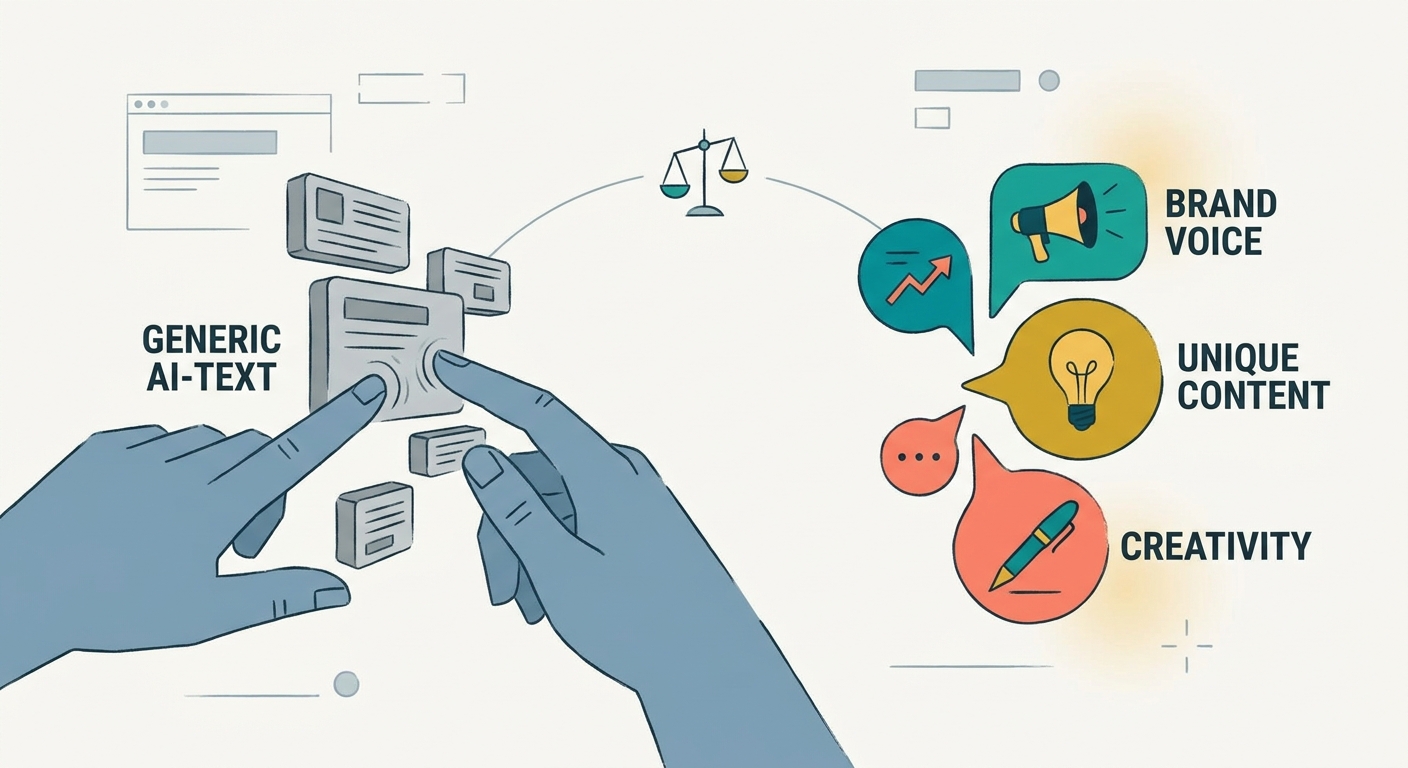
Learn how to scale your social media presence using the 70/30 automation rule to maintain your brand voice while leveraging AI for efficiency.
Social9 schedules your posts on 11 networks, and Autopilot can draft them in your brand voice for you to approve. Start on the free plan.
We use strictly necessary cookies to run this site. With your permission, we also use analytics cookies to understand how the site is used. We never use advertising cookies. See our Cookie Policy.