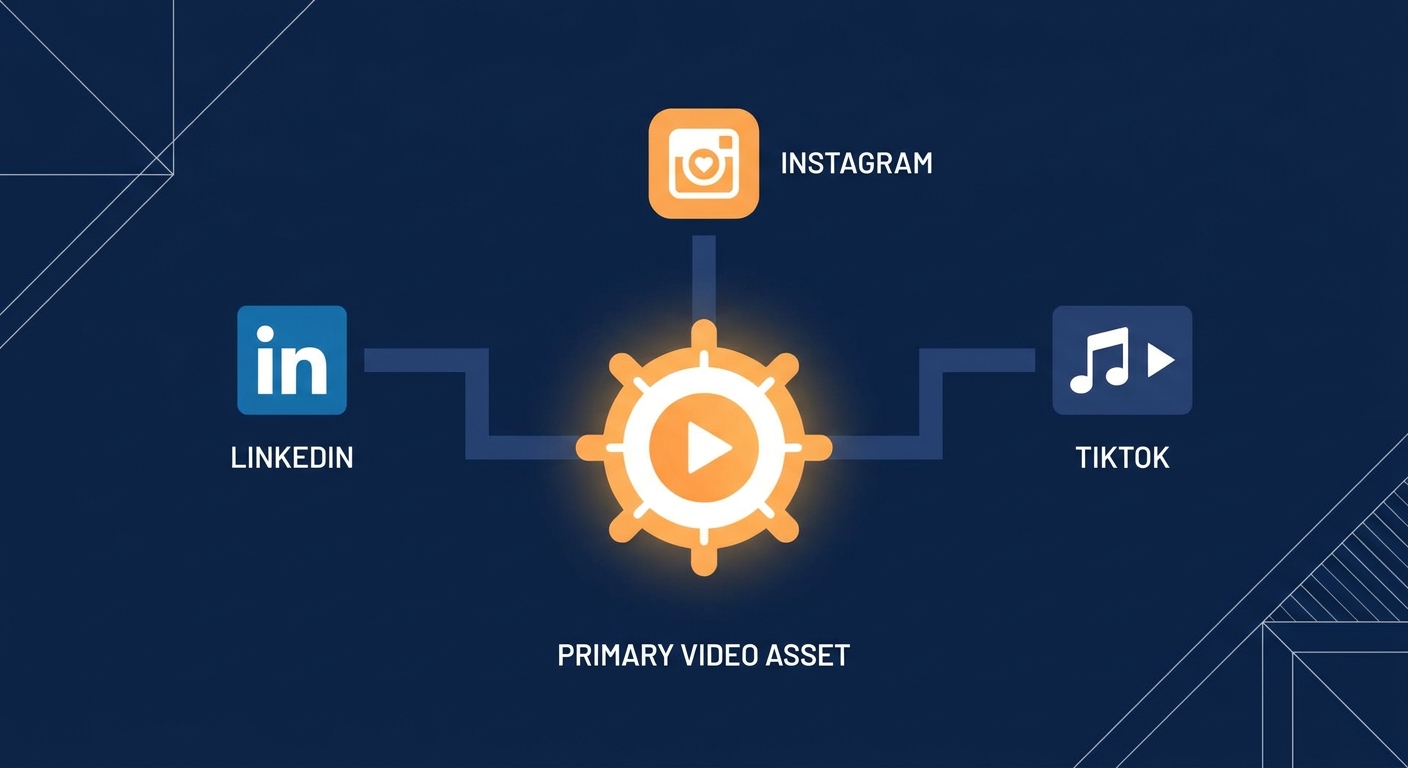
The "one-size-fits-all" approach to social media isn't just outdated; it’s a death sentence for your engagement. If you’re still blasting the exact same video file across TikTok, Instagram Reels, and LinkedIn, stop. You aren’t being efficient. You’re training your audience to ignore you.
In today’s digital noise, the brands that actually move the needle are the ones using the "Core-to-Satellite" model. Think of it as a hub-and-spoke system: one high-value anchor asset serves as the DNA for everything else you post. By stripping that pillar down into native modules, you aren't just spamming feeds—you’re meeting users where they live. Data from the Wyzowl 2024 Video Marketing Statistics shows that this kind of tailored approach can boost conversion rates by up to 73%.
It’s not about doing more. It’s about doing better.
Audiences aren't a monolith. They’re humans in different moods.
When someone is doom-scrolling Reels, they’re in Discovery Mode. They want entertainment, a quick hit of dopamine, and something visually arresting. When that same person jumps over to LinkedIn, they switch to Utility Mode. They’re looking for professional leverage, peer validation, and industry insights that help them do their jobs better.
If you treat LinkedIn like a billboard for your Instagram memes, you lose credibility. Fast.
Platforms are getting smarter, too. Algorithms now sniff out lazy, cross-posted duplicates and bury them. They prioritize "Native Premium" content—stuff that feels like it was born on the platform. As noted in the Sprout Social Social Media Trends 2026 report, your success depends on respecting the "psychological contract" you have with your followers. Break that contract, and you’re invisible.
Building Your "Core-to-Satellite" Workflow
Scaling without burning out requires a single source of truth. We call this the Pillar Strategy. Every campaign starts with one "Pillar Asset"—a deep-dive video, a whitepaper, or a podcast episode. You can see how we structure these foundations in our Content Strategy Guide.
Once your pillar is set, you use the Deconstruction Matrix. You aren't creating new content from scratch; you’re chopping up your master asset into, say, a LinkedIn carousel, a 30-second Reel, or a newsletter blast.
graph TD
    Pillar[Pillar Asset: Blog/Video] --> Sat1[LinkedIn Carousel]
    Pillar --> Sat2[Reels/Shorts]
    Pillar --> Sat3[Newsletter Snippet]
    Pillar --> Sat4[Professional Hook/Text Post]
Stop viewing your content as a finished sculpture. View it as a set of Legos. Each piece serves a specific purpose, but they all belong to the same structure.
The Hook Shift: Adapting to Intent
Your hook is your make-or-break variable.
On Reels, you have 1.5 seconds to stop the scroll. Forget professional polish; go for raw, high-energy, and visually stimulating. Use text overlays that punch. Be human.
On LinkedIn, the game changes. Your audience here isn't looking for a quick thrill. They’re looking for a return on their time (ROT). A LinkedIn hook needs to promise a specific takeaway or a sharp, counter-intuitive insight. When you pull a technical point from a video, strip the jargon and answer the only question that matters: Why should this professional care?
Scaling with AI (Without Losing Your Soul)
AI is a hell of an engine, but don't let it take the wheel.
Use it for the heavy lifting—transcribing, timestamping, and drafting the rough skeletons. Then, step in and provide the "human polish." No AI can replicate your brand’s specific nuance or your industry expertise. Check out these AI Tools for Marketers to streamline the process, but always keep a human in the loop.
sequenceDiagram
    participant Raw as Raw Video
    participant AI as AI Engine
    participant Human as Human Editor
    participant Pub as Platform Publishing

    Raw->>AI: Transcription & Segmentation
    AI->>Human: Drafted Content Modules
    Human->>Human: Refinement & Contextualization
    Human->>Pub: Multi-Platform Distribution
Let the AI handle the mechanical drudgery of cutting and transcribing. Your creative team should be spending their energy on the "last mile"—the tone, the edge, and the strategic value.
Let’s say you’re a B2B software firm launching a 20-minute whitepaper on supply chain automation. A dry PDF is just a digital paperweight. Don't let it die.
Instead, turn it into:
- A LinkedIn Carousel: 10 slides that break down the core findings. High dwell time, high shareability.
- A Series of Reels: Three 45-second clips featuring an SME talking about the most controversial stat in the report. Keep it mobile-first and punchy.
- A Newsletter Snippet: A short, punchy email with a killer hook that drives traffic back to the full report.
You want the long-form pillar to feel authoritative and polished. You want the social snippets to feel like a conversation. That contrast is where your brand identity lives.
Measuring What Actually Matters
Stop obsessing over "Likes." They’re vanity metrics. They feel good, but they don't pay the bills.
Measure your success by Click-Through Rate (CTR) and conversions. Are people going to your website? Are they joining your list? Look at the aggregate ROI of your satellite pieces. If your LinkedIn carousel is driving 500 high-intent visitors to your site every week, you’re winning—even if the post didn't go "viral." Use LinkedIn Content Marketing Best Practices as your benchmark to see if you’re actually moving the needle against industry standards.
Frequently Asked Questions
Should I post the exact same content on all platforms?
No. While your core message should remain consistent, the format, tone, and hook must be adapted to meet the unique expectations of the platform's audience. A LinkedIn user expects professional depth, while an Instagram user expects visual storytelling.
How do I maintain brand voice across different platforms while staying native?
Develop a core brand style guide that outlines your values and key vocabulary. Within that framework, allow for "tonal flexibility"—be more formal and data-driven on LinkedIn, and more conversational, punchy, and human on social video platforms.
How much time should I spend repurposing vs. creating original content?
A healthy balance is roughly 80% repurposing high-performing core assets and 20% original experimentation. This allows you to scale your output while still testing new formats and ideas.
Focus on CTR and conversion to your owned channels. These metrics indicate that your content is effectively moving the audience from "passive observer" to "active lead."
How do I balance high-production video with raw mobile-first content?
Treat high-production assets as your "Pillar" content (the source of truth) and raw mobile content as the "Satellite" assets (the entry point). The raw content builds trust and authenticity, while the high-production content establishes authority and provides value.
 Alex ChenAI Content Strategist