Your brand is currently having an identity crisis. You might not see it, but your customers definitely do.
If you’re copy-pasting the same LinkedIn post onto Instagram, or treating your email newsletter like a glorified blog dump, you’re missing the point. You aren’t being "consistent"; you’re being lazy. And in a digital ecosystem that moves at light speed, laziness is a death sentence for your brand authority.
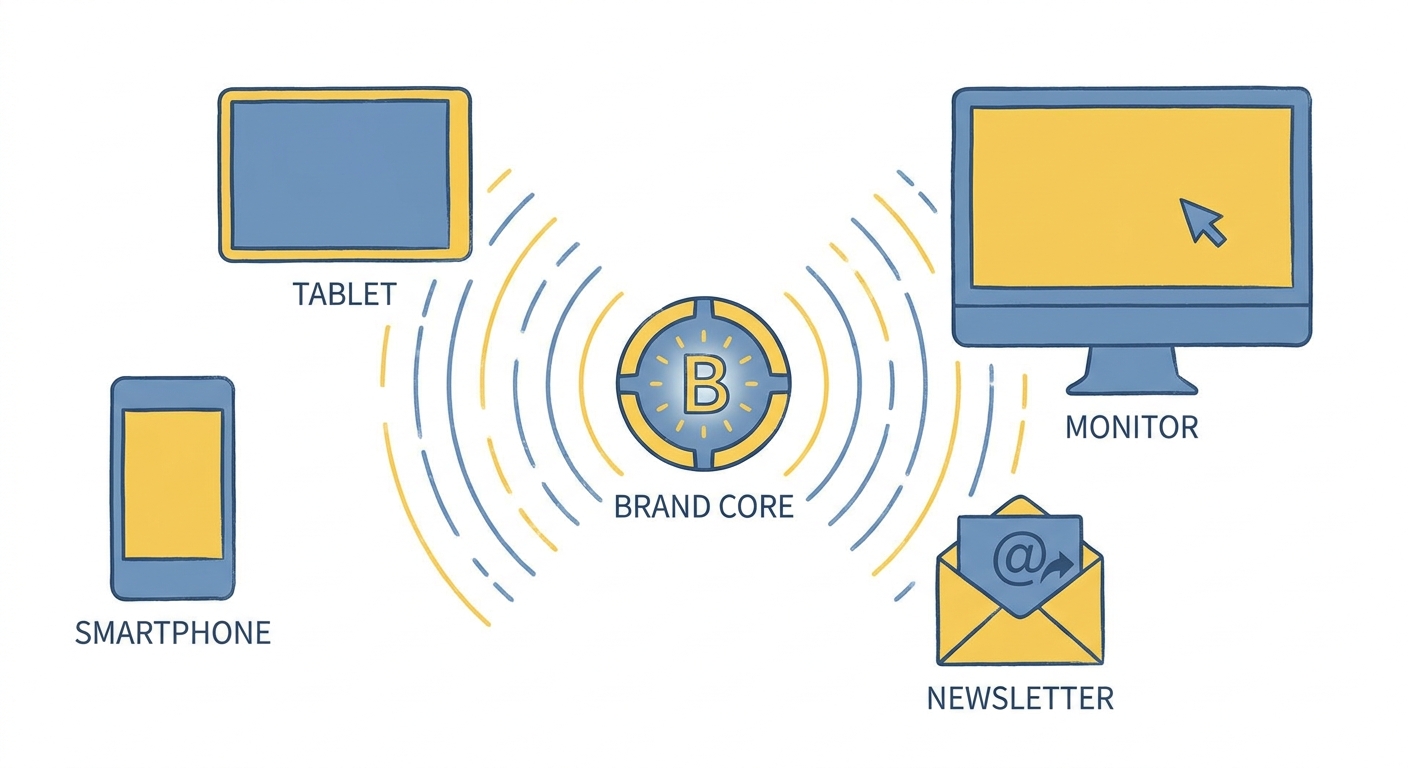
True consistency isn't about using the same logo or the same color hex codes. It’s about translation. It’s about taking the core "soul" of your message and adapting it so that it actually lands in the specific environment where your audience is hanging out.
The Myth of "One Size Fits All"
We’ve all been told that "omnichannel" is the holy grail. But somewhere along the way, marketing teams confused "omnichannel" with "omni-identical."
When you shove the exact same content into every corner of the internet, you’re treating your audience like a monolith. You’re assuming that the person scrolling through TikTok with a five-second attention span wants the same experience as the person sitting down with a cup of coffee to read a deep-dive industry report on Substack.
They don’t.
If you want to win, you have to stop broadcasting and start communicating. This means respecting the context of the platform. A tweet is a whisper. A white paper is a lecture. A video is a conversation. If you try to turn a whisper into a lecture, nobody is going to listen.
Why Your Brand Feels Stale
Ever feel like your engagement is flatlining? It’s not the algorithm. It’s the repetition. When your audience sees the same voice, the same structure, and the same tired hooks across every single touchpoint, they eventually suffer from "brand blindness." They stop seeing your content as valuable information and start seeing it as background noise.
You need to disrupt that rhythm.
Adaptation doesn’t mean changing your values. It means changing your delivery. It means understanding that on Twitter, you need to be punchy, contrarian, and quick. On LinkedIn, you need to be insightful, professional, and slightly vulnerable.
Are you actually speaking to people, or are you just talking at them?
The Framework: Adapt, Don't Recreate
You don’t have to reinvent the wheel every time you sit down to write. That’s the beauty of a content pillar strategy. You can take one "Big Rock" piece of content—a massive guide, a podcast episode, or a webinar—and shatter it into a dozen different formats.
But here is the secret: You have to rewrite, not just repurpose.
If you’re taking a 2,000-word article and trying to squeeze it into an Instagram carousel, don’t just take screenshots of the text. Pull out the one core insight. Make it a single, sharp visual. Let the image do the heavy lifting.
If you’re turning a video into a newsletter, don't just provide a transcript. Write the story of the video. Give your subscribers the behind-the-scenes context that the YouTube audience didn't get.
The Psychology of Context
Why does this matter? Because of trust.
When a brand meets me where I am, I trust them. If I see a brand that understands the vibe of the platform I’m on, I assume they understand their industry, too. It’s a subtle signal of competence.
Conversely, when a brand looks like it’s being run by a bot—posting the same corporate-speak drivel across every channel—I tune out. It feels robotic. It feels cheap. And in 2024, if you feel cheap, you are cheap.
How to Start Auditing Your Presence
Take a look at your last five posts on three different platforms. Ask yourself these three questions:
- If I moved this post to another platform, would it feel out of place? (If the answer is no, you’re being too generic.)
- Does this post provide value on its own, or is it just a teaser for something else? (If it’s just a teaser, you’re asking for a favor before you’ve earned the right to ask.)
- Does the "voice" sound like a human person who actually cares, or does it sound like a press release?
If your content sounds like a press release, burn it. Start over.
The Future is Adaptive
We are entering an era where AI can generate infinite amounts of "content." That means the value of generic, middle-of-the-road content is plummeting toward zero.
The only things that will hold value are perspective, personality, and context.
If you want to stand out, you have to be more than a content mill. You have to be a curator of your own brand voice. You have to be willing to break the "rules" of professional writing if it means being more authentic. You have to risk being a little bit weird, a little bit bold, and a lot more human.
Stop worrying about being "consistent" in the way your brand guidelines told you to be in 2015. Start worrying about being relevant.
Consistency is a trap. Relevance is a superpower.
So, what are you going to do differently tomorrow? Are you going to keep churning out the same digital sludge, or are you going to start talking to your audience like they’re actually people?
The choice is yours. Just don't blame the algorithm when your audience stops caring. They didn't leave you. You left them behind a long time ago.
 Jessica ThompsonBrand Strategy & Community Expert