What is social media autopilot? How AI posting works (and where to keep a human)
Social media autopilot uses AI to plan, draft, schedule and publish posts. Learn how the loop works, platform AI rules, and where a human must stay in charge.
Autopilot & AI
Learn how to scale social media content using AI without sacrificing your brand's unique voice. Master the 'Human-in-the-Loop' framework for authentic engagement. Jessica ThompsonBrand Strategy & Community ExpertPublished 6 min read
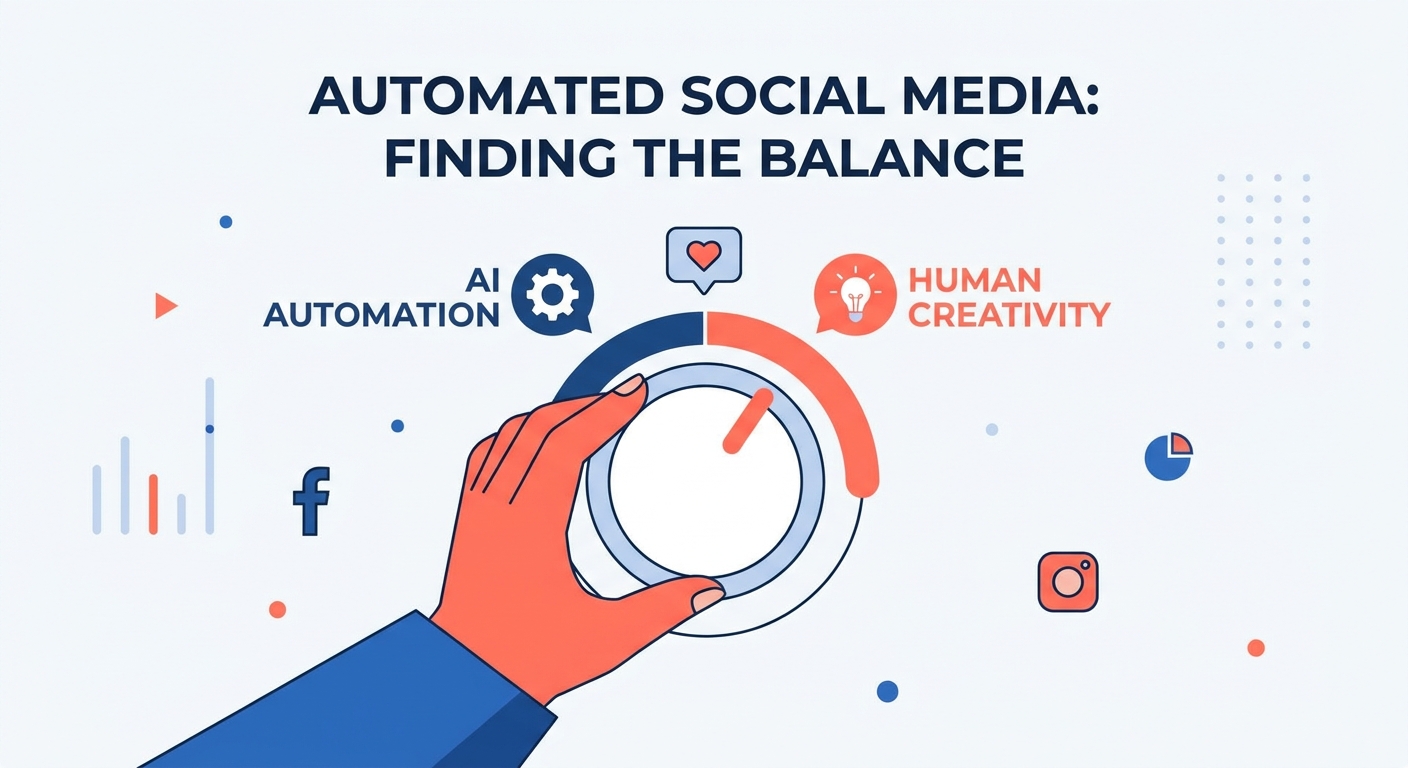
Scaling your social presence in 2026 isn't a numbers game. It’s not about how many posts you can vomit into the feed per hour. It’s about how many of those posts actually feel like they were written by a living, breathing human who understands the room.
The era of the rigid, month-long content calendar is dead. It’s been replaced by the chaotic, high-velocity world of "fastvertising." If you’re still relying on raw, unrefined AI output to fill your feed, you aren't building a brand—you’re shouting into the void with a megaphone that sounds like a dial-up modem.
The secret to surviving this shift? Stop choosing between speed and soul. You need a "Human-in-the-Loop" (HITL) framework. Think of automation as your engine, but keep human intuition firmly in the driver’s seat.
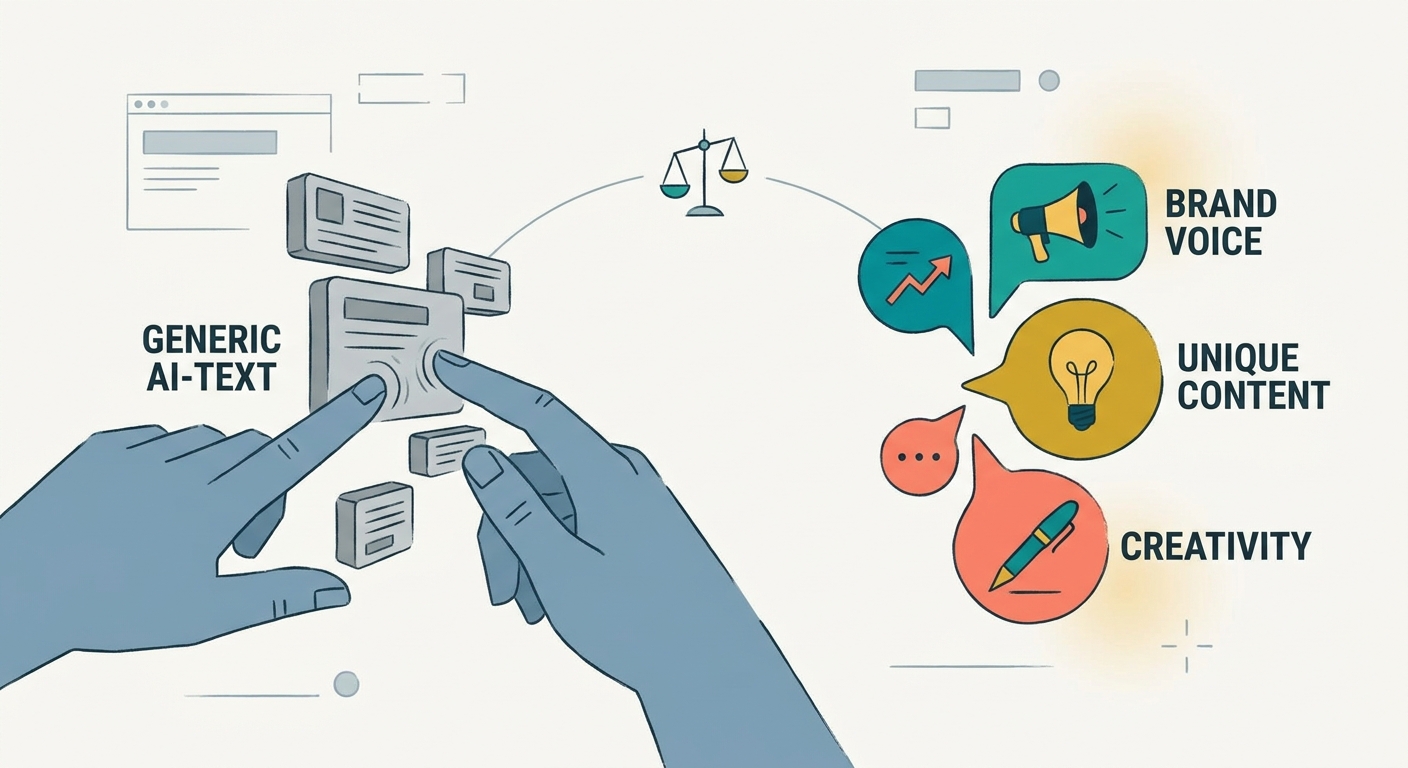
The "Authenticity Gap" is widening. Audiences have developed a sixth sense for the sterile, perfectly balanced, and suspiciously upbeat tone of generative AI. When your social feed looks like a brochure written by a committee of robots, you aren't building a community. You’re building a wall.
According to Hootsuite’s 2026 Social Trends report, the most successful brands are leaning into "intentional imperfection." This means letting the occasional off-beat sentence slip through. It means using a rhythm that feels like a text message from a friend rather than a press release from a corporation.
The real danger here is the "robotic feedback loop." When you feed AI content back into AI, the nuances vanish, leaving behind a bland slurry of corporate buzzwords. If your captions are consistently 150 characters, feature the same emoji patterns, and never express a controversial or distinct opinion, you’re signaling that you don't care enough to show up. A brand without a pulse is just noise. And in a crowded social marketplace, noise is the first thing people learn to mute.
You can’t expect a tool to replicate your brand if you haven't defined what your brand sounds like when it’s not being "professional." Most companies make the mistake of giving AI adjectives like "friendly," "authoritative," or "innovative."
These are useless. They are far too broad to translate into actual syntax.
To truly scale, you need a "Humanity Score" for your content. This involves building a system prompt that mandates specific linguistic behaviors. When you develop your Brand Voice Guide, go beyond adjectives. Define your cadence. Do you use short, punchy sentences? Do you use parentheticals to add "asides"? What is your stance on Oxford commas or conversational fillers?
A robust system prompt should look like this:
The goal of automation is to handle the heavy lifting—research, formatting, initial drafting—so your creative team can spend their time on the "vibe check." The HITL process acts as the ultimate filter between your brand’s intent and the public’s perception.
graph TD
    A[AI Research & Drafting] --> B[Human Vibe Check & Edits]
    B --> C[Compliance & Brand Voice Audit]
    C --> D[Automated Distribution]
    D --> E[Analytics Loop]
    E -- Feedback/Optimization --> A
In this pipeline, the AI acts as your junior researcher. It scans trends, pulls data points, and drafts the skeleton. The human editor then steps in to inject the "soul." This is where you adjust the tone to match current cultural moods, add a personal anecdote, or hack away the parts of the AI draft that sound too "perfect." By the time it hits the compliance and brand voice audit, the content has been vetted for both accuracy and emotional resonance.
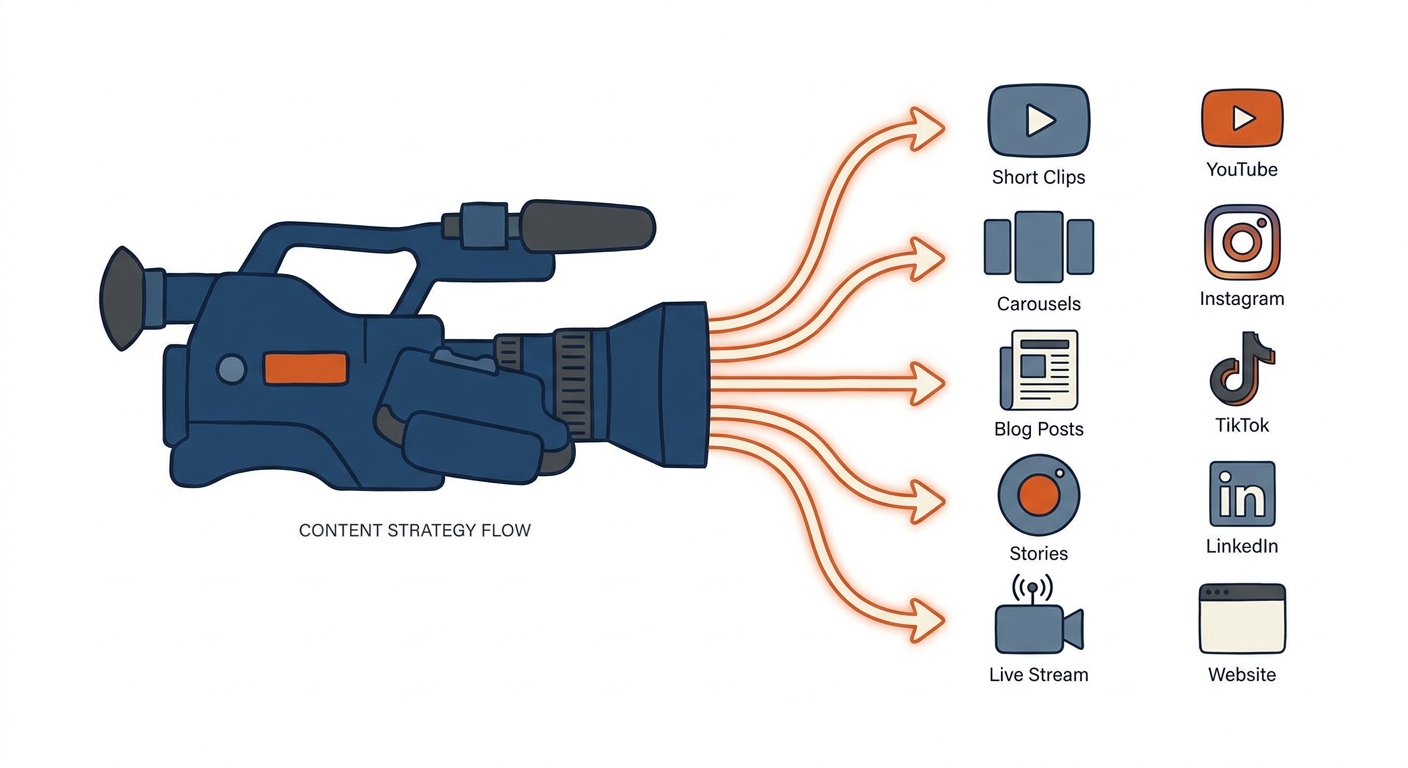
Scaling is about repurposing, not just repeating. Take one high-quality, human-authored deep dive—a white paper, a long-form video, or a thoughtful LinkedIn essay—and use it as the "source of truth."
AI can then take that singular piece of human-led intelligence and atomize it into 20+ social variants tailored for different platforms. As noted by Robotic Marketer, the key is to ensure the AI isn't just summarizing, but re-contextualizing the core message for the specific audience of each channel.
Furthermore, empower your team through employee advocacy. Instead of forcing employees to share sterile corporate posts, provide them with templates that include the "bones" of the message but allow them to inject their own professional perspective. When your people share content that sounds like them, your brand becomes a network of humans rather than a faceless entity.
The way we discover content has fundamentally shifted. Social platforms are search engines. When a user searches for "best sustainable packaging," they aren't looking for a hashtag-stuffed image; they are looking for a video or a carousel that provides a direct answer.
This means your automated captions must be optimized for semantic SEO. Stop worrying about whether your hashtags are "trending" and start worrying about whether your caption contains the keywords that address the actual search intent of your audience. If you are using automation to generate these captions, ensure your system prompt prioritizes natural language, clarity, and keyword density. If your metadata doesn't answer the user's question, the algorithm won't care how "automated" or "consistent" your posting schedule is.
"Fastvertising" is the art of moving at the speed of culture. It is dangerous, high-stakes, and essential. To manage it, you need "guardrails." These are pre-approved brand assets, tone-guidelines, and "no-go zones" that your team and your AI tools are strictly forbidden from crossing.
When cultural shifts happen—and they happen fast—you need a "kill switch" for your automated schedule. Never let an AI post to your channels without a human having eyes on it during periods of heightened social sensitivity. As explored in Deloitte’s insights on the future of media, the rise of micro-dramas and rapid-response content requires a nimble team that can pivot in minutes. If you aren't prepared to pause your automation, you aren't prepared to play in the modern social arena.
If you are still measuring success by "likes," you are missing the point of automation. Likes are vanity; community engagement and first-party data are sanity.
Audit your automated posts by asking: Are these posts driving comments that spark a conversation? Are they leading users to your owned platforms? If your automation is just generating noise, it’s not an asset—it’s a liability. Use your analytics loop to identify which "voice" parameters are actually driving engagement. If you find that your "intentional imperfection" posts are outperforming your "polished" posts by a factor of three, then you have your answer: drop the polish and double down on the human.
Focus on injecting "intentional imperfection"—varying sentence structure, using conversational fillers, and ensuring the prompt dictates a specific, non-corporate persona that reflects how your team actually speaks.
It is the mandatory gatekeeping stage where a human reviews, edits, and approves AI-generated drafts to ensure cultural context and brand alignment are accurate before publication, preventing tone-deaf or inaccurate content from reaching your audience.
Centralize your brand voice parameters in a "Master Voice Bible" prompt that is used across all tools, ensuring uniform vocabulary and tone settings regardless of the specific AI application you are using.
Algorithms prioritize "engagement" and "value." If content is generic, repetitive, or "robotic," it receives less reach; if it is optimized for search and provides community value, the origin matters less than the resonance.
Create a "Fastvertising" template library that includes pre-approved brand voice guardrails, allowing creators to pivot quickly while staying within the defined brand identity and maintaining a human-led approval process for high-risk content.
Social media autopilot uses AI to plan, draft, schedule and publish posts. Learn how the loop works, platform AI rules, and where a human must stay in charge.
Learn how to scale your social media presence using the 70/30 automation rule to maintain your brand voice while leveraging AI for efficiency.
Stop manual editing. Learn how to use AI-driven content repurposing tools to transform one long-form video into a month of high-intent social media posts.
Social9 schedules your posts on 11 networks, and Autopilot can draft them in your brand voice for you to approve. Start on the free plan.
We use strictly necessary cookies to run this site. With your permission, we also use analytics cookies to understand how the site is used. We never use advertising cookies. See our Cookie Policy.