What is social media autopilot? How AI posting works (and where to keep a human)
Social media autopilot uses AI to plan, draft, schedule and publish posts. Learn how the loop works, platform AI rules, and where a human must stay in charge.
Autopilot & AI
Stop manual drafting. Discover how AI-powered content creation and agentic workflows boost efficiency, scale production, and drive strategic marketing results. David KimAI EngineerPublished 5 min read
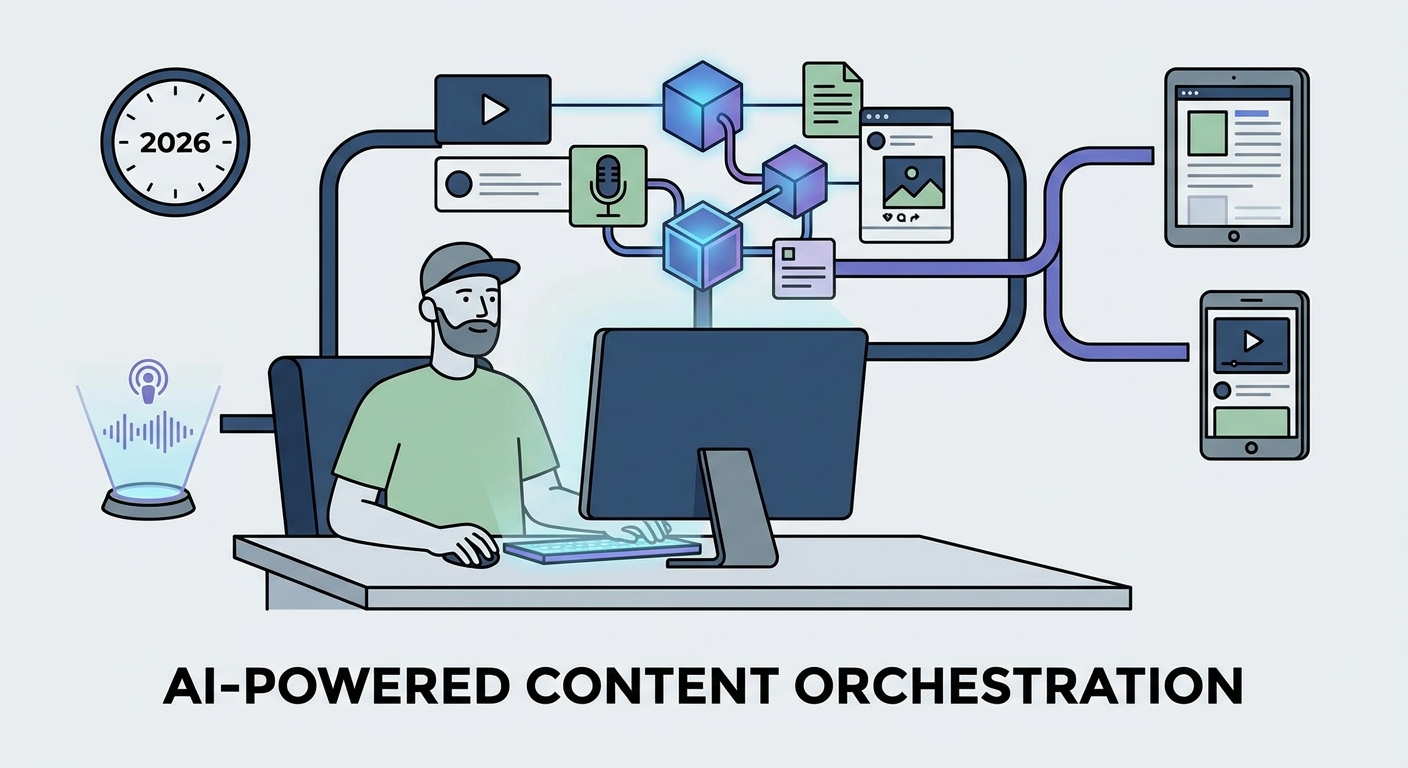
Content creation in 2026 isn't a typing race. It’s a game of orchestration. If you’re still measuring success by how many words your team can hammer out in an hour, you’re already behind. The novelty of chatbots has worn off, and we’ve entered the age of operational necessity. AI-powered content creation is no longer a "nice to have"—it’s the baseline for survival in a digital landscape that feels more crowded by the minute.
Consider this: the AI-powered content creation market is projected to reach $8.28 billion by 2030. If you’re ignoring this shift, you aren’t just being "cautious." You’re voluntarily handing your market share to competitors who have already automated the grunt work of their editorial pipelines.
We’ve moved past the "prompt-and-copy" phase. You know the one: you ask a chatbot for a paragraph, it spits out something bland, and you tweak it until it’s barely passable. That’s manual labor with extra steps.
We are now in the era of "Agentic Workflows."
In this model, you aren't just using a tool; you’re deploying an autonomous agent. These systems don’t just write. They research. They analyze search intent. They draft. They even package assets for your social channels. This transition is, without a doubt, one of the most critical strategic shifts in AI adoption for any modern marketing department.
An agentic workflow isn't about replacing your team’s brains. It’s about offloading the cognitive tax of routine production. When an agent handles the heavy lifting—the data synthesis, the outlining, the initial structuring—your writers stop being laborers. They stop suffering from "blank page syndrome." They become architects. They spend their time on what actually moves the needle: narrative structure, emotional resonance, and high-level strategy.
Let’s be honest. The move to AI isn't about vanity or keeping up with tech trends. It’s about the bottom line. Recent industry statistics show that generative models have fundamentally rewritten the economics of content.
Scaling used to be expensive. You wanted more content? You hired more writers, more editors, more SEO specialists. Your operational costs ballooned right alongside your output.
AI changes that math. Now, you can scale output by an order of magnitude without tripling your headcount. You can maintain a consistent, high-quality cadence across your newsletters, blogs, and social platforms while your human team focuses on the strategy that makes that content actually work.
The old way of doing SEO was a guessing game. You’d target a keyword and hope for the best. That’s dead.
AI-powered tools now offer "predictive SEO." Before a single word is written, these systems analyze search intent, map out content gaps, and dissect the competitive landscape. They tell you exactly what your audience is asking. By aligning your content with these data-backed insights, you aren't just throwing spaghetti at the wall—you’re ensuring that every asset you produce has a genuine chance of ranking and, more importantly, providing real utility to your reader.
When you stop paying for hundreds of hours of manual drafting, your budget shifts. You stop paying for "typing" and start investing in senior strategists. You’re trading a team that’s constantly in "react mode" for a team that drives a proactive, data-informed strategy.
There’s a pervasive fear that AI will turn every brand into a robotic echo chamber. And honestly? It will—if you treat it like a "set it and forget it" tool.
The antidote is the "Human-in-the-Loop" standard. AI is a world-class generator of raw material, but it lacks the lived experience and cultural context that gives your brand its pulse. Your editorial team is the final gatekeeper. They inject the intuition. They provide the emotional resonance. When you maintain brand voice with AI, you aren't just playing spellcheck. You’re ensuring the output aligns with your company’s values. Use AI for the structure of the argument; use the human for the soul of the narrative.
To win, you have to stop viewing AI as a piece of software and start viewing it as a cog in your engine. Here is how the modern, efficient content cycle actually works:
graph TD
    subgraph AI_Automated_Tasks [AI-Automated Tasks]
        A[1. Predictive SEO Analysis] --> B[2. AI-Driven Briefing]
        B --> C[3. Agentic Drafting]
    end

    subgraph Human_Led_Decision_Points [Human-Led Decision Points]
        C --> D{4. Human Editorial Review}
        D -- Approved --> E[5. Multi-channel Distribution]
        D -- Needs Revision --> C
    end

    style AI_Automated_Tasks fill:#f9f9f9,stroke:#333,stroke-width:2px
    style Human_Led_Decision_Points fill:#e1f5fe,stroke:#0277bd,stroke-width:2px
Don’t buy a tool and hope for the best. That’s how you get mediocre content, just faster. To build a scalable content framework, you need standards.
The biggest hurdle? "AI hallucinations." Sometimes, these models present total nonsense with absolute authority. This is why your editorial process must be rigorous. Every AI-generated piece needs a verification phase. Check the citations. Cross-reference the data. Audit the tone. Never trust the first draft blindly. Treat it like a high-quality intern’s work: it’s impressive, but it needs a mentor’s review before it ever sees the public.
The ROI is simple: time saved and performance gained. If your team saves 15 hours a week on research and formatting, that’s 15 hours of high-level strategy added back to your calendar. Combine that with the increased search visibility from predictive SEO, and the math starts to look very, very good.
Future-proofing your strategy isn't about knowing everything today. It’s about acknowledging that these tools are evolving. If you’re comfortable with an agentic workflow now, you’ll be in the driver’s seat when the next wave of tools hits. If you’re still struggling to get a chatbot to write a decent email, you’re already falling behind.
No. Search engines like Google focus on the helpfulness and expertise of the content, not the origin. If the content is high-quality, accurate, and provides value to the reader, it will perform well regardless of whether it was assisted by AI or written entirely by a human.
Focus on prompt engineering that emphasizes your specific style guide, including tone, vocabulary, and sentence structure preferences. Most importantly, ensure a human editor performs a final pass to inject idiomatic expressions and unique brand perspectives that a model might overlook.
An AI tool requires manual input for every step (e.g., "write this section"). An AI agent is autonomous; it can be given a goal (e.g., "research, draft, and format a blog post on X") and it will execute the sequence of tasks required to achieve that goal with minimal oversight.
AI will replace content laborers—those who focus solely on high-volume, low-value writing. It will not replace content strategists and creative thinkers. The future belongs to the "AI-augmented professional" who uses technology to amplify their unique human creativity.
The most critical step is creating a centralized repository of your brand guidelines and "source of truth" documentation that the AI can reference during every drafting session. Consistency is a byproduct of clear, documented constraints.
Social media autopilot uses AI to plan, draft, schedule and publish posts. Learn how the loop works, platform AI rules, and where a human must stay in charge.
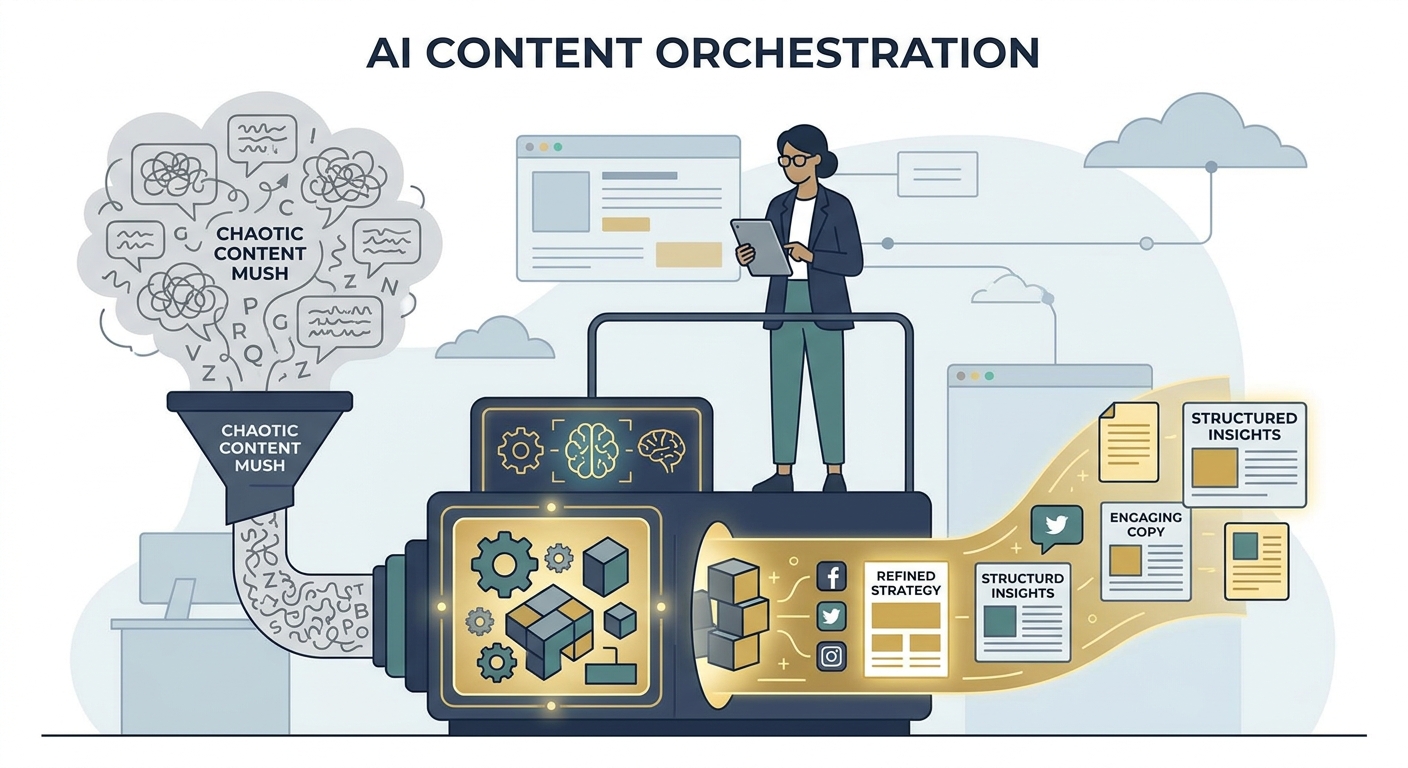
Stop 'prompting and praying.' Learn how to master agentic workflows and human-centric AI strategies to scale your content marketing efforts in 2026.

Stop churning out generic AI fluff. Learn how to build a full-stack content workflow that scales your unique human expertise and builds reader authority.
Social9 schedules your posts on 11 networks, and Autopilot can draft them in your brand voice for you to approve. Start on the free plan.
We use strictly necessary cookies to run this site. With your permission, we also use analytics cookies to understand how the site is used. We never use advertising cookies. See our Cookie Policy.