What is social media autopilot? How AI posting works (and where to keep a human)
Social media autopilot uses AI to plan, draft, schedule and publish posts. Learn how the loop works, platform AI rules, and where a human must stay in charge.
Autopilot & AI
Stop the volume-first grind. Learn how to use AI for content repurposing to build resonance and drive high-intent engagement through a human-centric framework. Nikita ShekhawatSocial Media Growth ExpertPublished 6 min read
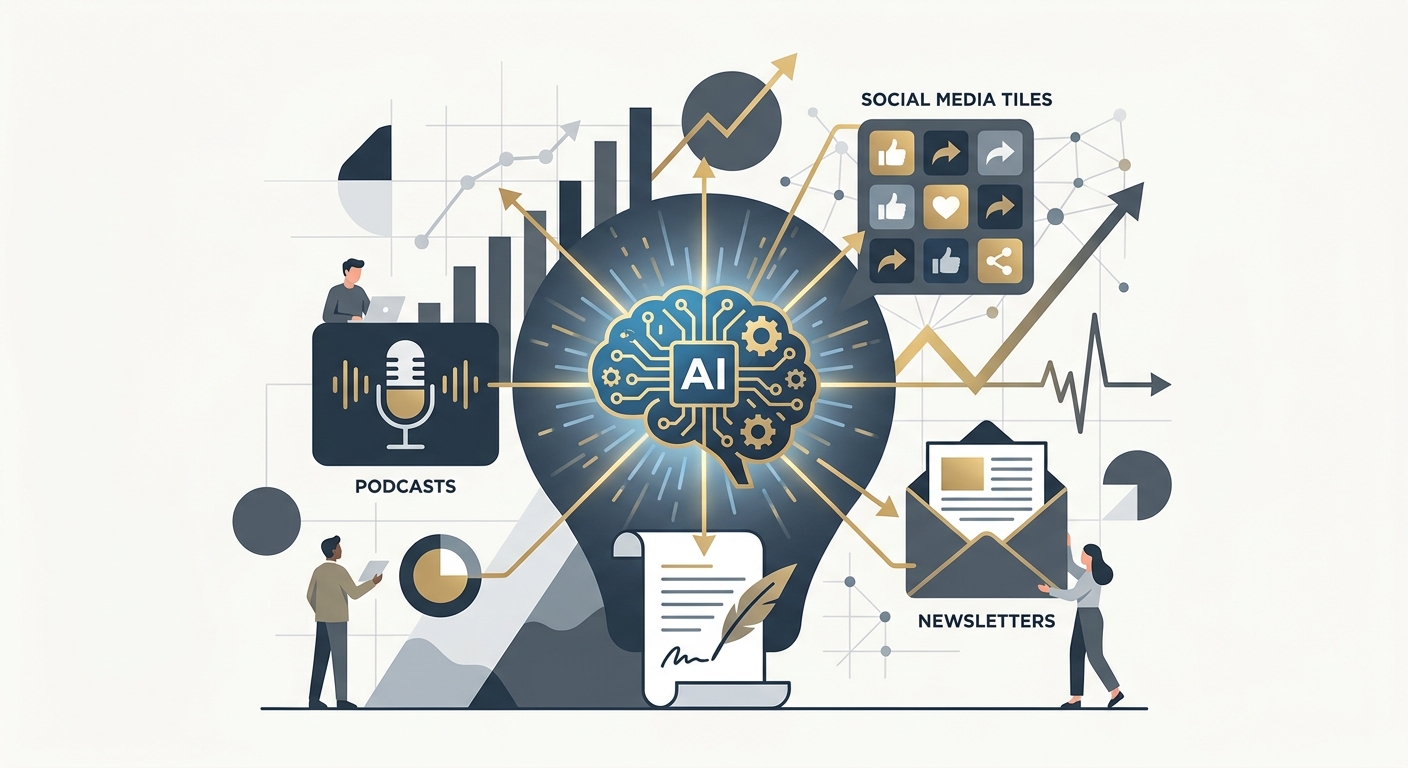
Digital growth isn't about cranking out more noise. It’s about squeezing more meaning out of the work you’ve already done. We are finally dragging ourselves out of the "content factory" era—that frantic, volume-obsessed grind that defined 2024—and stepping into the age of resonance.
If you’re still trying to win by flooding the zone with generic, algorithm-chasing drivel, stop. You aren’t building an audience. You’re building a graveyard of unread posts. The brands that actually matter in 2026 quit the volume-first game long ago. They’ve adopted a "Human-in-the-Loop" framework, using AI not as a replacement for their intellect, but as a megaphone for their unique perspective. This is how you reclaim your time, sharpen your voice, and turn one high-value asset into a month’s worth of high-intent engagement.
For years, the industry preached that "consistency is king." All that did was turn insight into a commodity. If you dig into the 2026 Digital Engagement Benchmarks, the message is loud and clear: reach is a vanity metric that has completely decoupled from actual business impact.
Audiences have developed a sixth sense for AI-generated filler. They can smell it a mile away. When every brand sounds like a sanitized, middle-management version of a chatbot, standing out requires a sharp pivot back to the unfiltered, the anecdotal, and the messy reality of being human.
This is the "Authenticity Paradox." In a world drowning in synthetic content, the smartest way to use AI is to delegate the boring, heavy lifting of structuring so you can pour your limited human energy into the nuances that actually move the needle. You don’t need more content. You need more resonance.
The massive shift toward human-centric marketing isn't just a trend; it's a survival mechanism. People are exhausted. When you stop writing for a bot and start writing for the human on the other side of the screen, your metrics shift from "likes"—which mean absolutely nothing—to real, tangible interaction.
Human-first content wins because it carries the weight of lived experience. Sure, an AI can summarize a trend. But it cannot share the scar tissue of a failed project, the frustration of a missed deadline, or the specific, weird joy of a hard-won victory. When you leverage AI to handle the data synthesis, you’re free to insert the "human-in-the-loop" checkpoints that define your brand’s personality. This isn't just a stylistic choice. It’s a strategic imperative.
The "Repurposing Waterfall" is your antidote to the content treadmill. Stop trying to reinvent the wheel every single morning. Instead, pour your best creative energy into a "Hero Asset"—a deep-dive webinar, a long-form essay, or an episodic podcast. That one piece of intellectual property becomes your source of truth for every other channel.
The cascade is simple, but it demands discipline:
By atomizing one strong idea into twenty micro-assets, you stay visible without ever having to stare down a blank page.
graph TD
    Hero[<b>Hero Asset</b><br/>Webinar/Long-form/Podcast] --> AI[AI Processing Engine]

    AI --> N[Newsletter]
    AI --> L[LinkedIn Narrative]
    AI --> V[Short-form Video Scripts]
    AI --> C[Community Engagement]

    N --> H1[Human-in-the-Loop: Edit & Polish]
    L --> H2[Human-in-the-Loop: Edit & Polish]
    V --> H3[Human-in-the-Loop: Edit & Polish]
    C --> H4[Human-in-the-Loop: Edit & Polish]

    H1 --> Publish[Publish to Channel]
    H2 --> Publish
    H3 --> Publish
    H4 --> Publish

    style Hero fill:#f9f9f9,stroke:#333
    style AI fill:#e1f5fe,stroke:#01579b
    style H1 fill:#fff3e0,stroke:#e65100
    style H2 fill:#fff3e0,stroke:#e65100
    style H3 fill:#fff3e0,stroke:#e65100
    style H4 fill:#fff3e0,stroke:#e65100
Many creators are terrified that AI will turn their brand into a bland, corporate echo chamber. That only happens if you treat AI as an "output engine" rather than an "editing assistant." If you want to scale your voice without losing your soul, you have to move beyond generic prompts.
Feed your best historical content—the stuff that actually got people to reply—into your AI workflow. Use it to train the model on your syntax, your favorite analogies, and your "raw" observations. Treat this as your comprehensive content strategy foundation. By giving the AI your "style DNA," you ensure the drafting phase actually sounds like you, leaving you to perform the final "human-in-the-loop" edit that adds the necessary warmth and imperfection.
The old school of thought was obsessed with the "Best Time to Post." Forget that. That’s a relic of a simpler time. The future is the "Audience Fingerprint." Your specific audience doesn't care about global industry averages; they care about their own chaotic routines.
By using AI social media workflows to analyze when your specific followers engage with high-intent content, you stop shouting into the void and start showing up exactly when your audience is ready to listen. It’s the difference between casting a net in the middle of the ocean and fishing in a stocked pond.
If you're still obsessing over likes, you’re playing a game that was rigged ten years ago. Growth in 2026 is measured in intent. We use AI tools to categorize audience feedback into three buckets: "Supportive," "Questioning," and "Converting."
When someone leaves a comment, an AI layer can analyze the sentiment and help you prioritize your response. A "Questioning" comment is a lead waiting to be nurtured. A "Converting" comment is a signal to move the conversation to a private channel. By focusing on these intent-based interactions, you transform your social media from a megaphone into a sales engine.
There is a strange, quiet power in being transparent about your process. In a world where everyone is hiding the fact that they use AI, we’ve found that acknowledging it—and showing the "behind-the-scenes" of how we use it to support, not replace, our thinking—builds radical trust.
When you disclose that your draft was assisted by AI, but your insights were forged in the fire of your own experience, you gain massive credibility. It shows you value the reader’s time enough to use efficiency, but you value their intelligence enough to provide genuine human insight. If you’re struggling to align your workflow, our content services are designed to help teams bridge that gap between automated efficiency and human-centric strategy.
Not if you follow the 80/20 rule. Use AI for 80% of the heavy lifting in drafting and structuring, but reserve 20% of your time to inject your own "soul"—the stories, the specific anecdotes, and the controversial opinions that no machine can replicate.
AI should be your drafting engine, and you should be the Creative Director. Never publish raw AI output. Use the machine to get the raw material onto the page, then perform a rigorous human edit to ensure the tone, context, and empathy are intact.
The "Set it and forget it" trap. Automating distribution without checking for context or cultural sensitivity is a recipe for brand damage. AI is a tool, not a strategy; if you stop paying attention to the final output, you are essentially outsourcing your brand's reputation to a black box.
AI helps with volume, but it can only help with engagement if you use it to identify patterns in what your audience actually cares about. AI is excellent at showing you what people are talking about, but it is up to the human to craft the hook that triggers genuine empathy.
Social media autopilot uses AI to plan, draft, schedule and publish posts. Learn how the loop works, platform AI rules, and where a human must stay in charge.
Discover how to leverage automated content repurposing workflows to maximize your content's reach and impact across all social media platforms using AI-powered tools.
Stop using AI as a typewriter. Learn to build agentic workflows that scale high-authority content and beat synthetic mediocrity in 2026.
Social9 schedules your posts on 11 networks, and Autopilot can draft them in your brand voice for you to approve. Start on the free plan.
We use strictly necessary cookies to run this site. With your permission, we also use analytics cookies to understand how the site is used. We never use advertising cookies. See our Cookie Policy.