How agencies manage 20+ client calendars without burning out
A playbook for agencies running 20+ client calendars: workspace setup, a capacity formula, a monthly cadence, approval SLAs, safe access and burnout rules.
Playbooks
Learn how social media marketers can win AI-powered search in 2026 using backlinks, authority signals, and citation monitoring. Emily RodriguezContent Marketing SpecialistPublished 7 min read
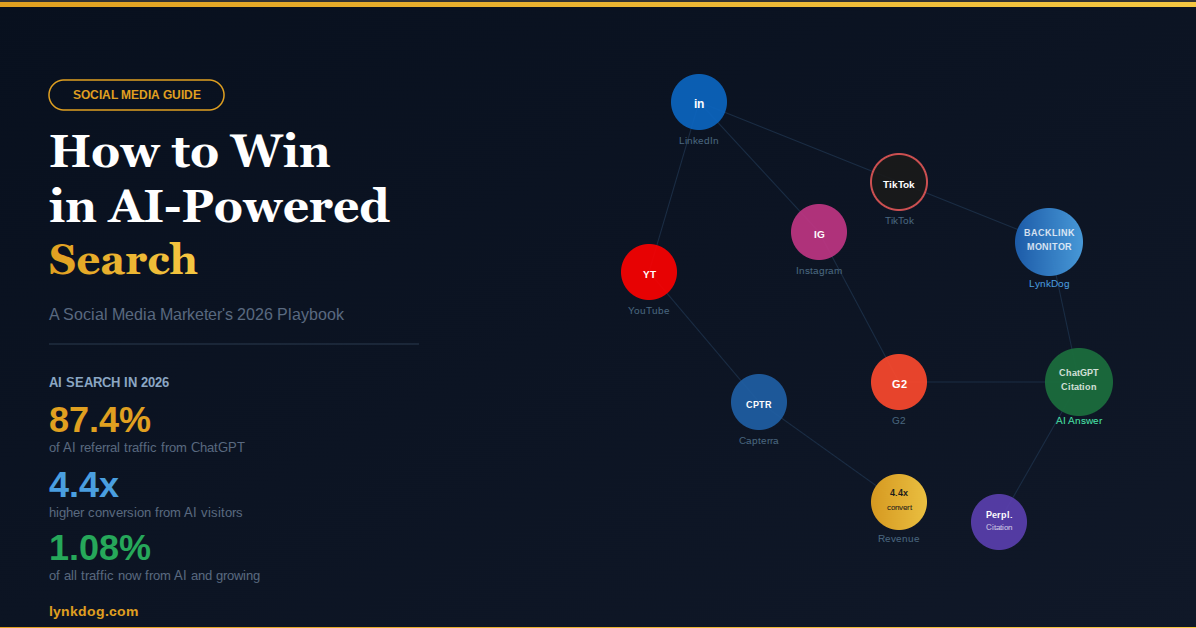
Social media marketers are sitting on an underutilized asset. The content you publish across LinkedIn, Instagram, TikTok, and YouTube does more than drive engagement. When it is distributed well, it generates authority signals that influence how brands rank in traditional search and, increasingly, whether those brands appear in AI-generated answers.
In 2026, AI search engines have become a primary discovery channel for B2B buyers. According to data published by Conductor and Superlines, AI referral traffic now accounts for 1.08% of all website traffic and is growing approximately 1% month over month. ChatGPT alone drives 87.4% of that traffic. Research from Semrush found that AI-driven visitors convert 4.4 times higher than standard organic visitors. For B2B social media teams, this is the channel where brand investment in 2026 generates outsized conversion returns.
The question is how a social media team influences AI search outcomes. The answer requires understanding how AI engines decide which brands to recommend, and what social media activity can do to strengthen those decisions.
AI search platforms do not use a simple ranking algorithm. They synthesize information from multiple sources, weight it against authority signals, and generate a recommendation. The authority signals they draw on include content quality, domain authority, third-party validation, and the breadth of a brand's digital footprint.
Third-party validation in the AI search context means backlinks from credible sources, review profiles on B2B platforms like G2 and Capterra, directory listings on aggregator sites, and brand mentions across publications, forums, and communities. Research from SE Ranking's study of 2.3 million pages found that referring domains carry a SHAP value of 1.21 for ChatGPT citations, making backlink authority roughly twice as important to ChatGPT's recommendation decisions as to Google AI Mode.
Social media marketing contributes to these authority signals in ways that are not always obvious to the social media teams generating them.
Strong social media content creates downstream effects that directly influence AI search visibility. Specifically, high-quality social content tends to:
Earn editorial backlinks from publications and industry blogs that reference the content, especially data-driven posts, original research, and strong point-of-view content that media outlets find worth citing
Drive traffic to the brand's G2, Capterra, Product Hunt, and directory profiles when campaigns direct audiences to leave reviews or engage with listings, improving the health and authority of those profiles
Generate brand mentions in community platforms like Reddit and LinkedIn communities that AI engines use as authority signals
Create the social proof and discussion volume that makes a brand appear frequently enough across the web to earn AI citation consideration
Each of these downstream effects strengthens the authority infrastructure that AI engines draw on when deciding whether to recommend a brand. The connection between social media activity and AI citation share is real, but it operates indirectly through the authority signals that social content helps generate.
Here is the critical challenge most social media teams are not thinking about. The authority signals that social campaigns help generate are not permanent. Backlinks decay. Directory listings go stale. Brand mentions lose relevance as platforms restructure their indexing. According to industry data, approximately 15% of B2B backlinks are lost annually through silent removal, noindexing, or attribute changes.
A LinkedIn campaign that generates a wave of media coverage and earns twenty backlinks from industry publications in a single quarter is a significant authority-building success. But if six of those backlinks decay within eighteen months, and nobody on the marketing team monitors that decay, the authority that campaign generated is quietly eroding.
For social media teams investing in content that earns links and drives directory engagement, this matters because the return on that investment depends on the authority signals remaining intact. A campaign's long-term ROI is not just the immediate traffic and engagement it generates. It is the cumulative authority it builds, which continues to drive AI citation share and organic visibility as long as the links and placements remain healthy.
The solution is to treat every authority signal that a social campaign generates as a managed asset rather than a historical record. That requires adding backlink monitoring to the marketing stack alongside social media management tools.
This is where a tool like LynkDog becomes part of the social media team's infrastructure. LynkDog monitors every backlink and directory listing a campaign generates, providing 24/7 tracking of status codes, anchor text changes, and rel attribute changes across the entire link portfolio. Instant alerts via Email and Slack notify the team whenever a placement changes, so recovery can happen before the authority loss becomes material.
The practical workflow for social media teams is straightforward. When a campaign earns media coverage and the resulting articles link back to the brand, those links get imported into LynkDog. When a campaign drives G2 or Product Hunt engagement that creates new directory listings, those platforms get added to the monitored portfolio. The monitoring runs automatically from that point, alerting the team only when action is required.
Building a social media operation that contributes durably to AI search visibility requires three components working together.
First, content production at the quality and scale that earns authority. AI social media platforms like Social9 make this achievable by automating the platform-specific adaptation of content across Instagram, LinkedIn, TikTok, YouTube, and X. Consistent, high-quality content at volume is what builds the brand presence that generates downstream authority signals. Posting manually across multiple platforms at the cadence required to build meaningful brand presence is not sustainable without automation.
Second, campaigns designed to generate durable authority signals rather than only short-term engagement. This means prioritizing content formats that earn links: original research, data-driven analysis, industry surveys, expert roundups, and case studies. It means directing engaged audiences toward G2, Capterra, and directory platforms where reviews and listings accumulate over time. It means building earned media relationships with publications that produce backlinks that last.
Third, monitoring that protects the authority these campaigns generate. Without this layer, the authority built through months of social content investment gradually decays without any signal that it is happening.
One of the challenges in connecting social media work to AI search outcomes is the measurement gap. Traditional social metrics (impressions, engagement rate, follower growth, link clicks) do not map directly to AI citation share. The measurement framework needs to expand.
Specifically, social media teams contributing to AI search visibility should track:
Backlinks earned from media coverage generated by social campaigns, using a monitoring tool to verify they remain healthy
Directory listing health across G2, Capterra, Product Hunt, and other platforms driven by social campaign activity
AI citation share tracked by an AI visibility monitoring tool to measure whether the brand is appearing in ChatGPT, Perplexity, Gemini, and Google AI Overview responses for target queries
Branded search volume trends as a proxy for brand recognition building in the AI search environment
According to research published by EMARKETER, between 40% and 60% of cited sources in AI-generated answers change month to month. Citation volatility is structurally high. Brands that maintain healthy authority signals through active monitoring experience more stable citation share than brands whose authority infrastructure is degrading silently.
For social media teams that have not yet connected their content strategy to AI search visibility, the starting point is an audit of the authority signals the team's work has already generated. Most teams will find that their campaigns have earned more backlinks and directory placements than they realize, and that some of those placements have already decayed.
An audit using LynkDog takes minutes to set up with a free account covering 20 monitored links. Import the backlinks generated by the last twelve months of campaigns. Import the directory listings the brand holds on G2, Capterra, and similar platforms. The monitoring begins immediately, and the first alert will tell you whether any of those authority signals are currently healthy or need recovery.
That starting point audit often shifts how social media teams think about campaign planning. When you can see which types of content generate the most durable backlinks, those formats become higher priorities in the content calendar. When you can see which directory platforms produce the most stable listings, those platforms become targets for intentional engagement campaigns. The measurement creates the feedback loop.
Social media marketing in 2026 operates in an environment where the downstream effects of content quality and distribution reach well beyond engagement metrics. The authority signals generated by strong social content contribute directly to AI search visibility, which is now a measurable, high-conversion discovery channel for B2B brands.
Protecting those signals through active backlink and directory monitoring is the step that most social media teams are not taking. Adding this layer to the social media marketing stack closes the loop between content investment and durable authority building, and it ensures that the AI search visibility earned through months of consistent campaign work does not silently erode.
A playbook for agencies running 20+ client calendars: workspace setup, a capacity formula, a monthly cadence, approval SLAs, safe access and burnout rules.
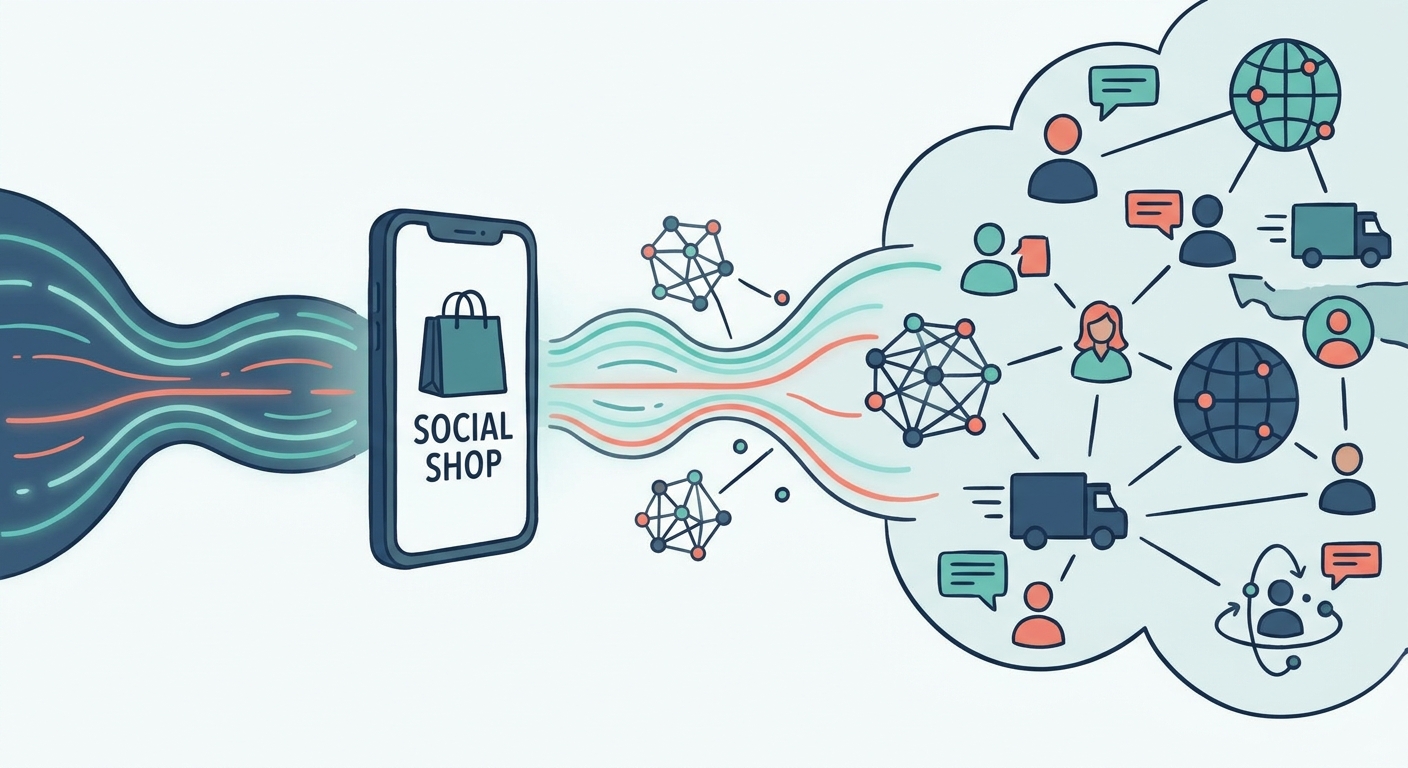
Stop manual workflows. Learn how AI integration APIs and headless architecture are transforming social commerce into an autonomous, high-conversion engine.

Stop the chaos. Discover how to build a high-output, AI-human hybrid social media workflow that converts and scales in 2026. Read the handbook.
Social9 schedules your posts on 11 networks, and Autopilot can draft them in your brand voice for you to approve. Start on the free plan.
We use strictly necessary cookies to run this site. With your permission, we also use analytics cookies to understand how the site is used. We never use advertising cookies. See our Cookie Policy.