
The "gold rush" is over. Remember two years ago? Everyone was panicking, scrambling to shove AI into every corner of their pipeline just to say they were doing it. It was messy, controversial, and frankly, a bit desperate. But by 2026, the dust has settled. We’re no longer asking if we should use AI; we’re asking how we can use it without losing our minds—or our creative identity.
According to the State of AI in Gaming 2026 Report, we’ve entered an era of massive, calculated growth. For studio heads and leads who’ve been in the trenches for decades, the reality is simple: AI isn't here to replace the visionary. It’s here to act as a force multiplier. Used right, it lets human creativity scale in ways that used to be physically impossible. Used wrong, it’s just expensive digital noise.
Why the Industry is Shifting to "Co-Design" Models
We used to treat AI like a intruder at the dinner table. We feared it would render the artist obsolete—a black box that would churn out "good enough" content while firing the human staff. Thankfully, that fear has given way to a much more practical reality: the "Co-Design" model.
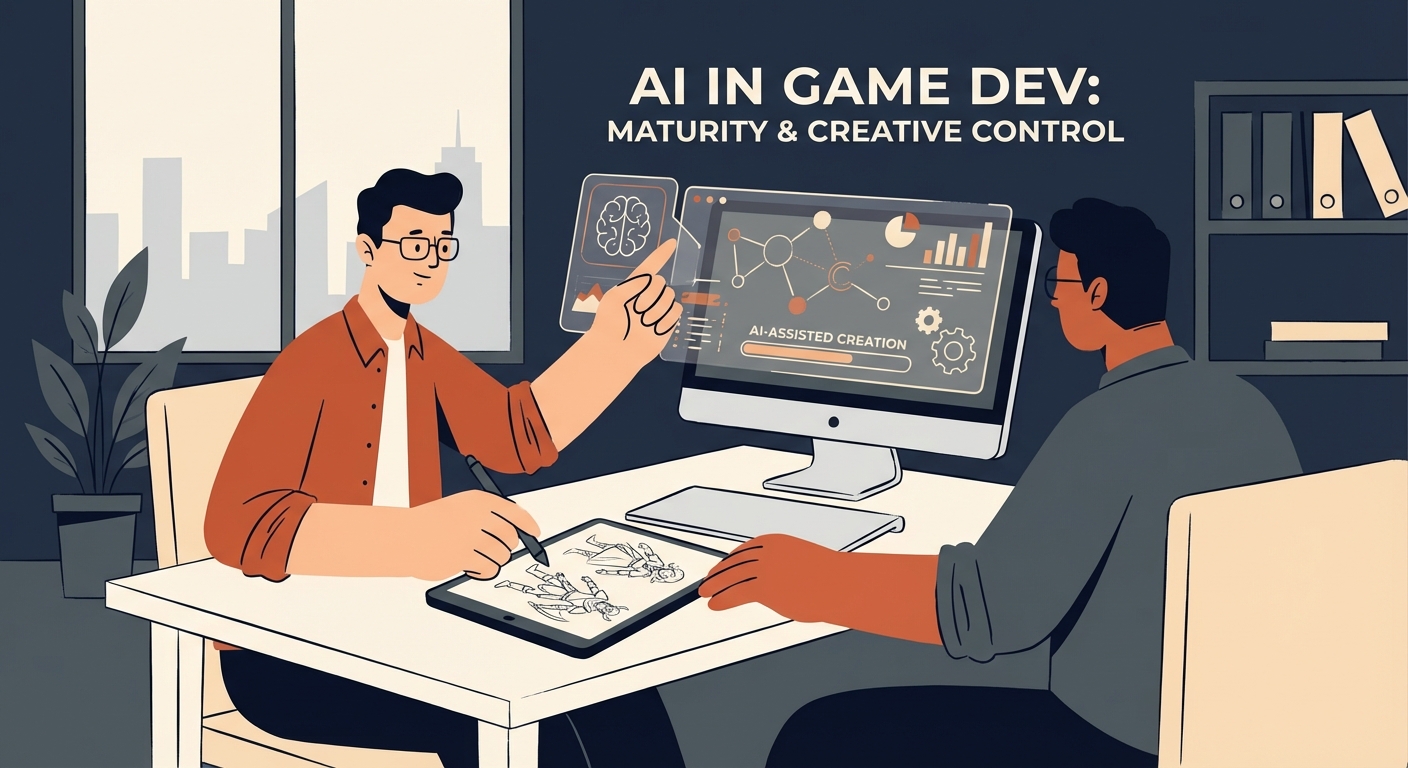
Think of it as a partnership. AI is the intern who never sleeps and handles the grunt work. It’s perfect for the repetitive, soul-crushing stuff—texture tiling, LOD generation, or cranking out basic environmental assets. You know, the tasks that kill your flow state and keep you from doing the real work.
In this workflow, the designer isn't a button-pusher. They’re a conductor. You’re refining intent. You’re deciding the "soul" of the scene—the narrative pacing, the emotional weight of a beat, the tiny, human details that separate a masterpiece from a generic cash-grab.
This loop is critical. It keeps the final output tethered to your studio’s specific brand. The goal isn't "automation"; it’s augmented direction. The AI gives you the raw clay; you’re the one sculpting it into something that actually means something to the player.
How Can AI Enhance Your Asset Pipeline?
Efficiency is nice, but quality is the only thing that keeps the lights on. When we look at sprites and textures, AI tools are now capable of generating base layers and seamless tiling patterns in seconds. This doesn't mean the artist is finished; it means they get to skip the three hours of noise-mapping and jump straight to the fun part: color grading, stylistic integration, and adding that final, human touch.
In 3D modeling, we’re seeing a massive shortcut in the block-out phase. AI can spit out complex environment geometry from a simple sketch or a few lines of text. This lets designers iterate on level layouts before a single polygon is hand-modeled. If you’re curious about how to weave these pipelines together without breaking your process, our Full-Cycle Game Development Services are built exactly for this—balancing automated speed with high-end creative vision.
Then there’s audio. We’re moving away from static, looping tracks toward generative soundscapes that actually listen to the game. Imagine a forest that doesn't just play a 30-second loop. Instead, it generates unique, context-aware ambient noise based on the time of day, the player’s location, and their history of interactions.
The smartest studios are currently moving away from off-the-shelf, generic models. They’re training proprietary models on their own back catalogs. That’s how you keep your IP feeling like yours and not like something scraped from the internet.
PCG 2.0: What Makes AI-Powered Level Design Different?
Old-school Procedural Content Generation (PCG) was built on strict, rigid logic. It was predictable. After two hours, any halfway-decent player could see the seams. It was essentially a slot machine—lots of randomness, but zero intelligence.
PCG 2.0 is different. It’s context-aware. It doesn't just stitch rooms together based on a math table; it watches the player. If a player is dying for the tenth time at a specific combat encounter, an adaptive system can subtly tweak the layout—maybe adding a bit more cover or shifting a health pickup—to keep the challenge fair without breaking the narrative. This is the difference between a static, random map and a living world that reacts to the player's presence. We’re finally moving from "randomness" to "narrative-driven design."
How Do You Maintain the "Human-in-the-Loop" Mandate?
The biggest danger right now? "Lazy" AI. When a studio hits "generate" and just pushes the output straight to the engine without a second look, the result is hollow. Players can smell it. It’s that weird, soulless aesthetic that feels like a fever dream.
You have to treat AI like a junior assistant, not the lead director.
You need a quality-control framework that is non-negotiable. The Art Director must be the final judge. If the AI produces something that clashes with the tone of the game, you throw it out. Period. As noted in recent Ethical AI in Games analysis, the industry is watching. Players are smart; they favor studios that prioritize artistic integrity. The winners in 2026 are the ones using AI to support their human talent, not to replace it.
Practical Strategy: Implementing AI Without Sacrificing Brand Integrity
Transparency is the bedrock of trust. If you’re using AI, be upfront about it. Players are generally fine with tech that reduces crunch or improves the final product, but they absolutely hate being lied to.
High-performing studios are already shaving up to 40% off their production timelines by being smart about where they integrate these tools. You can see how this looks in practice by checking out the Case Studies of Our Work, where we show how we use technology to serve the creative goal, not the other way around.
As noted in the latest AI Game Development Trends 2026, the secret isn't a massive, company-wide overhaul. It’s starting small. Pick the bottlenecks that eat the most time for the least creative return—background assets, dialogue-tree variants, basic geometry—and start there. Audit your pipeline, find the pain points, and fix them.
Conclusion: Future-Proofing Your Studio
Stop thinking of AI as a "replacement" and start thinking of it as a "tool." That’s the only way forward. By adopting a co-design philosophy, you protect your studio from the volatility of the industry and give your team the breathing room they need to build something truly immersive.
AI isn't the end of the designer. It’s the start of a much more ambitious chapter. Audit your pipeline, integrate intelligently, and keep the human hand firmly on the wheel of the creative process.
Frequently Asked Questions
Will AI replace game designers in 2026?
AI will not replace designers, but it will replace designers who refuse to incorporate these tools into their workflow. The role is evolving from "creator of assets" to "AI Orchestrator," where the designer’s primary function shifts toward defining the creative constraints and curating the AI’s output to ensure it aligns with the game’s vision.
How can small indie studios leverage AI for game design without high costs?
Small studios are in a unique position to leverage the explosion of open-source models and cloud-based AI tools. These platforms offer enterprise-level capabilities without the need for massive, on-site hardware investments, allowing indie teams to compete on production quality that was previously reserved for AAA studios.
What are the biggest risks of using AI-generated content in games?
The primary risks include legal ambiguity regarding copyright, stylistic inconsistency that can break player immersion, and the "uncanny valley" effect of generic, soulless content. Maintaining a strict "human-in-the-loop" quality control process is the best defense against these pitfalls.
How does AI-powered procedural generation differ from traditional PCG?
Traditional PCG relies on rigid, rule-based algorithms that result in predictable patterns. AI-powered PCG uses machine learning to create adaptive environments that react to player behavior, skill level, and narrative progress, resulting in a world that feels tailored to the individual player's journey.