
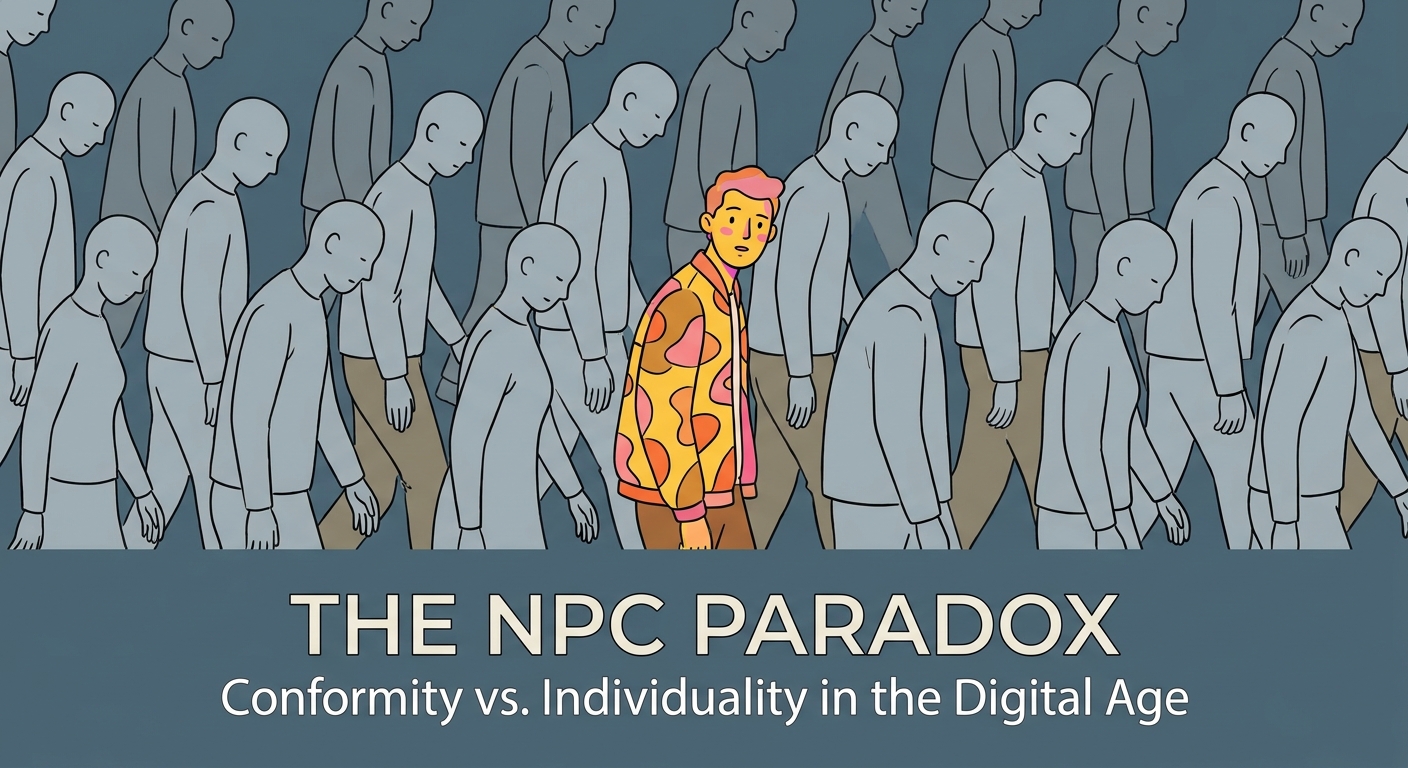
If you’ve spent more than five minutes on a social feed this year, you’ve seen the accusation: "You’re an NPC." It’s the ultimate digital slap—a way to strip someone of their soul by relegating them to the status of a background prop in a video game.
In 2026, the term has mutated far beyond its gaming roots. It’s become a universal shorthand for anyone perceived as a carbon copy, a person lacking an original thought, or someone whose pulse is perfectly synced to the rhythm of the algorithm. It’s the defining insult of our era. It represents a collective, gnawing anxiety that we’re all just reading from a script we didn't write. To understand how we got here, we have to learn more about the evolution of internet speech in our Gen Z Slang Dictionary. The shift from "background filler" to "social pariah" tells the story of our own digital alienation.
What Does "NPC" Actually Mean in 2026?
At its most technical level, NPC stands for "Non-Playable Character." In the world of RPGs like Skyrim or World of Warcraft, these are the entities that populate the map. They offer pre-programmed dialogue and repetitive side quests to make the world feel lived-in. They are defined by one thing: predictability. They don't grow. They don't learn. And they certainly don't deviate from their code.
In 2026, the term has been weaponized to describe "algorithmic conformity." When someone calls you an NPC, they aren't suggesting you aren't human. They’re suggesting your humanity has been outsourced to a feed. It’s a critique of the "copy-paste" lifestyle—where opinions are adopted from viral clips, fashion is dictated by micro-trends, and social performance is optimized for engagement rather than genuine connection.
| Feature | Classic Gaming NPC | Modern Internet NPC |
|---|---|---|
| Dialogue | Repetitive, pre-scripted lines | Echoed viral takes, trend-slang |
| Behavior | Predictable patterns | Cycle of algorithm-driven consumption |
| Agency | Zero (programmed by devs) | Low (programmed by algorithms) |
| Purpose | World-building filler | Engagement-farming filler |
How Did the NPC Meme Start? (A Timeline)
The journey of the NPC meme is a strange, winding road that mirrors the evolution of the internet itself. It began in the quiet, dusty corners of gaming forums, where players mocked the clunky, recursive dialogue of NPCs. It was a harmless piece of gaming culture—a shared joke about the limitations of digital immersion.
However, the tone shifted drastically during the 2018 political cycle. The term was adopted as a weaponized meme, often accompanied by the grey-skinned "Wojak" face to imply that those with opposing viewpoints were literally incapable of critical thought. You can read the comprehensive history of the Wojak NPC meme here, which details how the term transformed from a gaming inside joke into a polarizing tool of digital dehumanization.
By the mid-2020s, the meme underwent another metamorphosis. The rise of the "NPC Streamer" on platforms like TikTok turned the concept into a surreal form of performance art. Creators began mimicking the robotic, loop-like behaviors of video game characters in exchange for digital gifts. What started as a way to mock others became a way to monetize the very "robotic" nature people once feared. The Guardian’s deep dive into the strange world of NPC livestreaming captures the irony perfectly: we became so obsessed with the idea of the "programmed human" that we started paying real money to watch people perform it live.
The "AI-Mirror" Effect: Why Are We Mocking "Bad AI"?
There is a profound, uncomfortable irony in the fact that we have become obsessed with calling each other "AI" or "NPCs" at the exact moment that actual, generative AI has become indistinguishable from human input. We are living through an "AI-Mirror" effect: because we are surrounded by machines that sound human, we have started scrutinizing our fellow humans for signs of being "synthetic."
The psychological discomfort is palpable. When we see someone parrot a viral opinion without a hint of nuance, or follow a trend that feels hollow, we recoil. We label it "NPC energy" because it reminds us of the predictive text models we interact with daily. The following flowchart illustrates the "Conformity Loop" that keeps this cultural engine running:
By labeling others as NPCs, we are essentially trying to affirm our own "Main Character" status. We are mapping out the boundaries of human authenticity in a world where the line between organic thought and algorithmic suggestion is thinner than ever.
Is "NPC Energy" Destroying Original Thought?
The term is now a cornerstone of "brain rot" culture. It describes the tangible degradation of our attention spans and, more importantly, our capacity for dissent. When you consume rapid-fire content for hours on end, you aren't just watching videos; you are training your brain to recognize and replicate patterns. Why algorithmic trends are shaping our 2026 cultural landscape is a question of survival for the individual mind.
Humans have an evolutionary drive for social cohesion, but the internet has hyper-charged this instinct into a demand for consensus—or else. According to research on the psychology of conformity, the fear of being an outsider often forces individuals to adopt group-think behaviors just to feel safe in digital spaces. In 2026, the NPC label is the stick used to keep the herd in line. If you don't repeat the current "correct" opinion, you are mocked; if you do, you are a drone. It is a lose-lose dynamic that actively punishes original thought.
How to Avoid "NPC Energy": A Guide to Authenticity
Escaping the "scripted" lifestyle doesn't require you to delete your social media accounts and retreat to a cabin in the woods—though, for the record, that does help. It requires intentionality.
- Cultivate Offline Friction: Spend time in environments where the algorithm cannot reach you. Real-world hobbies—woodworking, hiking, playing an instrument—force you to engage with the physical world, where "glitches" and failures are part of the process, not a sign of being a bot.
- Practice "Slow Consumption": Break the cycle of high-speed feed scrolling. If you find yourself holding an opinion that you can't explain in your own words, pause. Research it from multiple angles. If you repeat a talking point, make sure you know why you believe it.
- Embrace the "Main Character" Flaws: The hallmark of an NPC is a lack of depth. Real people have contradictions, messy opinions, and histories that don't fit into 30-second clips. Stop trying to be "aesthetic" or "relatable" and start trying to be honest. Authenticity often looks like a mess, and that is exactly the point.
Ultimately, the best way to stop being an NPC is to stop treating your life like a performance. The algorithm is a tool, not a director. You don't need to be the protagonist of a viral story; you just need to be the author of your own.
Frequently Asked Questions
Is being called an NPC always an insult?
Not necessarily. While it is primarily used as a jab to call someone unoriginal or "robotic," it can also be used in a self-deprecating way to acknowledge that we all feel like we are on "autopilot" during the mundane parts of our work or daily routines.
Where did the NPC meme start?
It originated as a gaming term for background characters with limited functionality. It evolved into a political meme in 2018 to mock opposing viewpoints and later exploded on TikTok through "NPC streaming," where creators perform repetitive, robotic movements for digital tips.
What does "NPC energy" mean in 2026?
"NPC energy" describes a person who appears to have no distinct personality or critical thinking skills, instead blindly echoing popular trends, social scripts, or algorithmic talking points without showing any signs of genuine internal reflection.
Is the NPC trend dying or evolving?
The trend is evolving. While the initial shock of the "NPC streamer" has worn off, the label has become a permanent part of our vocabulary for social critique. It is no longer just a meme; it is a diagnostic tool we use to navigate the increasing complexity of human identity in a digital-first world.