What is social media autopilot? How AI posting works (and where to keep a human)
Social media autopilot uses AI to plan, draft, schedule and publish posts. Learn how the loop works, platform AI rules, and where a human must stay in charge.
Autopilot & AI
The 2026 content marketing playbook is brutal, short, and honest: AI has pushed the cost of hitting "publish" to zero, but it’s sent the cost of earning someone Alex ChenAI Content StrategistPublished 6 min read
The 2026 content marketing playbook is brutal, short, and honest: AI has pushed the cost of hitting "publish" to zero, but it’s sent the cost of earning someone’s attention through the roof.
We’ve left the honeymoon phase. Remember when a passable, AI-generated blog post was enough to get a search crawl? That era is dead. We are currently drowning in a digital ocean of synthetic, lukewarm noise. The real challenge today isn't whether you can churn out a thousand articles before lunch—it’s whether a single one of those articles actually says something worth reading.
If your strategy is just letting an algorithm do the heavy lifting, you aren't scaling. You’re just filling the internet's junk drawer.
In the early days, marketers treated LLMs like digital photocopiers. They spat out generic, pulse-less advice that sounded like it was written by a committee of robots. That doesn't fly anymore. Today, the industry has matured into a hybrid model. We use AI for the "scaffolding"—the boring stuff like organizing data, outlining, and brainstorming—but we rely entirely on humans for the "flesh." That means emotional resonance, gritty industry anecdotes, and the kind of hard-won authority that Google actually respects.
The barrier to entry has hit the floor. Because everyone can create volume, volume is no longer a proxy for value. If you check Google’s Guidance on AI-generated content, you’ll notice they don't care about the origin of the text. They care about the signal. Google isn't hunting for AI; they are hunting for "unhelpful" content. If your content is indistinguishable from the average of the internet, you are effectively invisible.
The most dangerous trap of AI is "regression to the mean." These models are trained on the vast, messy collective of the entire internet. They naturally gravitate toward the most likely, most average, and most predictable way to say anything. If you tell an AI to write about "the future of marketing," it will give you the most statistically probable response—which is a graveyard of tired clichés and robotic transitions. When your brand voice is built on this, you lose the sharp edges that make you you. A brand that sounds like everyone else is a brand that no one remembers.
We’ve all seen it: the AI that sounds like a Rhodes Scholar while being completely, dangerously wrong. This is the "hallucination" problem. In a professional setting, this isn't just a quirky bug; it’s a liability. Whether it’s citing a fake court case or botching a technical spec, AI lacks a moral or professional compass. Without a rigorous human verification workflow, you are one bad prompt away from a PR nightmare or a loss of trust that takes years to fix.
At the heart of modern SEO is EEAT: Experience, Expertise, Authoritativeness, and Trustworthiness. You can dive into the specifics of these ranking factors at Search Engine Journal. The fundamental problem? AI has no life. It can synthesize what a thousand people have written about a topic, but it cannot recount the messy, frustrating, human lessons learned from a failed project or a hard-won pivot. When you rely solely on AI, you strip your content of the very thing that proves you’re a real practitioner in your field.
To actually win, you have to stop treating AI as the creator and start treating it as the assistant. This workflow keeps your content anchored in reality while keeping your efficiency high.
graph TD
    A[Ideation] --> B[Draft Structure]
    B --> C{Human Expert Review}
    C -->|Needs Improvement| A
    C -->|Approved| D[Fact-Checking]
    D -->|Inaccurate| C
    D -->|Verified| E[Final Polish]
    E --> F[Publishing]

    style C fill:#f9f,stroke:#333,stroke-width:2px
    style D fill:#f9f,stroke:#333,stroke-width:2px
    style E fill:#bbf,stroke:#333,stroke-width:2px
If you use AI to assist your writing, treat the output as a rough draft. Never a final product. Before you hit publish, you need to inject the "Human Factor." This is non-negotiable:
If you’re struggling to make this pivot, our content services focus specifically on bridging the gap between high-velocity production and high-value human expertise.
To stop your brand from sounding like a generic chatbot, stop using generic prompts. Use "few-shot prompting." Give the AI 3–5 examples of your best, most authentic work as a style guide. Define a custom knowledge base for it to reference. You are essentially "caging" the AI within your brand’s specific vocabulary and constraints. You aren't just giving it a task; you are training a digital intern that requires constant supervision.
The future of marketing isn't about keyword density; it’s about "value density." As the web becomes saturated with AI-generated fluff, the premium on human perspective will skyrocket. The companies that win in 2026 are the ones using AI to reclaim time—time they then reinvest into deep-dive research, original reporting, and strategic thinking. According to the Content Marketing Institute’s AI Trends 2026 report, the most successful organizations are already pivoting toward this "Human-in-the-driver’s-seat" model. They know that trust is the only currency that matters in an AI-saturated market.
We’re at a crossroads. You can use AI to outsource your thinking, resulting in a hollow, generic presence that eventually gets filtered out by both search engines and human readers. Or, you can use it to amplify your unique perspective. AI is a tool of efficiency, not a substitute for intelligence. When you treat it as an assistant, you free yourself to focus on what actually moves the needle: connecting with your audience through shared experience.
For more insights on navigating this shift, explore our Future of Digital Marketing blog and learn how to keep your strategy ahead of the curve.
No. Google’s algorithms are designed to reward helpful, high-quality content regardless of how it was produced. However, they aggressively filter out "unhelpful" content—material that is robotic, repetitive, or lacks unique value. If your AI content is just a low-effort rewrite of existing search results, it will likely struggle to rank.
Consistency is maintained through rigorous prompting—specifically using "few-shot" techniques that feed the AI examples of your best content—and an unbreakable human-editing gate. Never publish a raw AI output; always have a human editor review the tone and structure to ensure it aligns with your brand guidelines.
The biggest risks are factual inaccuracies, commonly known as "hallucinations," and the loss of brand differentiation. When you rely solely on AI, you risk publishing false information while simultaneously sounding exactly like your competitors, which erodes the trust and authority essential for building a brand.
Prioritize EEAT (Experience, Expertise, Authoritativeness, and Trustworthiness). Focus on injecting unique insights, proprietary data, and personal anecdotes that an AI cannot scrape from the web. When your content provides a perspective that is physically impossible for a model to generate on its own, you gain a massive competitive advantage.
Social media autopilot uses AI to plan, draft, schedule and publish posts. Learn how the loop works, platform AI rules, and where a human must stay in charge.

Stop churning out generic AI fluff. Learn how to build a full-stack content workflow that scales your unique human expertise and builds reader authority.
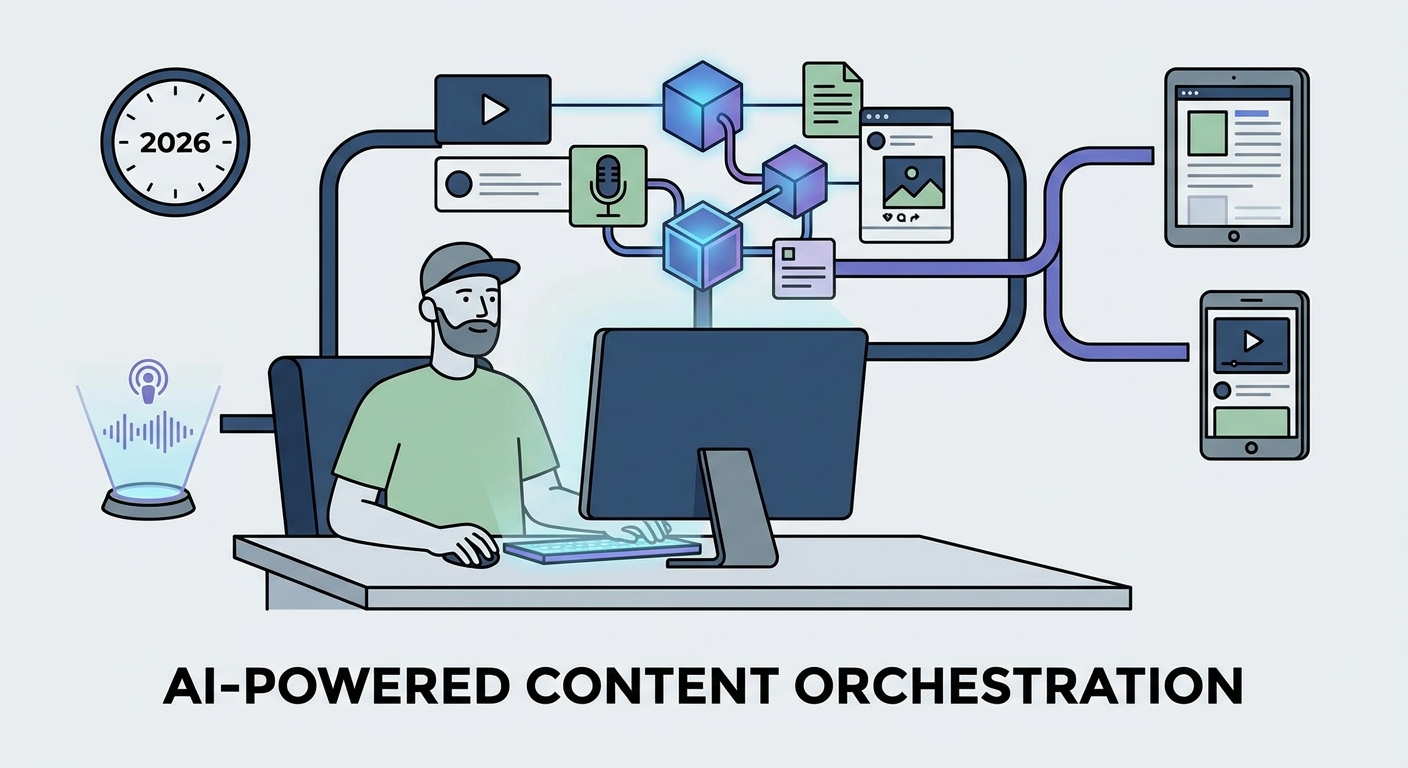
Stop manual drafting. Discover how AI-powered content creation and agentic workflows boost efficiency, scale production, and drive strategic marketing results.
Social9 schedules your posts on 11 networks, and Autopilot can draft them in your brand voice for you to approve. Start on the free plan.
We use strictly necessary cookies to run this site. With your permission, we also use analytics cookies to understand how the site is used. We never use advertising cookies. See our Cookie Policy.