
Forget slapping a filter on a JPEG and praying for a viral hit. That’s 2022 thinking, and it’s a one-way ticket to obscurity. In 2026, building a professional NFT collection is a high-stakes marriage of generative art, technical metadata management, and smart contract architecture.
If you want to survive, you have to stop treating your project like a collection of one-offs. You’re building a brand. You need to blend the wild, unpredictable creativity of AI diffusion models with the cold, unyielding logic of the blockchain. Before you dive into the deep end, make sure you understand the basics of what is an NFT? to ensure your project is built on solid ground rather than hype.
What Exactly is an AI-Generated NFT?
At its core, an AI-generated NFT is a digital asset where the primary visual layer—the "soul" of the piece—is born from machine learning. We’ve finally moved past those awkward, glitchy GAN experiments of the early days. Today, we’re living in the era of diffusion models. These are the heavy-duty engines powering tools like Midjourney and Stable Diffusion. They’ve crunched the statistical distribution of billions of images, allowing you to "prompt" specific aesthetics, character archetypes, and moods with surgical precision.
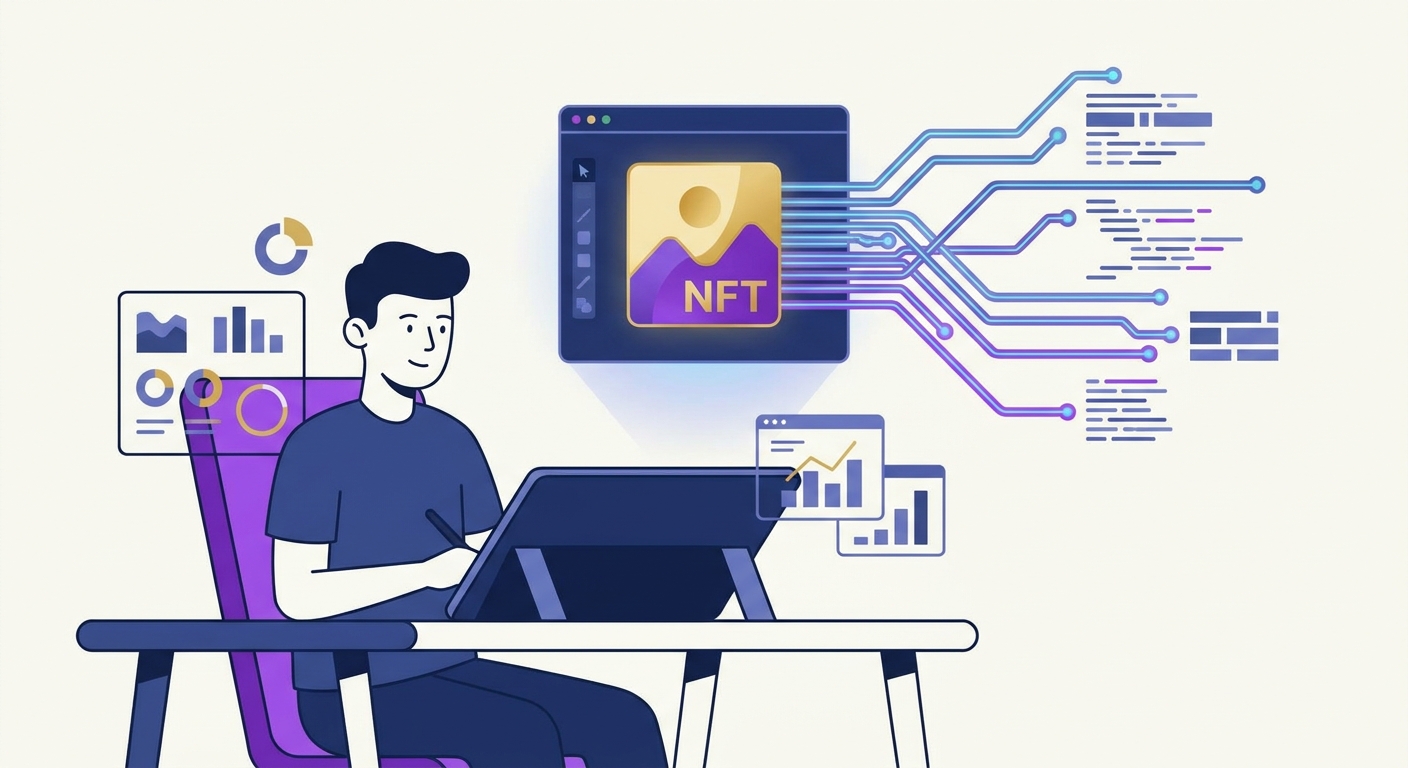
But here’s the catch: the AI only gives you raw material. The NFT itself? That’s a triple threat. It’s the image, the metadata (the JSON file that tells the blockchain which "traits" your character is wearing), and the smart contract governing ownership. In 2026, the gold standard isn't just generating art—it’s generating layers, curating them with a human eye, and programmatically stacking them to create genuine, quantified scarcity.
The 5-Step Workflow: How to Build Like a Pro
If you want your collection to hold value, you need a process that’s disciplined, repeatable, and slightly obsessive.
- Ideation & Prompt Engineering: Nail your "brand look." Are you going for gritty cyberpunk, soft watercolor, or 3D claymation? Your prompts need to be rock-solid and consistent.
- Asset Generation: Use your AI model to generate "Base Layers"—think heads, bodies, accessories, and backgrounds.
- Curation & Human-in-the-Loop: AI is a tool, not your creative director. You are the filter. If an output looks like trash, delete it. Only the best stuff makes the cut.
- Metadata & Rarity Configuration: Use custom scripts to assign rarity traits to your layers. A "Golden Crown" headpiece should be significantly rarer than a "Baseball Cap."
- Smart Contract Deployment: Finally, push your assets to the chain.
The Toolkit: What to Use in 2026
The market is currently choked with "all-in-one" generators that promise the moon but deliver garbage. Don't fall for it. You need a modular stack—tools that give you creative freedom without eating your technical workflow.
1. For Artistic Precision: Midjourney & Stable Diffusion
When your brand’s value is tied to its aesthetic, these two are the industry standard. Midjourney is the king of high-fidelity, polished output; it’s perfect if you want to minimize post-processing.
Stable Diffusion is the heavy lifter. If you need local control, offline generation, or the ability to train "LoRAs" (Low-Rank Adaptation models) on your own specific characters, this is your home base. Training a LoRA ensures that every one of your 10,000 pieces feels like it belongs to the same universe.
Pro-Tip: Keep a side-by-side of your raw AI output versus your polished version. A quick pass in Photoshop or a vector-tracing tool is often the difference between a $5,000 project and a $50 dud.
2. For Workflow Automation: The "All-in-One" Platforms
If you aren't a developer, don’t panic. Tools like HashLips or various no-code NFT generators act as the "middleware." They take your folders of AI-generated traits, shuffle them, and handle all that tedious JSON metadata generation for you. They ensure that every single NFT has the right rarity scores baked into its code.
3. For Minting and Deployment: The Bridge to Web3
Once your files are ready, it’s time to move them onto the chain. You don’t need to be a Solidity genius to do this.
- Zora Network is the clear favorite for creators who want low costs, high speed, and a focus on keeping their royalties.
- If you’re building something complex, keep the OpenSea Developer Docs bookmarked. It’s essential for making sure your metadata plays nice with the world’s largest marketplace.
| Tool Name | Ease of Use (1-10) | IP Rights Included | Minting Integration |
|---|---|---|---|
| Midjourney | 8 | Yes (Paid Plan) | No |
| Stable Diffusion | 4 | Yes | No |
| Manifold | 7 | Yes | Yes (Excellent) |
| Zora | 9 | Yes | Yes (Native) |
The Art of Consistency: Don't Let Your Collection Look Like a Junk Drawer
The number one rookie mistake? Generating 1,000 images using random seeds and wildly different prompts. The result is a chaotic mess that looks like a collage of mismatched pixels.
Treat your AI like a design studio. Use a consistent "Seed" or a "Fixed Style Reference" in your prompts. When you're generating your "Cyber-Frog" collection, create 50 variations of the head using the exact same prompt structure. Swap out the accessories, but keep the lighting, the color palette, and the camera angle locked down. When these layers are randomized and stacked, the final result will look like a deliberate, cohesive design series rather than a glitchy accident.
Legal & Ethical: Do You Actually Own This?
The legal status of AI art is still a moving target. According to the official US Copyright Office AI Guidance, work created entirely by AI without human intervention is tough to copyright.
This is exactly why the "Human-in-the-Loop" model is non-negotiable. By manually curating, layering, and tweaking your assets, you’re injecting the human authorship necessary to claim ownership. Always read the Terms of Service for your AI platform. Most, like Midjourney, grant you commercial rights to your creations—but only if you’re on a paid subscription. Don't skip the fine print.
How to Monetize Beyond the Initial Sale
If you think your NFT is just a one-time transaction, you’re missing the point. The most successful creators in 2026 are building ecosystems.
- Subscription Models: Use your NFT as a "digital key." Holders get access to a private Discord or a newsletter where you pull back the curtain on your prompt engineering.
- Utility-Based NFTs: Give your holders a vote on the next "season" of your collection. Make them feel like stakeholders.
- Patreon-Gated Perks: Offer your collectors high-res prints or behind-the-scenes access to your generation workflows. Reward the people who believe in your vision.
Frequently Asked Questions
Do I own the copyright to the NFTs I create with AI?
Generally, yes—provided you use a paid service that grants commercial rights. However, the level of protection depends on how much "human authorship" you added to the final asset. Don't just prompt and pray; add your own creative touch.
Can I sell AI-generated art on all NFT marketplaces?
Most marketplaces are open to AI art, but some require you to disclose it. Always check the specific platform policy before you hit "list." Transparency is your best friend.
How do I make a collection of 1,000+ unique pieces using AI?
You don't generate 1,000 full images. You generate "traits"—10 backgrounds, 10 hats, 10 heads—and use a layering engine to combine them into 1,000 unique permutations. It’s like a digital deck of cards.
Is it free to create AI NFTs?
Nope. You’ll have subscription fees for your AI tools, and then there are "gas fees" to pay when you mint on the blockchain. Before you start, make sure you’ve set up a cryptocurrency wallet and have enough funds to cover the transaction costs.
What do I need before I start minting my first collection?
You need a clear brand concept, a folder of consistent, curated trait assets, a properly formatted JSON metadata file, and a funded wallet. Get your ducks in a row before you start paying for gas.