Advertising Trends: Exploring the NPC Concept in Digital Media

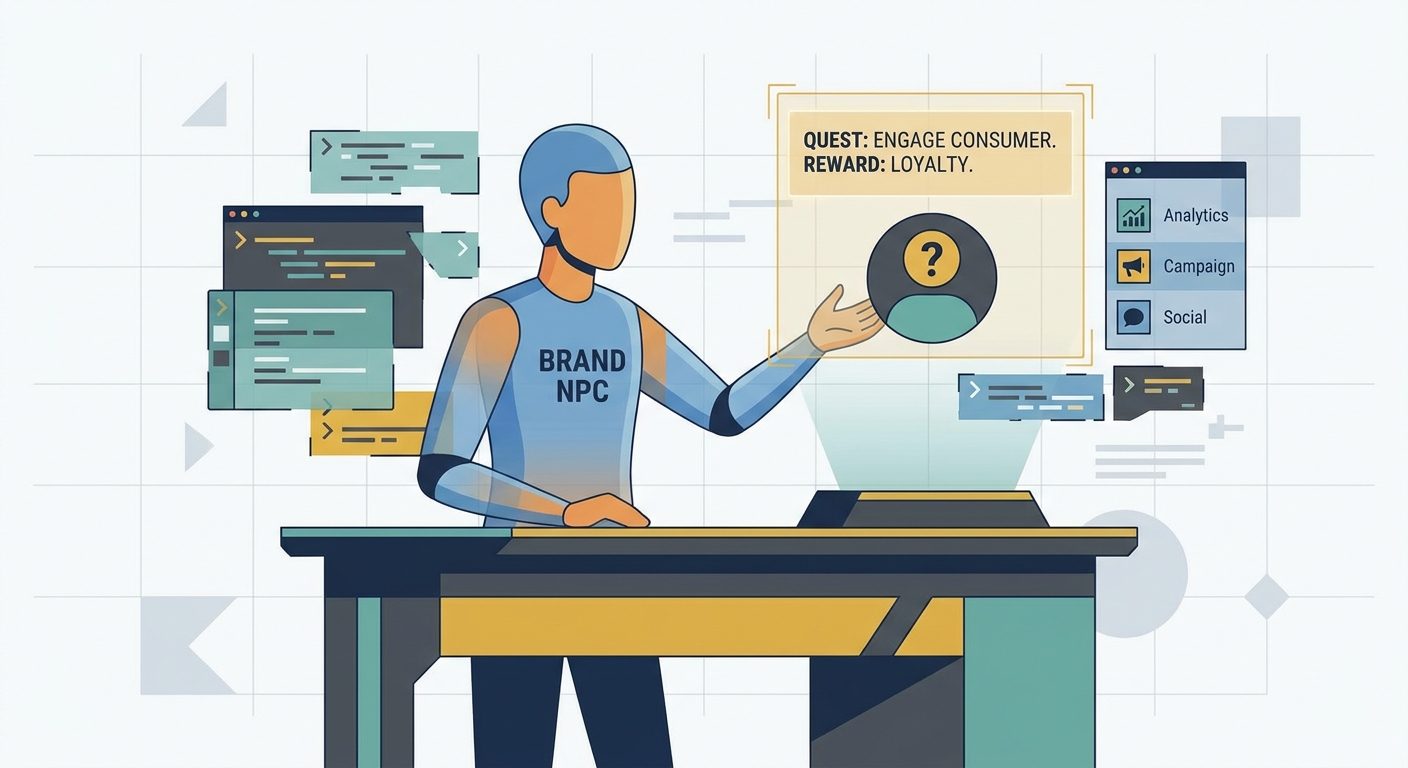
The "Non-Playable Character"—once a derisive term for the background fodder of gaming—has clawed its way out of the console and into the boardroom. By 2026, it’s become the blueprint for digital advertising.
Brands aren't just broadcasting messages anymore. They’re engineering "Brand NPCs." These are autonomous digital agents that don't just "chat"; they guide, they persist, and they treat every customer interaction like a high-stakes quest. The static landing page is dying. In its place, we’re seeing a reality where your brand identity is an interactive presence that never sleeps, never breaks character, and never drops the ball.
What is the NPC Concept, and How Did It Escape Gaming?
To understand why every CMO is currently obsessed with "NPC-ifying" their brand, we have to look back at the chaotic laboratory of 2023. Remember the origins of the NPC streaming phenomenon on TikTok? It felt like a fever dream. Creators repeating singular, robotic phrases in response to digital gifts.
It looked like a gimmick. But look closer. It revealed a fundamental truth about human psychology: we crave predictable, responsive feedback loops.
In the 2026 advertising landscape, a "Brand NPC" isn't a glitchy bot. It’s the evolution of brand voice into a functional, digital teammate. Traditional advertising asks a user to "view" an ad. The Brand NPC asks the user to "interact" with a persona. It’s the shift from a monologue to a scripted dialogue where the brand maintains its guardrails while providing the illusion of bespoke, human-like attention.
Why Are Brands Shifting Toward "NPC-Style" Interactions?
The primary driver here is the brutal math of attention. In a world of infinite content, users don't want to browse; they want to be guided. By connecting NPC strategies to broader CX goals, companies are successfully transforming the tedious act of passive shopping into a gamified "quest."
Then there’s the issue of scale. A human sales rep has a finite bandwidth. They get tired. They have bad days. A Brand NPC, powered by an enterprise-grade LLM, can handle ten thousand simultaneous conversations while maintaining the exact tone, cadence, and empathy parameters your marketing team defined.
It turns the "always-on" requirement of modern business from a logistical nightmare into a competitive advantage. When a user feels they are being "helped" by an entity that understands their specific context—rather than being fed a generic lead-gen form—the friction of the conversion funnel drops to near zero.
How Does the AI-Driven NPC Work in Practice?
We are moving past the era of "if/then" tree-based chatbots. Modern NPC implementation relies on autonomous agents that process intent, retrieve brand-specific context, and generate responses within a strictly defined personality matrix. The goal isn't to make the AI "human." It’s to make the AI a perfect avatar of the brand’s mission.
This technical loop captures the essence of "scripted spontaneity." The AI Logic Layer acts as the engine, but it is perpetually constrained by the Brand Guardrails. This ensures that while the interaction feels fluid and conversational, it never veers into "hallucinations" or off-brand territory. It’s the difference between a chatbot that says "I don't know" and an NPC that says, "That’s a great question—let me guide you to the specific solution we built for that."
Is Generative UI the New Business Moat?
We are witnessing a seismic shift from "Search and Click" to "Chat and Guide." As Jakob Nielsen’s predictions for 2026 clarify, the companies that win will be those that treat their interface as a living, breathing guide rather than a graveyard of static links.
This isn't just about changing how your website looks. It’s about changing how you produce the intelligence that powers that interface. By integrating advanced AI-content production, brands can ensure their NPC agents are constantly updated with real-time inventory, pricing, and campaign data.
This creates a "Generative UI" that physically changes its layout and focus based on the user's conversation. It effectively builds a moat around your customer experience. If your site is the only one that "talks" to the user and solves their problem in three sentences, why would they ever go back to a competitor’s static menu?
The "Uncanny Valley" Risk: How Do You Avoid AI Fatigue?
There is a fine line between a helpful brand agent and a creepy, over-automated void. The "Uncanny Valley" in advertising occurs when an AI tries too hard to mimic human emotion and fails, leading to instant distrust.
The solution? Don't hide the fact that it's an AI. Embrace the "Hybrid NPC" model.
The Hybrid NPC acknowledges its nature as a digital assistant while maintaining a high-empathy baseline. When a query exceeds the complexity of the script—or when the user expresses genuine frustration—the system must have a seamless "human-in-the-loop" trigger. This isn't a failure of the technology; it’s a design feature. By knowing exactly when to hand off from the NPC to a human expert, you maintain the brand’s integrity while ensuring no customer is left trapped in an automated loop.
How Can Your Brand Build Its First "Brand NPC" Today?
Building an NPC strategy is not an overnight task, but it is an essential one as projections for the 2026 advertising landscape indicate a total move toward autonomous, intent-based marketing.
- Identify high-frequency, low-friction touchpoints: Start where your customers ask the same questions repeatedly. These are the perfect training grounds for your first NPC.
- Train your LLM on brand-specific scripts: Do not let the model "wing it." Feed it your brand voice guidelines, your core messaging pillars, and a library of "ideal" interactions. Treat this like training a new employee on your company culture.
- Implement guardrails: You must hard-code the boundaries. An NPC should be able to offer discounts, explain features, and guide users to checkout, but it should never be able to deviate from your core value proposition.
Conclusion: The Future of Digital Personality
The NPC trend is not a gimmick. It is an infrastructure shift. We are moving toward a future where the "web page" as we know it—a static, one-size-fits-all document—becomes a relic. In its place, we are building intelligent, interactive personas that represent our brands.
By adopting the NPC concept, you aren't just automating customer service. You are creating a digital ambassador that can speak to a million people at once, while making every single one of them feel like they’re the only person in the room.
Frequently Asked Questions
What exactly is an "NPC" in the context of digital advertising?
In advertising, an "NPC" is a digital persona—often an AI-powered agent—designed to provide predictable, scripted, and highly personalized guidance to a user. Unlike a traditional chatbot, it acts as a character within the brand’s ecosystem, guiding the user through a "quest" of information or purchasing, ensuring consistent brand voice throughout the journey.
Is the NPC trend just a viral gimmick, or is it here to stay?
The NPC trend is a foundational shift in how brands deliver customer experience. As AI capabilities evolve, autonomous agents are becoming the primary interface for digital interactions. It is here to stay because it solves the dual problem of scalability and personalization that has plagued digital marketing for decades.
How can my brand use NPC strategies without feeling "fake" or "creepy"?
Avoid the "Uncanny Valley" by prioritizing transparency and utility over fake human emotion. Use the "Hybrid NPC" model: allow AI to handle high-frequency, routine tasks with speed, but build in automated triggers that hand off complex or emotionally charged interactions to human staff. Authenticity in this context comes from being a helpful, reliable guide, not a faux-human.
What are the primary benefits of using AI-powered NPC agents?
The primary benefits are the "triad of efficiency": 24/7 availability that ensures no customer is left waiting, a perfectly consistent brand tone that never breaks character, and the ability to create high-frequency, low-friction conversion paths that significantly outperform static, one-size-fits-all landing pages.