What is social media autopilot? How AI posting works (and where to keep a human)
Social media autopilot uses AI to plan, draft, schedule and publish posts. Learn how the loop works, platform AI rules, and where a human must stay in charge.
Autopilot & AI
The era of "AI slop" is over. You know the stuff: that relentless, gray tide of generic, hollow, repetitive content that reads like it was churned out by a bore Alex ChenAI Content StrategistPublished 5 min read

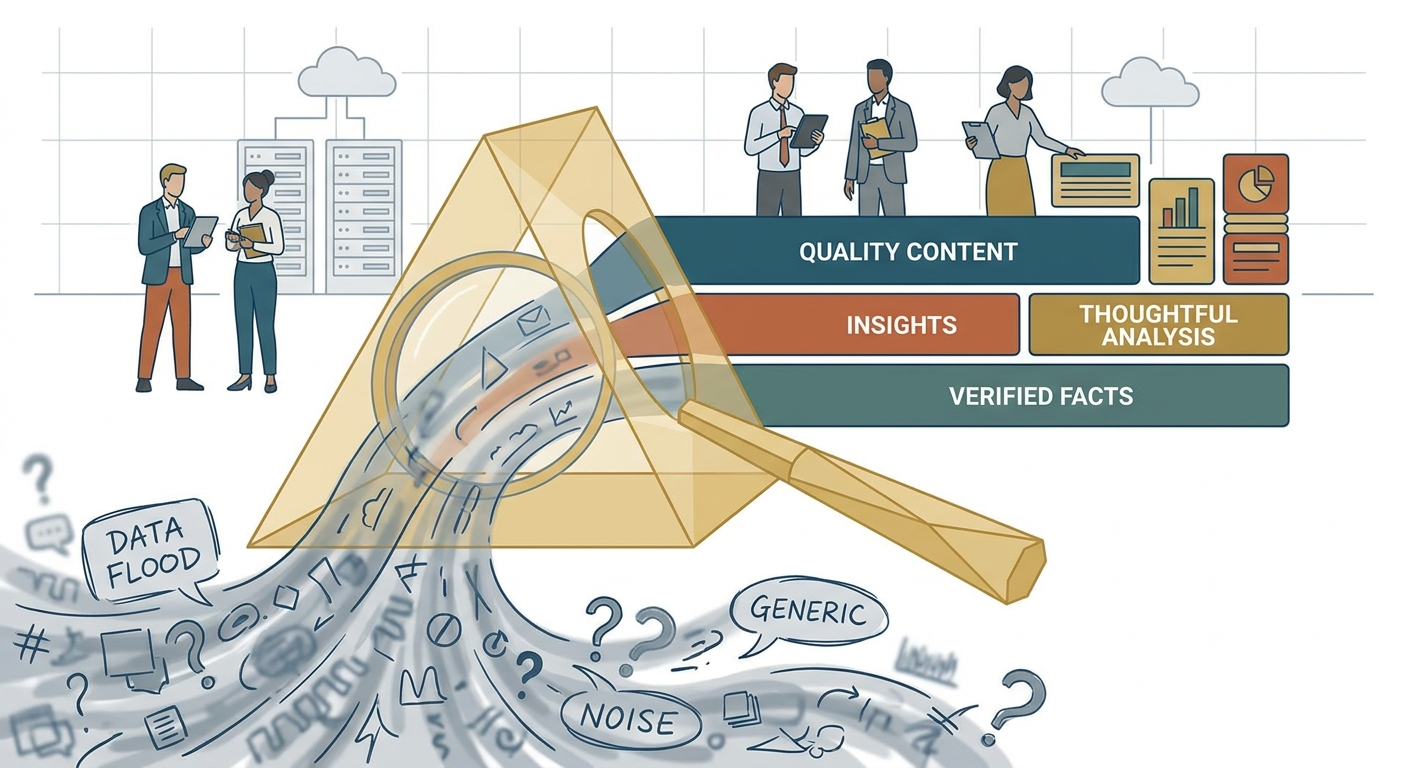
The era of "AI slop" is over. You know the stuff: that relentless, gray tide of generic, hollow, repetitive content that reads like it was churned out by a bored robot.
In 2026, virality isn’t about how fast you can hit "generate." It’s about how strategically you can hide the machine and highlight the human. Audiences have developed a collective "AI-dar." They can smell a synthetic sentence from a mile away, and they’ll scroll right past it without a second thought.
If you want to win, you need to stop treating AI like a content factory and start treating it like a force multiplier for your own expertise. As research from McKinsey makes clear, the winners aren't the ones replacing humans—they’re the ones giving their humans superpowers.
We’ve hit a wall. "Velocity-first" content—pumping out ten blog posts a day just to feed the algorithm—is now actively punished. Platforms are getting smarter. They track dwell time, thoughtful comments, and genuine shares. If your content feels mechanical, the algorithm knows it, and the audience ignores it.
The difference between a viral hit and a digital ghost town? The "Authenticity Gap."
Basic AI output is essentially a middle-of-the-road summary. It’s safe, it’s polite, and it’s mind-numbingly boring. It misses the weird, messy nuances of a real industry. If you’re just prompting your AI to "write a blog post about X," stop. You’re building a headstone, not a brand. To actually succeed, you need to feed that machine your own internal data, your battle-tested case studies, and your non-negotiable stylistic guardrails.
The "one-size-fits-all" approach is officially dead. In 2026, content has to feel like it was written for the person reading it. We aren't just talking about swapping out a company name in a template. We’re talking about adaptive, user-intent-driven narratives that shift their tone based on who’s looking. AI should be the engine that analyzes which topics actually resonate with your specific audience segments, moving them from passive, glazed-over eyes to active engagement.
Virality isn't an accident; it’s a process. The teams winning right now use a "full-stack" workflow. AI handles the grunt work—the research, the structural skeletons, the formatting—but the human handles the soul. We believe this is the gold standard for production, which is why we implement these full-stack workflows to ensure every piece hits the mark.
AI provides the raw clay, but the human sculptor has to shape it. The "Human-in-the-Loop" model is the only way to ensure longevity. As noted in recent trends from the Associated Press, the future of media depends on the "Human Curator." This person is the final gatekeeper. They ensure the content isn't just factually correct; they ensure it has a heartbeat. Without that human layer, your content is just digital noise.
If your draft uses words like "delve," "unlock," "in today’s fast-paced world," or "game-changer," you’ve already lost. You’re signaling to the reader that you didn't care enough to write it yourself. Use this simple checklist to scrub the rot:
AEO—or AI-driven Search Optimization—is the new game. You aren't just trying to rank on Google anymore; you’re trying to become the "source of truth" that Perplexity, Gemini, and SGE pull from when they answer a user’s question.
graph TD
    A[User Query] --> B{AI Model Analysis}
    B --> C[Retrieve Contextual Data]
    C --> D[Evaluate Content Authority & Structure]
    D --> E{Content Meets AEO Criteria?}
    E -- No --> F[Standard Search Result]
    E -- Yes --> G[Inclusion in AI Summary]
    G --> H[High-Value User Engagement]
To win here, you need to be direct. Answer the "who, what, where, and why" immediately. Use data that machines can parse and trust. Don't bury the lead.
We recently took a technical guide that was produced entirely by AI. It was technically accurate, sure. But it was sterile. It had a 45-second dwell time and zero social shares.
We brought in a subject matter expert. They didn't rewrite the whole thing—they just injected lived experience. They added a contrarian take on how the industry usually does things, simplified the jargon, and added a specific story about a client failure.
The result? Dwell time jumped to 2 minutes and 15 seconds. Social shares increased by 400%. As highlighted in recent AI marketing statistics, the bridge between "AI-generated" and "high-performing" is almost always paved with human oversight.
Audiences prioritize value over provenance. If the content solves a problem, offers a unique perspective, or provides genuine emotional resonance, the "AI-generated" tag becomes irrelevant. The stigma exists only when the content is lazy.
The biggest mistake is over-reliance on automation. Brands that treat AI as a "set it and forget it" tool fail to establish a competitive moat. AI is an engine, but the brand’s perspective and human expertise must be the steering wheel.
You must train your models on your existing brand assets—your best-performing articles, your style guides, and your unique vocabulary. Maintaining a rigorous human-in-the-loop review process is the only way to avoid the default "AI-sounding" prompt structures that plague generic content.
Yes. Traditional SEO targets keywords to rank on a results page. AEO targets "intent-dense" answers that provide high-value, research-backed depth. You are writing to be the "source of truth" that AI models cite when they answer a user's question directly.
Social media autopilot uses AI to plan, draft, schedule and publish posts. Learn how the loop works, platform AI rules, and where a human must stay in charge.
If you’re wondering whether AI-powered content services are worth your budget in 2026, you’re asking the wrong question. It’s not about the tech; it’s about the

Stop using AI for fluff. Learn the 2026 'Human Sandwich' workflow and predictive AI strategies to engineer viral content and avoid 'AI slop' fatigue.
Social9 schedules your posts on 11 networks, and Autopilot can draft them in your brand voice for you to approve. Start on the free plan.
We use strictly necessary cookies to run this site. With your permission, we also use analytics cookies to understand how the site is used. We never use advertising cookies. See our Cookie Policy.