Analysis of a Film's Conclusion: Key Plot Points Explained

The final minutes of a movie aren’t just a place to park your car and head for the exit. They’re the crucible. It’s where the story either earns its keep or falls apart. A conclusion is the definitive statement a filmmaker makes about the world they’ve built, serving as the lens through which you have to re-evaluate everything that came before. If you want to move past the superficial "what happened" and get to the "why it matters," you have to stop watching passively and start interrogating the screen.
The Climax vs. The Resolution: Know the Difference
There’s a lazy habit among amateur critics of mashing the climax and the resolution into the same bucket. Big mistake.
The climax is the peak of the mountain—the point of no return where the protagonist’s fate is sealed in fire and action. The resolution, though? That’s the fallout. It’s the settling of dust. It’s the new status quo. Understanding this distinction is vital for exploring resolution techniques in filmmaking, because it tells you whether the director is chasing the adrenaline of the action or the weight of the consequences.
Narrative coherence lives in the space between these two. A "closed" ending ties every thread into a neat bow. It’s comforting, final, and absolute. An "open" ending, however, demands that you do the heavy lifting. It leaves the door ajar, forcing you to participate in the meaning-making process. Neither is objectively "better." The only thing that matters is whether the choice serves the story’s heart.
Why the Ending Trumps the Plot
We’re living in an era where emotional payoff beats logical airtightness every day of the week. Audiences are sharp. They know that a plot hole is usually a minor annoyance compared to a thematic betrayal.
The true power of an ending is its rewatchability. When a finale is nailed with precision, it acts as a retrospective mirror. Suddenly, the first act isn’t just an introduction—it’s a map of foreshadowing that takes on darker, deeper colors once the final frame hits.
Thematic consistency is the only thing keeping a film from capsizing under the weight of its own twists. A twist should never exist just to make your jaw drop. It needs to be a thematic pivot—a moment that forces you to look at the protagonist’s entire journey through a completely different, more revealing lens.
How to Deconstruct a Finale (A No-Nonsense Guide)
If you want to move from "casual viewer" to "critic," you need a framework. You can read up on academic film analysis methodology, but practical application requires a cold, clinical eye.
Step 1: Find the "Point of No Return." What’s the exact moment the protagonist’s path became irreversible? That’s your climax. Everything else? That’s your resolution.
Step 2: Map the theme. Ask yourself: What is the film actually saying about its conflict? Does the ending validate the protagonist’s goals, or does it mock them?
Step 3: Watch with the sound off. This is the secret weapon. If the lighting shifts from high-contrast to flat, or if the camera switches from frantic handheld work to a rock-steady tripod shot, the director is hitting the "emotional trigger" button. Pay attention to how the visuals shift when the story settles.
Visualizing the Narrative Arc
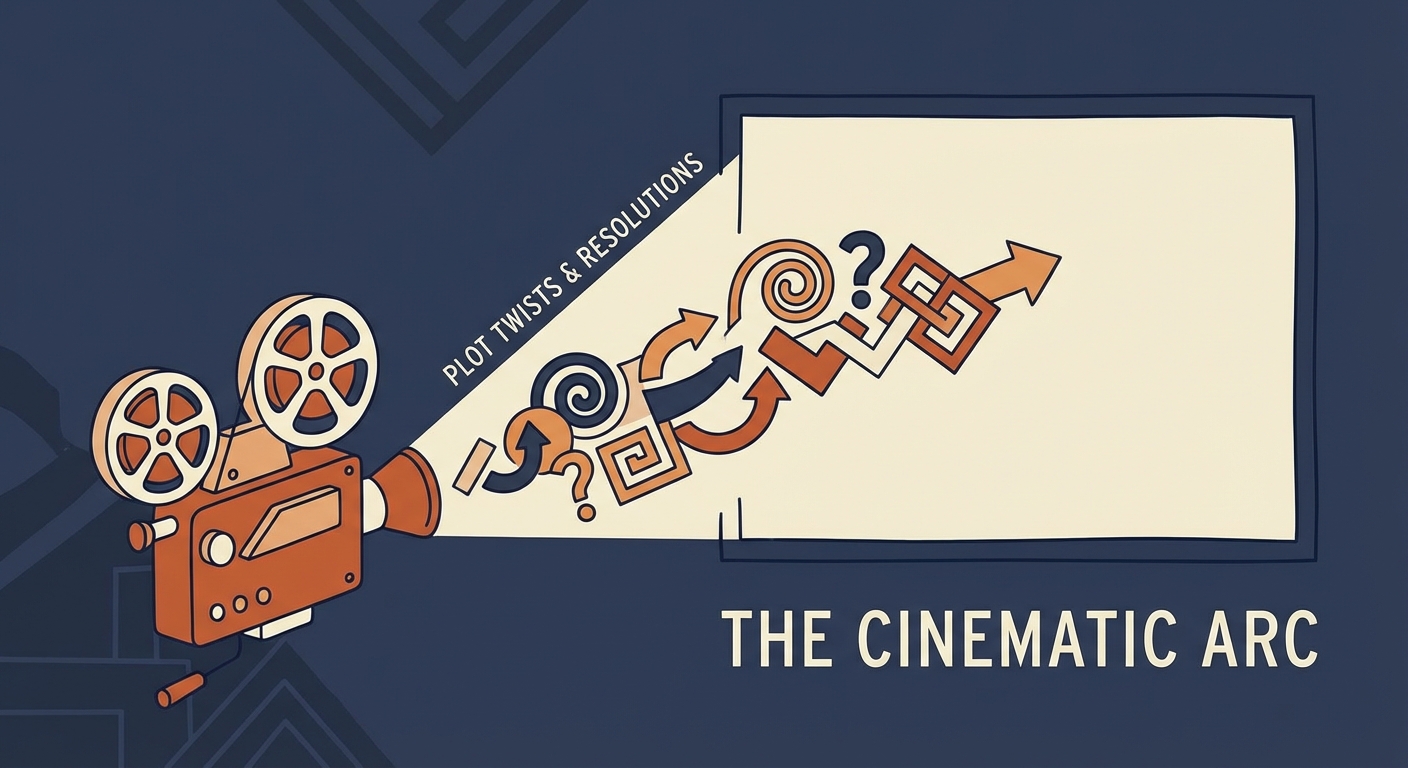
The following diagram illustrates the tension release of a standard narrative structure and how a twist functions as a forced deviation from the expected falling action.
The Toolkit of Modern Closures
Modern cinema leans on specific structural devices to leave a mark. The "Twist Ending" is a high-wire act. When done right—as explored in The Art of Plot Twists—it recontextualizes the entire movie. When done poorly, it’s a transparent cheat.
Then there are circular narratives, where the final scene mirrors the opening to show how much (or how little) a character has evolved. And of course, there’s deliberate ambiguity. Sometimes, "not knowing" is the point. If a film leaves a question hanging, it’s usually because the answer is secondary to the character’s internal change.
Deep Writing vs. Lazy Writing
Use the "Logical Gap" test. If a character acts completely out of character just to make the ending work—without any setup for that change—the writing is lazy. Period. It doesn't matter how "clever" the twist is if it breaks the internal logic of the person on screen.
We often look to Auteur theory to see if an ending feels intentional. Does this conclusion align with the director’s past work? If a director known for bleak, nihilistic stories suddenly forces a saccharine "happy" ending, that’s usually a neon sign pointing to studio interference. When you learn how to craft compelling narrative content, you realize that every choice in the final act must be earned by the previous ninety minutes of setup.
The "Reverse Engineering" Workshop
To master analysis, read films backward. Pick a movie you love and trace the final scene back to the start. Where was the seed of that ending planted?
If you’re stuck, use this checklist:
- Does the ending resolve the internal conflict (character growth) or just the external conflict (the plot)?
- Are the visual cues in the final scene consistent with the film’s color palette?
- If I strip away the final twist, does the movie still hold water? (If the answer is no, the twist is a crutch).
Comparing a "closed" ending—like the meticulous wrap-up of a classic noir—to an "open" ending—like the gut-wrenching, unresolved beats of modern horror—will sharpen your ability to identify the structural intent behind these choices.
Common Pitfalls (Stop Doing These)
The biggest trap? Confusing summary with analysis. A summary tells us what happened. An analysis explains why it matters.
Also, watch the visual language. A character might be saying "I won," but if the color grading is grey and the audio mix feels claustrophobic, the director is telling you that the victory is hollow. Finally: stop obsessing over plot holes. A movie can have a dozen inconsistencies and still be a masterpiece if the character arc rings true.
The Final Frame
Analyzing a film’s conclusion isn't about "solving" it like a math problem. It’s about deepening your engagement with the art. By dissecting the climax, the resolution, and the visual language that binds them, you gain a better understanding of how stories manipulate our emotions and shape our worldview.
Once you learn to look past the credits, you’ll find that the real film begins only after the screen goes black. For those looking to refine their own critical voice or seeking professional film critique services for their own creative projects, remember: the most enduring stories are the ones that leave you with more questions than answers.
Frequently Asked Questions
What is the difference between a climax and a resolution in film?
The climax is the point of no return where the narrative tension hits its peak and the central conflict is forced to a head. The resolution is the "aftermath" phase, where the story settles into its new reality and the thematic implications of the climax are allowed to breathe.
How do I know if an open-ended movie is "good" or just lazy writing?
An open ending is effective if it leaves the plot ambiguous while providing clarity on the character arc. If the ambiguity feels like a genuine thematic choice, it’s likely intentional. If it feels like the writer simply didn't know how to finish the story, it’s lazy.
Should I mention the director's intent when analyzing an ending?
Yes, referencing Auteur theory is valuable, provided it is supported by evidence. A director’s signature style—their recurring themes, visual motifs, and preoccupation with certain human conditions—often provides the "why" behind an ending that might otherwise seem confusing or out of place.
How can I describe a plot twist without just summarizing it?
Focus on the function of the twist. Instead of saying "The character was a ghost all along," describe how the twist reveals the protagonist’s inability to accept their own mortality. Explain what the revelation does to the audience's understanding of the character’s motivations throughout the film.